A Company at a Strategic Crossroads
Tesla in 2026 is no longer just an electric vehicle manufacturer—it is a company attempting to redefine itself across multiple industries simultaneously. From autonomous driving and artificial intelligence to energy storage and semiconductor manufacturing, Tesla’s ambitions have expanded far beyond cars.
Yet, with that ambition comes heightened scrutiny. Investors, analysts, and industry observers are increasingly divided over a central question: is Tesla still a growth powerhouse, or has its valuation outpaced execution?
The answer lies in a complex mix of aggressive spending, delayed timelines, and enormous long-term potential.
The Financial Pivot: Spending Big to Build the Future
Tesla’s latest financial strategy underscores its long-term vision—but also its near-term risks.
The company has raised its projected capital spending for 2026 from over $20 billion to more than $25 billion, signaling a significant escalation in investment intensity.
This spending is not arbitrary. It is directed toward several critical initiatives:
- Expansion of electric vehicle production capacity
- Development of energy storage infrastructure
- Investment in Terafab, a vertically integrated semiconductor facility in partnership with SpaceX and xAI
Despite this surge in spending, Tesla remains financially robust, holding $35.5 billion in net cash.
However, Wall Street expects that after these investments, Tesla’s net cash could decline to around $22.3 billion by the end of 2026, highlighting the scale of its capital commitments.
This shift represents a calculated trade-off: sacrificing short-term financial flexibility to secure long-term dominance.
Robotaxi Delays: A Reality Check for Autonomous Ambitions
Perhaps the most closely watched element of Tesla’s strategy is its push into autonomous mobility—specifically, its Robotaxi platform.
Originally positioned as a near-term growth driver, the rollout timeline has now been pushed back. Elon Musk has tempered expectations, acknowledging that large-scale deployment will take longer than anticipated.
Instead of rapid expansion, Tesla now plans a more gradual rollout, potentially reaching 12 U.S. states by the end of the year, far short of earlier ambitions.
Musk emphasized a safety-first approach, stating:
“It wouldn’t be right for us to go to, like, very large-scale unsupervised FSD when we know that there are software improvements in the pipeline that would improve safety.”
This cautious stance reflects both technical challenges and regulatory realities.
Still, the long-term potential remains enormous. Some projections suggest that robotaxi platforms could scale to $4 trillion in net revenue by 2030, with Tesla positioned as a key player.
Energy Storage: The Quiet Growth Engine
While Robotaxi dominates headlines, Tesla’s energy division is emerging as a powerful and often underestimated revenue driver.
The company’s Megapack and Powerwall systems are seeing increasing demand, particularly from:
- Utility companies
- AI data centers requiring stable energy supply
Energy storage has evolved into a high-margin segment, contributing a growing share of Tesla’s profits.
This business offers a level of stability that contrasts with the volatility of vehicle sales and emerging technologies.
However, competition—especially from Chinese battery manufacturers—poses a potential threat to pricing power and margins.
The AI Vision: From Cars to Computing Infrastructure
Tesla’s long-term strategy increasingly revolves around artificial intelligence.
The company is investing heavily in:
- Full Self-Driving (FSD) systems
- The Dojo supercomputer for AI training
- The Optimus humanoid robot
This positions Tesla as more than an automotive company—it becomes an AI infrastructure provider.
The long-term thesis suggests that Tesla could monetize AI not only through vehicles but also through computing services and robotics.
Yet these initiatives carry significant execution risk. Both Dojo and Optimus are described as high-uncertainty, high-reward projects that could dramatically influence Tesla’s valuation depending on their success.
Core Business Performance: EVs Still Matter
Despite its diversification, Tesla’s core business remains electric vehicles.
Key metrics highlight its scale:
- 1.66 million vehicles produced in 2025
- 1.64 million vehicles delivered
- $94.83 billion in annual revenue
In 2026, Tesla reported 16% year-over-year revenue growth, reaching $22.39 billion in Q1 alone.
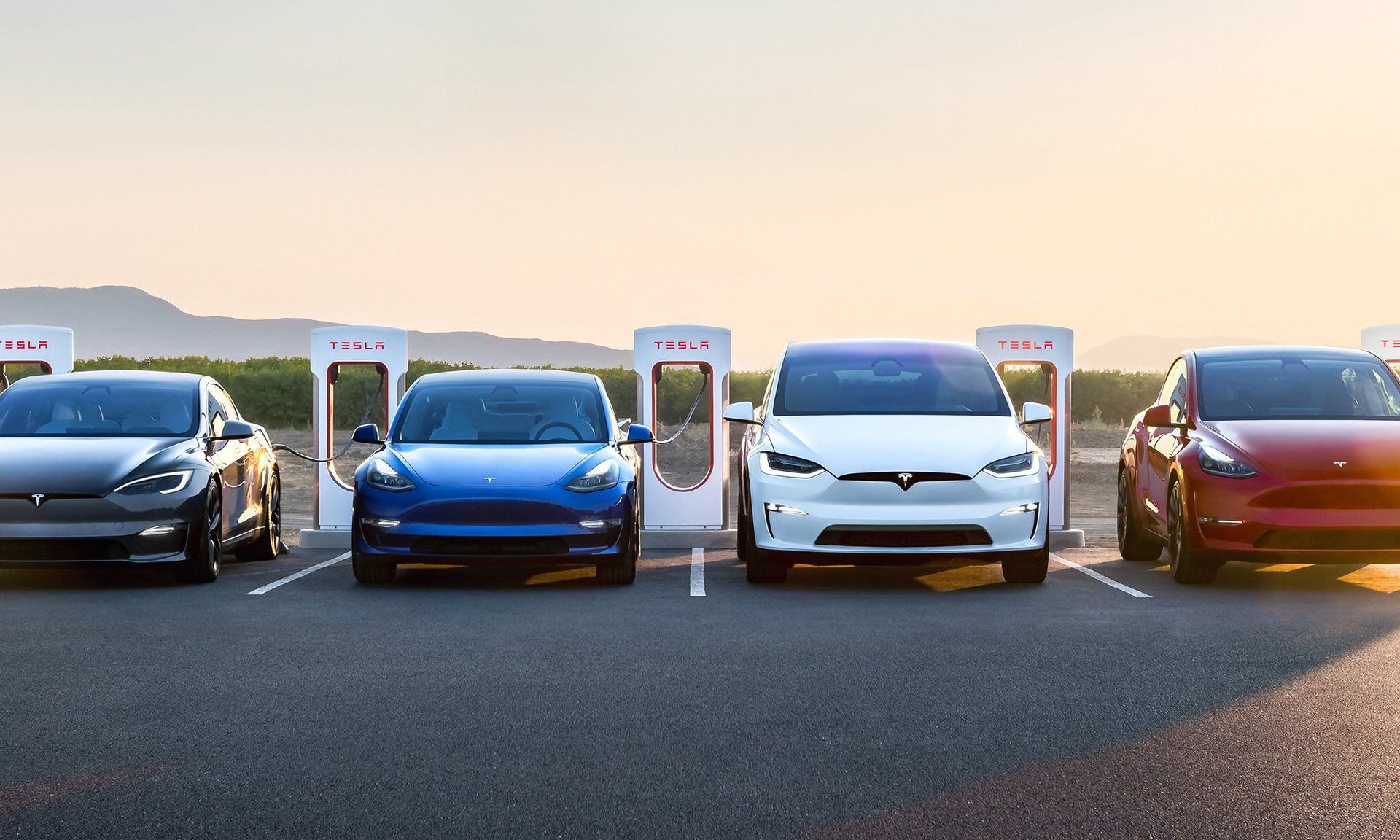
The company continues to manufacture its flagship models:
- Model 3
- Model Y
- Model S
- Model X
- Cybertruck
Additionally, upcoming products like the Cybercab, Tesla Semi, and Megapack 3 are expected to enter volume production in 2026, potentially boosting growth.
Market Sentiment: Bullish Structure, Critical Resistance
From a market perspective, Tesla’s stock reflects both optimism and caution.
Over the past year:
- Shares have risen 31%
- But also corrected nearly 25% from their peak
Technical analysis suggests a bullish structure, with key levels shaping investor sentiment:
- Strong support around 374–376.60
- Breakout potential above 379
- Major resistance between 383–387
Analysts describe the 383–387 range as a “decision zone” that could determine the stock’s next major move.
The Strategic Debate: Buy, Sell, or Hold?
Tesla’s outlook has become increasingly polarized.
The Bull Case
Supporters argue that Tesla is evolving into a multi-vector company, driven by:
- Robotaxi commercialization
- Energy storage scaling
- AI compute monetization
If these pillars succeed simultaneously, Tesla could unlock massive long-term value.
The Bear Case
Skeptics highlight:
- Delays in key projects
- High capital spending
- Execution risks across multiple fronts
They argue that much of Tesla’s future potential may already be priced into its valuation.
The Middle Ground
Many investors now treat Tesla as a high-volatility, long-term bet, rather than a predictable growth stock.
What Comes Next for Tesla?
The next few years will be decisive.
Key milestones to watch include:
- Progress toward unsupervised Full Self-Driving
- Expansion of Robotaxi networks
- Scaling of energy storage deployments
- Commercial viability of Optimus robots
- Execution of Terafab semiconductor strategy
Each of these represents both an opportunity and a risk.
Conclusion: A Defining Moment for Tesla’s Identity
Tesla in 2026 is navigating one of the most pivotal phases in its history.
It is no longer simply competing in the automotive sector—it is attempting to reshape industries spanning energy, AI, robotics, and infrastructure.
The company’s aggressive investment strategy signals confidence in its long-term vision. But delays in execution and rising capital demands introduce real uncertainty.
Ultimately, Tesla’s future hinges on one critical factor: its ability to deliver on multiple transformative technologies at once.
If it succeeds, it could redefine the global technology landscape. If it falls short, the gap between expectation and reality may prove difficult to close.


