



Škoda Peaq: A Flagship Electric SUV Signaling a New Era for Škoda
Introduction: A Strategic Leap into the Electric Future
The upcoming Škoda Peaq represents more than just another addition to the growing electric vehicle lineup—it is a deliberate statement of intent from Škoda Auto. Positioned as the brand’s flagship model, the Peaq embodies a shift toward larger, more premium electric vehicles designed for families, long-distance travel, and evolving consumer expectations.
- Introduction: A Strategic Leap into the Electric Future
- From Concept to Reality: The Evolution of the Peaq
- Segment Positioning: A Large, Family-Oriented Electric SUV
- Design Language: The “Modern Solid” Identity
- Powertrain and Performance: Scalable Electric Capability
- Practicality and Family Utility
- Driving Experience: Comfort Meets Control
- Market Context: Competing in an Emerging Segment
- Strategic Significance: Possibly the End of an Era
- What the Peaq Means for Škoda’s Future
- Conclusion: A Defining Moment for Škoda’s Electric Ambitions
Set to enter production in 2026, the Peaq is the production version of the Škoda Vision 7S concept unveiled in 2022. Its arrival signals a critical moment in Škoda’s electrification strategy—combining practicality, advanced design, and scalable technology within the competitive mid-size SUV segment.
From Concept to Reality: The Evolution of the Peaq
The Peaq’s development is rooted in the Vision 7S concept, which introduced Škoda’s new design philosophy and hinted at a future centered on electric mobility. That concept has now matured into a production-ready vehicle, retaining many of its defining features.


The Peaq name itself—revealed on January 13, 2026—carries symbolic weight. It reflects the model’s status as the pinnacle of Škoda’s lineup, aligning with its positioning as the brand’s largest, most expensive, and most technologically advanced offering to date.
According to early previews, the Peaq is expected to be unveiled officially in the summer of 2026, with sales following shortly after.
Segment Positioning: A Large, Family-Oriented Electric SUV
Designed for Scale and Practicality
The Peaq enters the market as a mid-size (D-segment) crossover SUV, offering a five-door configuration and seating for up to seven passengers. Its size alone distinguishes it within the brand’s portfolio:
- Approximately 4.9 meters in length, making it significantly larger than the Škoda Enyaq
- Longer than the combustion-powered Škoda Kodiaq, positioning it as a direct electric alternative
- Built on the widely used Volkswagen Group MEB platform
This architecture places the Peaq alongside other major electric vehicles such as the Volkswagen ID.4, Audi Q4 e-tron, and Ford Explorer EV.
However, Škoda’s approach emphasizes value and practicality. Early indications suggest pricing in the range of £50,000 to £60,000, positioning it competitively against premium rivals while offering comparable space and features.
Design Language: The “Modern Solid” Identity
Exterior Innovation Meets Functional Aesthetics
The Peaq introduces Škoda’s Modern Solid design language to production models. This approach focuses on durability, clarity, and a clean visual identity.
Key design elements include:
- Tech Deck front fascia, replacing the traditional grille
- T-shaped LED headlights and taillights
- Flush, electrically retractable door handles
- Strong geometric lines that emphasize robustness
These features align closely with the Vision 7S concept while adapting to production constraints.
Interior: Technology and Comfort at Scale
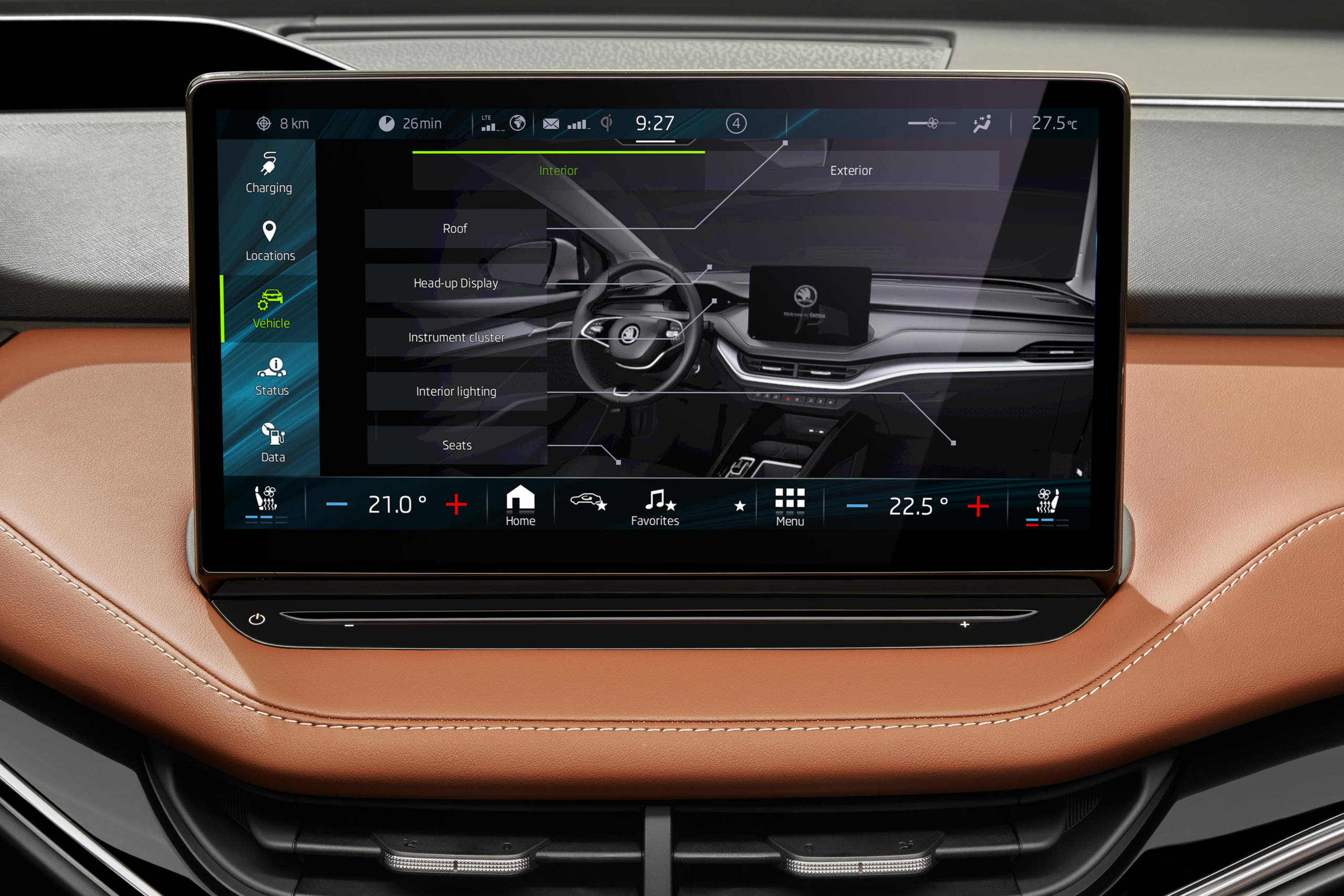
Inside, the Peaq is designed to maximize usability and comfort:
- A 13.6-inch vertically oriented touchscreen
- A 10-inch digital driver display
- Optional head-up display (HUD)
- Wireless charging and smartphone digital key functionality
- Panoramic roof and ambient lighting
The interior also introduces practical innovations such as a sliding center armrest and improved cabin ergonomics, reflecting Škoda’s “Simply Clever” philosophy.
Powertrain and Performance: Scalable Electric Capability
Battery and Motor Configurations
Škoda has outlined three primary variants for the Peaq:
| Variant | Battery Capacity | Drivetrain | Power Output |
|---|---|---|---|
| 60 | 63 kWh | RWD | ~201 hp |
| 90 | 91 kWh | RWD | Higher output |
| 90X | 91 kWh | AWD | ~295 hp |
These configurations provide flexibility for different driving needs, from efficiency-focused urban use to performance-oriented all-wheel-drive capability.
Range and Charging
- Up to 370–380 miles (approx. 595–610 km) of range for higher-capacity variants
- Fast charging capability of up to 195 kW
- One-pedal driving mode and vehicle-to-load functionality
This positions the Peaq competitively within the long-range electric SUV segment.
Practicality and Family Utility
The Peaq’s design prioritizes real-world usability:
- Seating for seven passengers
- Around 300 liters of boot space even with all seats in place
- Expanded cargo capacity up to 935 liters with rear seats folded
- Additional front trunk (frunk) for storage
Interior configurations include multiple trims such as Sportline, Lounge, Loft, and Suite, each tailored to different comfort and aesthetic preferences.
Driving Experience: Comfort Meets Control
Early driving impressions suggest that the Peaq maintains the balanced dynamics associated with Škoda’s EV lineup:
- Smooth ride quality, even without air suspension
- Adaptive dampers with multiple driving modes
- Responsive steering and maneuverability despite its size
- A turning circle comparable to smaller vehicles
Acceleration is described as linear and controlled, avoiding the abrupt torque delivery typical of some electric vehicles.
Market Context: Competing in an Emerging Segment
The Peaq enters a relatively underdeveloped but rapidly growing market: electric seven-seat SUVs.
Key competitors include:
- Peugeot E-5008 (direct rival)
- Premium models like Volvo EX90 and Kia EV9
- Emerging Chinese electric SUVs
Škoda’s strategy is to undercut premium pricing while offering comparable space and functionality—a move that could make the Peaq a strong contender in this segment.
Strategic Significance: Possibly the End of an Era
One notable aspect of the Peaq is its platform. It is built on the MEB architecture, which has underpinned many Volkswagen Group EVs. However, industry signals suggest it may be among the last models to use this platform before transitioning to next-generation architectures.
This positions the Peaq as both:
- A culmination of MEB-based development
- A bridge to future electric platforms
What the Peaq Means for Škoda’s Future
The Peaq is not merely a new model—it is a strategic pivot. As CEO Klaus Zellmer noted:
“The Škoda Peaq is designed for real life… it raises the Škoda brand to a new level: more spacious, more practical, and more attractive for everyday explorers.”
This reflects a broader ambition:
- To compete in higher-value segments
- To expand electric offerings globally
- To redefine the brand’s identity beyond affordability
Conclusion: A Defining Moment for Škoda’s Electric Ambitions
The Škoda Peaq stands at the intersection of innovation, practicality, and strategic repositioning. As a flagship electric SUV, it combines:
- Advanced design and technology
- Competitive performance and range
- Strong family-oriented practicality
If execution matches early expectations, the Peaq could set a new benchmark for value-driven electric SUVs and establish Škoda as a serious contender in the global EV market.