





Sha’Carri Richardson: The Sprint Star Who Conquered the Impossible
In modern athletics, dominance is often measured in fractions of a second. Yet occasionally, an athlete delivers a performance that transcends timing altogether—one defined by strategy, resilience, and spectacle. That is precisely what Sha’Carri Richardson achieved at the 2026 Stawell Gift in Australia, where she produced one of the most remarkable victories of her career.
- A Historic Sprint from “Scratch”
- Why the Stawell Gift Matters
- From Olympic Podium to Grass Track Mastery
- A Race Built on Precision and Recovery
- Mixed Fortunes: Christian Coleman’s Exit
- The Technical Challenge: Grass, Incline, and Strategy
- Cultural and Sporting Impact
- Financial and Competitive Context
- What This Means for the 2026 Season
- A Defining Chapter in a Growing Legacy
This is not merely a race result. It is a case study in elite sprinting adaptability, competitive psychology, and the evolution of a global track star operating beyond traditional Olympic settings.
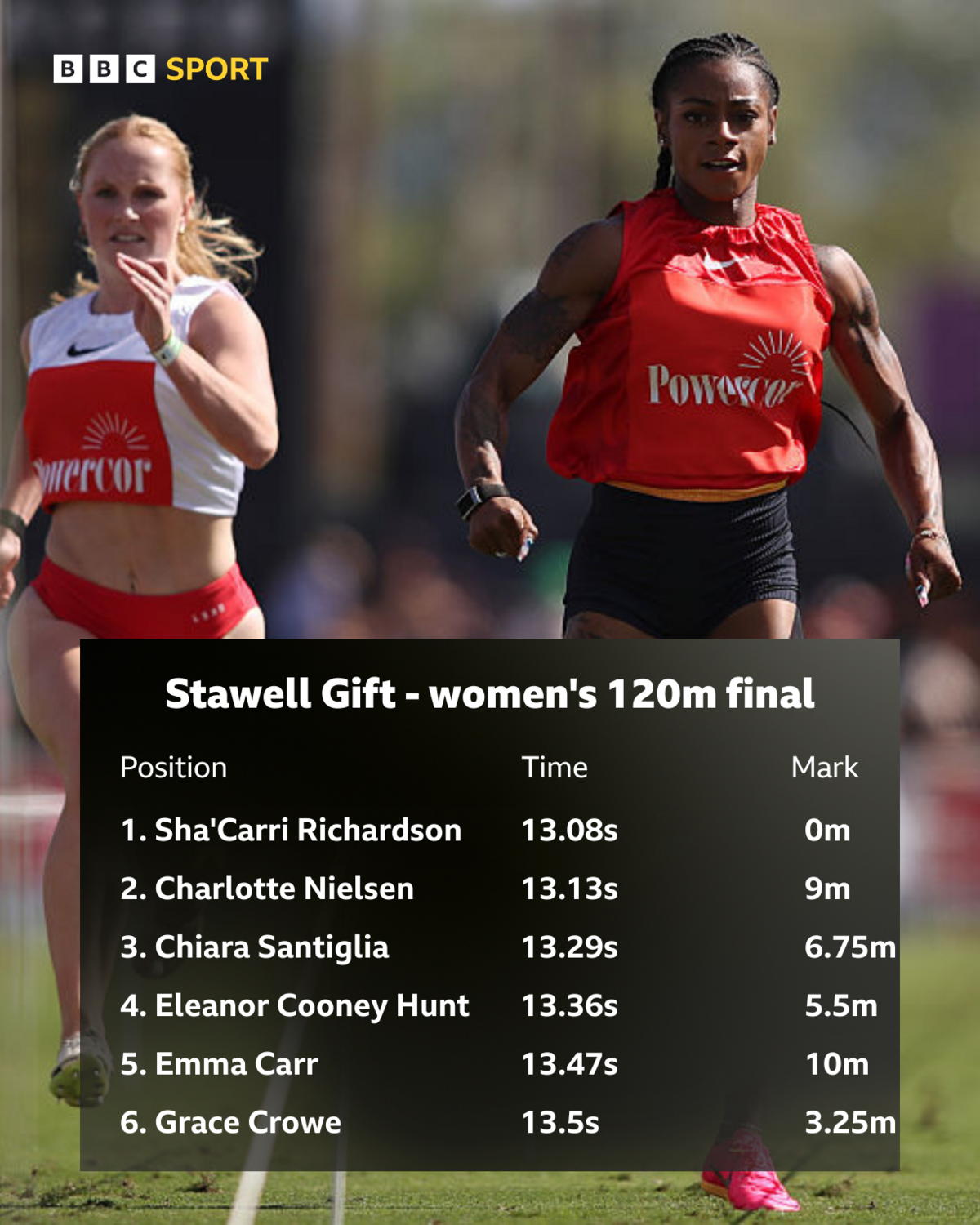
A Historic Sprint from “Scratch”
At the center of the story is the Stawell Gift, a unique 120-meter handicap race run on grass—far removed from the synthetic tracks used in global championships. The handicap system gives slower runners a head start, while elite athletes like Richardson must begin from “scratch,” effectively chasing the entire field.



In the 144th edition of the event, Richardson started from the very back, conceding up to nine meters to her competitors. What followed was a controlled, technically disciplined pursuit.
She closed the gap by the 90-meter mark and surged past the field to win in 13.15 seconds, becoming only the third woman in history to win the race from scratch.



Her own words captured the execution:
“Just make sure I’m patient that first 10-meters like my coach today told me, and just executing the rest. I think I realized I was gonna win right past 90.”
This performance is significant not just because of the victory, but because of the tactical precision required to achieve it under such constraints.
Why the Stawell Gift Matters
The Stawell Gift is not a conventional sprint event. It operates under a handicap format that fundamentally alters race dynamics.
What the format achieves:
- Levels the field between elite and emerging athletes
- Forces top sprinters to rely on pacing and timing, not just raw speed
- Introduces unpredictability rarely seen in standard track competitions
Winning from scratch is therefore considered one of the most difficult feats in professional sprinting. Richardson’s victory places her in a very small historical category, reinforcing her status as one of the most versatile sprinters in the sport.



From Olympic Podium to Grass Track Mastery
Richardson entered the race as a globally recognized name:
- 2024 Paris Olympics: Silver medal in the 100 meters
- 2024 Paris Olympics: Gold medal in the 4×100 relay
- 2023 World Championships: 100-meter champion
At 26, she is already among the fastest women in history. However, the Stawell Gift required a different skill set—adjusting to grass, managing an uphill incline, and pacing a longer sprint under pressure.
Her ability to adapt highlights a broader evolution in her career: from pure speed specialist to tactically complete sprinter.
A Race Built on Precision and Recovery
Richardson’s path to the final was not without risk. Earlier in the semifinals, she nearly lost her place after easing up too early, winning by just 0.007 seconds in a photo finish.
She acknowledged the need for discipline:
“I feel like I am having a great time, but also working on race pattern, me and my coach Dennis Mitchell staying calm, executing, and running through the line.”
That near-miss appeared to sharpen her focus. In the final, there were no errors—only controlled acceleration and decisive execution.
Mixed Fortunes: Christian Coleman’s Exit
Richardson was not the only headline name at the event. Her boyfriend, Christian Coleman—a former world champion—also competed.
Like Richardson, Coleman started from scratch. However, he failed to qualify for the final after finishing sixth in his semifinal.
He explained the challenge succinctly:
“Yeah, it is what it is… when you’re giving up that much of a margin, I mean, it’s pretty tough.”
The contrast between their outcomes underscores how demanding the handicap format is—even for world-class sprinters.
The Technical Challenge: Grass, Incline, and Strategy
Unlike standard track events, the Stawell Gift introduces multiple variables:
- Surface: Grass reduces traction and rebound compared to synthetic tracks
- Incline: A slight uphill gradient alters stride mechanics
- Distance: 120 meters extends beyond the traditional 100m sprint
- Handicap gaps: Require calculated pacing rather than explosive starts
Richardson’s victory demonstrated advanced biomechanical control. Her ability to maintain her drive phase longer and transition smoothly into top speed allowed her to close a significant gap efficiently.
This is a different kind of sprinting—one that rewards intelligence as much as speed.
Cultural and Sporting Impact
The Stawell Gift has been held since 1878 and remains one of Australia’s most iconic athletics events. Richardson’s participation—and subsequent victory—brought renewed global attention to the race.
Her reaction reflected the atmosphere:
“This is one of the most exciting, fun, and entertaining track meets I’ve ever ran in… the true love and support for track and field is unbeatable.”
For organizers, her success represents a bridge between traditional grass-track racing and modern international athletics. For fans, it reinforces the appeal of alternative race formats that challenge even the sport’s elite.
Financial and Competitive Context
Richardson earned A$40,000 (approximately $27,500) for the win. While modest compared to major international meets, the symbolic value of the victory is considerably higher.
The event featured more than 700 competitors, including many of Australia’s top runners, making it both a mass-participation spectacle and an elite competition.
There is no confirmed disclosure on whether Richardson or Coleman received appearance fees, though such arrangements are common at high-profile events.
What This Means for the 2026 Season
Richardson’s Stawell Gift victory is more than an isolated success—it provides insight into her current form and trajectory.
Key implications:
- Early-season momentum ahead of the Diamond League circuit
- Evidence of improved race discipline and tactical awareness
- Increased confidence against global rivals in upcoming championships
She is also expected to compete in major international events, including the World Athletics Relays in Gaborone, where top sprinters will converge later in 2026.
A Defining Chapter in a Growing Legacy
Sha’Carri Richardson’s career has already included Olympic medals, world titles, and moments of intense public scrutiny. The Stawell Gift adds a different dimension to her legacy.
It is not her fastest race. It is not her biggest prize.
But it may be one of her most technically impressive victories—one that required patience, adaptability, and precision under unusual conditions.
In a sport often defined by linear speed, Richardson proved that greatness can also come from chasing the field—and catching it.