




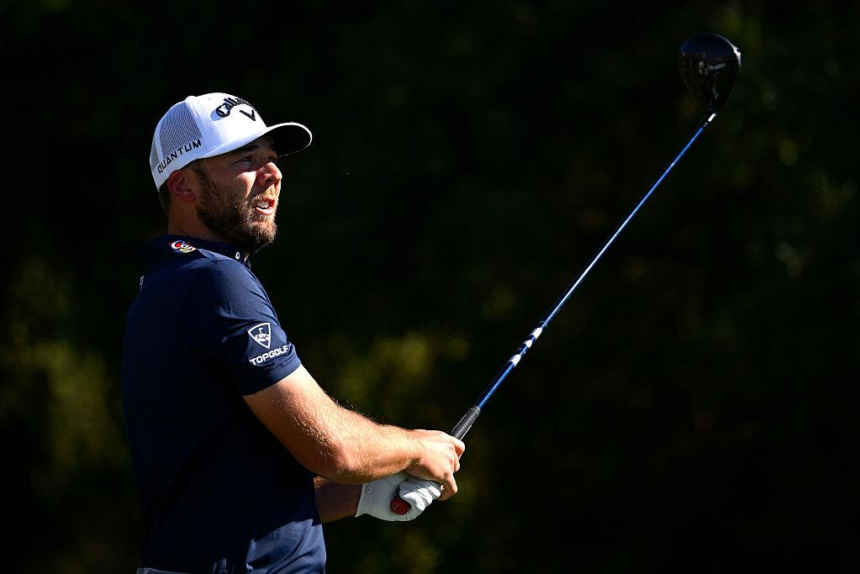
Sam Burns at a Turning Point: Inside His 2026 Masters Surge and Major Ambitions
A Breakthrough Moment at Augusta
As the 2026 Masters Tournament unfolds at Augusta National, few storylines have captured attention quite like the emergence of Sam Burns at the top of the leaderboard. After years of steady progress on the PGA Tour, Burns has positioned himself in contention at one of golf’s most prestigious stages—an environment that has historically challenged him.
- A Breakthrough Moment at Augusta
- Round One Analysis: Precision, Momentum, and Course Management
- Career Context: A Talented Golfer Still Chasing a Major
- Masters History: A Learning Curve at Augusta National
- Equipment Evolution and Technical Refinement
- Competitive Landscape: A Crowded Leaderboard
- Psychological Factor: Confidence vs. Expectation
- What a Victory Would Mean
- Outlook: Can Burns Sustain the Momentum?
- Conclusion: A Defining Week in Progress
Burns opened the tournament with a composed and technically sharp 5-under-par 67, matching the score of Rory McIlroy to share the first-round lead. This performance represents not only his best-ever round at Augusta National but also a potential inflection point in his career trajectory.

Round One Analysis: Precision, Momentum, and Course Management
Burns’ opening round was defined by efficiency and strategic execution. His scorecard included:

- One eagle
- Four birdies
- One bogey
A standout moment came early, when Burns capitalized on a par-5 opportunity, converting an eagle that set the tone for his round. His ability to maximize scoring opportunities on longer holes—particularly the par-5s—proved decisive.
Burns himself acknowledged the importance of this approach, noting:


“I think historically people who have success here play the par-5s really well, and we were able to do that today. So it’s a good recipe around this golf course.”
This insight reflects a broader understanding of Augusta National’s strategic demands, where scoring on par-5 holes often separates contenders from the field.
Career Context: A Talented Golfer Still Chasing a Major
At 29 years old, Burns is no stranger to success on the PGA Tour. Since turning professional in 2017, he has accumulated:
- Five PGA Tour victories
- Multiple Ryder Cup appearances with Team USA
- Consistent ranking within the world’s top 50
However, his record in major championships has been less definitive. Despite flashes of promise, Burns has yet to secure:



- A major title
- A top-five finish in a major
His best performances include:
- T-7 at the 2025 U.S. Open
- Top-10 finishes at the U.S. Open in 2024 and 2025
This contrast—strong regular tour success versus inconsistent major results—has shaped perceptions of Burns as a talented player still seeking validation on golf’s biggest stages.
Masters History: A Learning Curve at Augusta National
Burns’ journey at the Masters has been gradual rather than immediate. Prior to 2026, his results included:
- 2022: Missed cut
- 2023: T-29
- 2024: Missed cut
- 2025: T-46
These results illustrate the complexity of Augusta National, a course known for its demanding greens, elevation changes, and strategic nuances.
Yet, his 2026 opening round suggests a player beginning to decode those challenges. His performance through Amen Corner—one of the most iconic stretches in golf—was particularly telling, as he executed key shots under pressure to build momentum.
Equipment Evolution and Technical Refinement
Burns’ improved performance also coincides with notable adjustments in his equipment setup for the 2026 season. His current configuration includes:
- Callaway Quantum Triple Diamond driver
- Callaway Apex MB prototype irons
- Titleist Vokey SM11 wedges
- Odyssey Ai-One #7 SB putter
These changes indicate a deliberate effort to optimize ball striking precision and short-game control—two critical factors at Augusta. His reputation as one of the PGA Tour’s more reliable putters further strengthens his competitive profile.
Competitive Landscape: A Crowded Leaderboard
Burns’ co-leader, McIlroy, remains a formidable presence. A five-time major champion and defending Masters winner, McIlroy’s consistency ensures that the pressure on Burns will intensify as the tournament progresses.
Close behind are established contenders such as:
- Patrick Reed
- Jason Day
- Scottie Scheffler
- Xander Schauffele
This depth underscores the challenge ahead. Maintaining a lead at Augusta requires sustained precision across all four rounds—something Burns has yet to demonstrate in a major championship setting.
Psychological Factor: Confidence vs. Expectation
One of the more nuanced aspects of Burns’ current position is the psychological shift that accompanies early success in a major.
Historically, players who contend early at Augusta often face increasing scrutiny and pressure. For Burns, the key variables will include:
- Maintaining composure under leaderboard pressure
- Managing expectations as a first-time major contender
- Executing consistently across varied course conditions
Encouragingly, his recent major performances suggest a player gaining confidence. Making the cut in all four majors in 2025 marked a significant step forward in consistency.
What a Victory Would Mean
A Masters win for Burns would represent a transformative milestone:
- His first major championship
- Entry into golf’s elite tier of major winners
- Validation of his progression from promising talent to established contender
It would also place him among a new generation of American golfers reshaping the competitive landscape, alongside players like Scheffler and Schauffele.
Outlook: Can Burns Sustain the Momentum?
The central question remains whether Burns can convert a strong opening round into a sustained challenge for the green jacket.
Key determinants will include:
- Performance on Augusta’s par-5 holes
- Putting consistency on fast greens
- Ability to limit mistakes on high-risk holes like the 15th
While uncertainty remains, his opening round offers clear evidence of readiness. As one of the few players to match McIlroy shot-for-shot, Burns has already demonstrated the technical and mental capacity required to contend.
Conclusion: A Defining Week in Progress
Sam Burns’ performance at the 2026 Masters is more than a strong start—it is a statement of intent. After years of incremental growth, he now finds himself in a position to redefine his career narrative.
Whether he ultimately secures victory or not, this tournament marks a critical juncture. For a player long viewed as a potential major champion, Augusta National may finally be the stage where that potential is realized.