




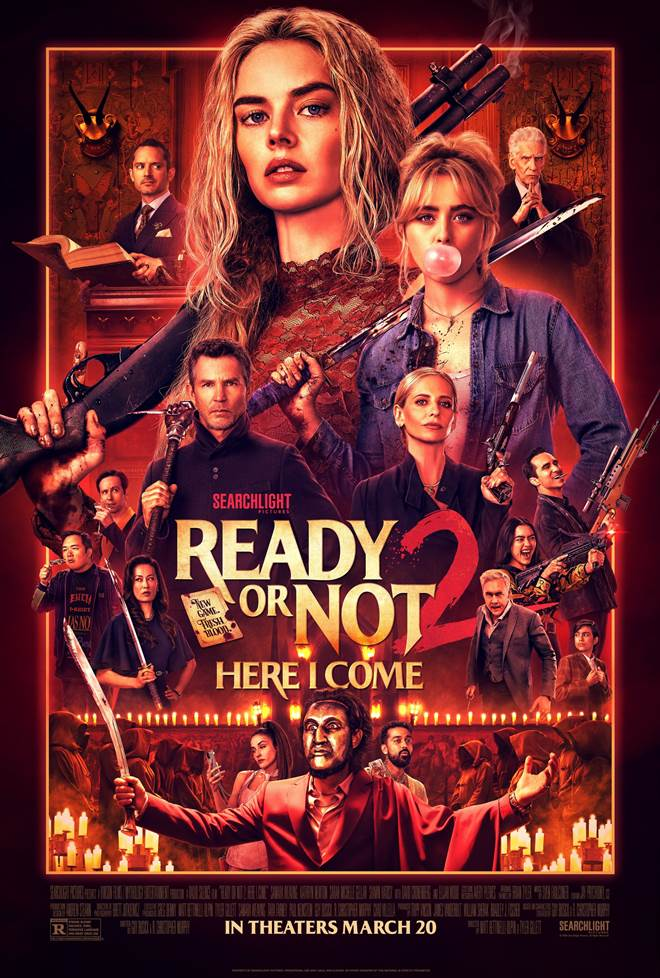
“Ready or Not 2: Here I Come”: When the Quietest Scene Becomes the Loudest Challenge
A Sequel That Expands the Game — and the Stakes
Seven years after the original Ready or Not carved out a space in modern horror-comedy, “Ready or Not 2: Here I Come” arrives with a familiar premise but a significantly expanded scope. What began as a contained survival story rooted in a single wealthy family’s deadly ritual has now evolved into a broader mythology—one that stretches across multiple powerful bloodlines competing for control.
- A Sequel That Expands the Game — and the Stakes
- The Scene That Tested the Filmmakers Most
- Breaking Down Complexity: The “Mini-Acts” Approach
- Managing Performance in a 14-Character Ensemble
- Coverage as a Narrative Tool
- The Editing Puzzle: Restructuring Information
- Expanding the Franchise: Bigger, Louder, and More Divisive
- A Shift in Tone: From Horror to Action Comedy
- Conclusion: Craft Behind the Chaos
The sequel picks up immediately after the events of the first film. Grace, once a bride fighting for survival, now finds herself at the center of something far larger. According to the film’s internal logic, her survival and destruction of a bloodline have triggered a new conflict: a global contest among elite satanic families, each vying to eliminate her before dawn and claim dominance.
On the surface, this escalation suggests a bigger, louder sequel—more action, more spectacle, and more elaborate set pieces. And in many ways, that is exactly what the film delivers. Yet, behind the explosive violence and dark humor lies a more technical, less visible challenge that defined the filmmaking process.
The Scene That Tested the Filmmakers Most
Directors Matt Bettinelli-Olpin and Tyler Gillett—collectively known as Radio Silence—are no strangers to orchestrating chaos. Their films are known for kinetic action, stylized violence, and tightly choreographed ensemble moments. However, in this sequel, the most difficult scene was not one involving gore or physical stunts.


Instead, it was a dialogue-heavy sequence involving 14 characters in a single room.
At the center of this moment is Elijah Wood’s attorney character, who delivers a detailed explanation of the rules governing the new deadly game. Structurally, it is an exposition scene—one that could easily stall momentum if mishandled.



“We joke that we have that scene in all of our movies,” Bettinelli-Olpin explained. “There’s always a scene where the entire ensemble is in a room having some big conversation. We try to have a different approach every time so it doesn’t get stale.”
What made this instance particularly demanding was its scale. Compared to a similar sequence in their earlier film Abigail, this scene required managing more characters, more narrative information, and more tonal balancing—all within a confined space.
Breaking Down Complexity: The “Mini-Acts” Approach
To manage the density of the scene, the directors divided it into smaller narrative segments.
Rather than treating the sequence as one continuous block, they structured it into what Bettinelli-Olpin described as “mini-acts,” each with its own internal rhythm and purpose. This approach allowed the scene to maintain momentum, even as it delivered large amounts of information.



However, the technical challenge extended beyond structure. The filmmakers also had to maintain continuity of energy across multiple shooting days.
“We’re shooting that scene over two or three days, but you have to maintain the sense that it’s happening in 15 minutes,” Bettinelli-Olpin said.
This constraint required careful coordination—not just in performance, but in tone. The scene had to feel immediate and cohesive, despite being assembled from fragmented production schedules.
Managing Performance in a 14-Character Ensemble
Large ensemble scenes introduce a unique set of logistical and creative pressures. In this case, some actors were delivering physically demanding performances, while others were primarily reacting or listening.
Balancing those dynamics required a flexible production strategy.
“We want to make sure that everybody has the time to give their best in what little moment they may have,” Gillett noted, emphasizing the importance of even the smallest gestures or reactions.
The directors also tailored the shooting schedule around individual actors’ needs. For emotionally or physically taxing scenes, they consulted performers directly.
“When someone has a trying scene, an exhausting scene, we usually ask, ‘Do you want us to start with you or end with you?’” Bettinelli-Olpin explained.
This collaborative approach ensured that performances remained consistent, even under demanding conditions.
Coverage as a Narrative Tool
One of the defining features of Radio Silence’s filmmaking style is extensive coverage. In practical terms, this means capturing a scene from multiple angles, perspectives, and performance variations.
“Our producer jokes that the way we shoot, you could tell the story from any character’s point of view at any moment,” Gillett said.
This philosophy is particularly relevant in ensemble scenes, where narrative meaning often emerges through reactions rather than dialogue alone.
“It’s not just what’s said,” Gillett added. “It’s how people respond and react to what’s said.”
The result is a dense visual dataset that allows for flexibility in post-production—but also introduces new challenges during editing.
The Editing Puzzle: Restructuring Information
Once filming wrapped, the complexity of the scene shifted into the editing room.
The directors discovered that, while the script’s structure was clear on paper, it did not translate seamlessly to the screen. Information felt repetitive, and certain narrative beats overlapped in ways that disrupted flow.
To address this, they undertook a significant restructuring process.
“We did a kind of mix-and-match puzzle game where we had to move the rules around,” Bettinelli-Olpin said.
The goal was to group related information together, ensuring clarity for the audience while preserving pacing. This iterative process required patience and precision—qualities that Gillett identifies as central to filmmaking itself.
“Any movie is just a series of choices with pressure over time,” he said. “You have to be patient because it’s in the doing of it that you experience all the wonderful discovery.”
Expanding the Franchise: Bigger, Louder, and More Divisive
While the technical craftsmanship behind the film is evident, the sequel’s broader creative direction has sparked debate.
By expanding its mythology to include multiple families and global stakes, the film shifts away from the contained tension of the original. The narrative now operates on a scale closer to franchise-driven action cinema, with comparisons drawn to properties like John Wick or even YA fantasy adaptations.
This expansion brings both advantages and drawbacks. On one hand, it allows for more elaborate set pieces, inventive deaths, and a wider range of characters. On the other, it introduces heavier exposition and a more complex narrative framework.
Critically, some observers have noted that the film’s emphasis on scale and mythology may come at the expense of emotional depth. Dialogue-heavy scenes, particularly those explaining the rules of the game, risk overwhelming the audience with information.
A Shift in Tone: From Horror to Action Comedy
Another notable evolution is tonal. While the original film blended horror with dark satire, the sequel leans more heavily into action-comedy territory.
The stakes are higher, the pacing is faster, and the humor is broader. The result is a film that prioritizes spectacle over subtlety, aligning itself more closely with contemporary blockbuster trends.
At the same time, the core thematic element—critique of wealth and power—remains present, though it now operates within a more crowded genre landscape.
Conclusion: Craft Behind the Chaos
“Ready or Not 2: Here I Come” may present itself as a loud, chaotic sequel filled with violence and dark humor, but its most revealing moment is also its quietest.
The 14-character exposition scene underscores the precision required to balance narrative clarity, performance, and pacing in a complex ensemble environment. It demonstrates that, even in a film defined by spectacle, the most difficult work often happens in stillness—in dialogue, structure, and editing.
Ultimately, the sequel reflects a broader trend in modern filmmaking: the tension between expansion and coherence. As franchises grow larger, the challenge is no longer just about doing more—but about making that “more” meaningful.