




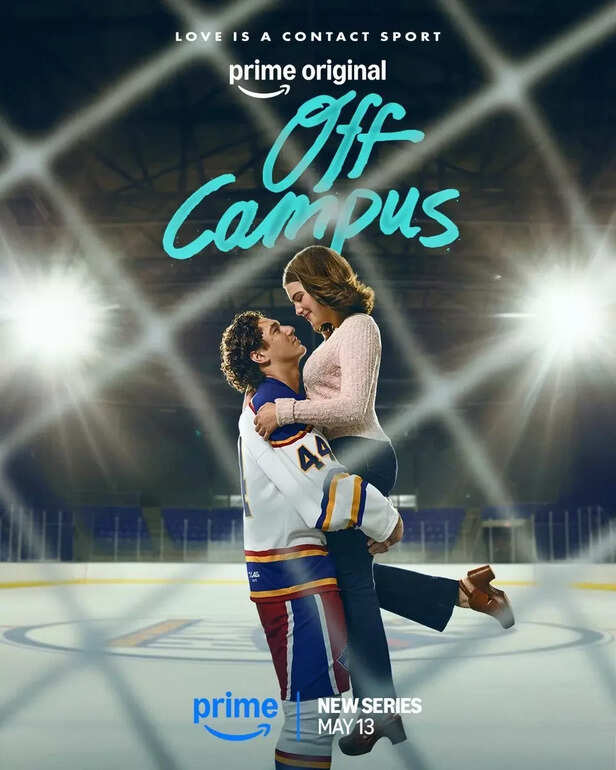
“Off Campus”: Why a Hockey Romance Drama Is Becoming Streaming’s Next Big Bet
The streaming landscape has developed a clear appetite for emotionally driven, youth-focused dramas—and Off Campus appears positioned to capitalize on that demand. With a confirmed release date, early renewal, and a growing subgenre behind it, the Amazon Prime Video adaptation of Elle Kennedy’s bestselling novels is entering the market with notable momentum.
- “Off Campus”: Why a Hockey Romance Drama Is Becoming Streaming’s Next Big Bet
- Release Strategy Signals Confidence
- A Story Built on Emotional Contrasts
- Cast and Creative Architecture
- The Rise of Hockey-Based Romance on Screen
- College Drama Reimagined for a Streaming Audience
- What the Early Renewal Suggests
- The Broader Cultural Context
- Outlook: A Defining Entry in a Growing Genre
Rather than functioning as a conventional sports drama, Off Campus operates at the intersection of romance, collegiate life, and identity formation. It is less concerned with the mechanics of hockey and more invested in the emotional ecosystems surrounding it—relationships, personal growth, and the turbulence of early adulthood.
Release Strategy Signals Confidence
Amazon has confirmed that Off Campus will premiere its full first season on May 13, releasing all episodes simultaneously in over 240 countries and territories. This global, binge-ready rollout reflects a distribution strategy typically reserved for high-confidence projects.
The decision is further reinforced by an early Season 2 renewal, announced even before the first season’s debut. In industry terms, such pre-release renewals indicate strong internal metrics—whether from test screenings, audience modeling, or confidence in the underlying intellectual property.



A Story Built on Emotional Contrasts
At its core, Off Campus follows what the official logline describes as:
“an elite ice hockey team, and the women in their lives, as they grapple with love, heartbreak, and self-discovery— forging deep friendships and enduring bonds while navigating the complexities that come with transitioning into adulthood.”
Season One centers on a familiar but effective narrative device: the “opposites attract” dynamic. The relationship between Hannah, a quiet songwriter, and Garrett, Briar University’s star hockey player, anchors the story.



This pairing is structurally significant. It allows the series to explore:
-
The tension between introversion and public identity
-
The cultural divide between creative and athletic spaces
-
The negotiation of power, vulnerability, and emotional exposure in young relationships
These thematic layers elevate the show beyond a standard campus romance.
Cast and Creative Architecture
The series brings together a cast that blends emerging talent with recognizable faces:
-
Ella Bright as Hannah
-
Belmont Cameli as Garrett
-
Mika Abdalla
-
Antonio Cipriano
-
Josh Heuston
-
Stephen Kalyn
-
Jalen Thomas Brooks
Behind the camera, Louisa Levy leads the adaptation and serves as co-showrunner alongside Gina Fattore. The production is backed by Temple Hill, with executive producers Wyck Godfrey, Marty Bowen, and James Seidman, alongside Leanna Billings and Neal Flaherty.



This combination of experienced producers and a strong source material base aligns with Amazon’s broader strategy of adapting proven literary properties into serialized content.
The Rise of Hockey-Based Romance on Screen
Off Campus is not emerging in isolation. It is part of a broader surge in hockey-centered storytelling, particularly within the romance genre.
Recent success stories include:
-
“Heated Rivalry”, a Canadian series that became a top-performing acquired scripted title on streaming platforms following its November 2025 debut
-
The ongoing popularity of hockey-adjacent series such as Shoresy, which further normalized sports-driven narrative universes
This trend reflects a shift in audience preferences. Hockey, traditionally underrepresented compared to football or basketball in mainstream scripted television, offers a fresh aesthetic—combining physical intensity with tight-knit team dynamics that naturally lend themselves to interpersonal drama.
College Drama Reimagined for a Streaming Audience
While Off Campus borrows elements from traditional “college soap” formats, its streaming context allows for more nuanced storytelling. Without the constraints of network television, the series can explore:
-
Complex romantic arcs without episodic reset
-
Character-driven pacing rather than plot-heavy structuring
-
Mature themes tied to identity, relationships, and personal agency
The result is a format that aligns closely with contemporary viewer expectations—particularly among younger demographics accustomed to binge consumption and serialized emotional continuity.
What the Early Renewal Suggests
The pre-launch Season 2 renewal carries strategic implications:
-
Franchise Potential
The underlying book series provides a roadmap for multi-season storytelling, reducing development risk. -
Audience Retention Strategy
Early renewal signals to viewers that investing in the series will yield long-term narrative payoff. -
Competitive Positioning
With platforms competing aggressively for YA and romance-driven audiences, securing continuity is a tactical move.
The Broader Cultural Context
The appeal of Off Campus also ties into a wider cultural moment. Contemporary audiences are increasingly drawn to stories that blend escapism with relatability—romance narratives grounded in recognizable life transitions.
College settings, in particular, remain a powerful narrative device. They represent:
-
A transitional life phase
-
A controlled environment for social experimentation
-
A space where identity, ambition, and relationships intersect
By embedding its story within this framework, Off Campus taps into a consistent and scalable storytelling model.
Outlook: A Defining Entry in a Growing Genre
The success of Off Campus will likely depend on execution rather than concept. The ingredients—popular source material, proven genre demand, and strong production backing—are already in place.
If the series can balance its romantic core with credible character development and sustained narrative tension, it has the potential to extend beyond a single-season success and establish itself as a defining entry in the evolving “sports romance” category.
At minimum, it represents a calculated expansion of streaming platforms into hybrid genres that merge emotional storytelling with niche sporting backdrops.