



Lewis Hamilton in 2026: Control, Competition, and a Career Reignited
A Season Defined by Freedom and Friction
At 41, Lewis Hamilton finds himself at the center of one of Formula 1’s most compelling narratives—not simply as a competitor, but as a figure reshaping team dynamics at Ferrari.
- A Season Defined by Freedom and Friction
- Wheel-to-Wheel Warfare: Hamilton vs Leclerc
- The Contract Factor: Who Really Decides?
- A Resurgence on Track
- Off-Track Visibility: Culture, Media, and Influence
- The Competitive Landscape: Where Hamilton Stands
- What This Means for Formula 1
- Conclusion: A Defining Chapter in Hamilton’s Legacy
The early rounds of the 2026 season have revealed a driver revitalized, aggressive, and—crucially—operating under conditions that may be altering the traditional hierarchy within the sport. The central tension is no longer just between teams, but within Ferrari itself, where Hamilton and Charles Leclerc are engaged in increasingly intense on-track battles.
These developments raise a deeper question: how much control does Ferrari actually have over one of the most decorated drivers in Formula 1 history?
Wheel-to-Wheel Warfare: Hamilton vs Leclerc
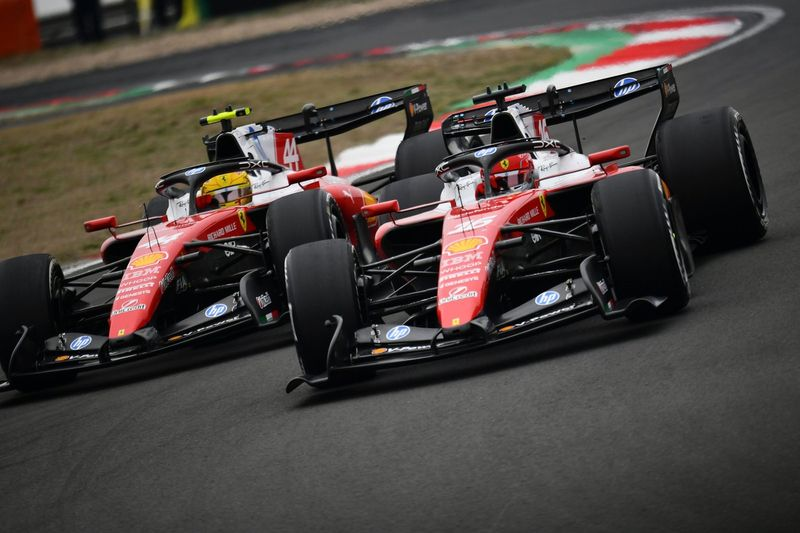
The rivalry between Hamilton and Leclerc has quickly escalated into one of the defining storylines of the 2026 championship. Their duel at Suzuka stands out as a flashpoint moment.
Leclerc reflected on the intensity of that encounter:

“Our cars touched in the chicane – I was even afraid I’d gotten a puncture.”
Such admissions underline the razor-thin margins separating elite drivers at the front of the grid. These are not cautious exchanges; they are calculated risks taken at extreme speeds.
From a technical perspective, aggressive intra-team battles can compromise race outcomes. Drivers fighting each other may lose battery efficiency, tire life, and track position—factors that collectively determine race strategy success.
Former driver Timo Glock articulated the concern clearly:
“If the two cars are getting in each other’s way and losing battery power… then the team management must intervene.”
He added a warning grounded in experience:


“My gut feeling is that we’ll see them both in the gravel trap after a collision at some point.”
The Contract Factor: Who Really Decides?
What differentiates this situation from typical team rivalries is the suggestion that Ferrari may lack full authority over Hamilton’s racing decisions.
Former driver Ralf Schumacher offered a pointed interpretation:
“I think even if Fred Vasseur wanted to say something, he couldn’t. That’s why Ferrari has no chance. Hamilton will decide for himself.”
If accurate, this implies that Hamilton’s contract includes clauses granting him significant autonomy—unusual in a sport where team orders often dictate race outcomes.
This dynamic has broader implications:
- Strategic control: Team principals like Frederic Vasseur may be limited in managing race-day conflicts.
- Operational morale: Schumacher noted the internal strain, highlighting how mechanics and engineers may react when drivers compromise results through internal battles.
- Performance trade-offs: Freedom for drivers can enhance competitiveness but reduce team cohesion.
In effect, Ferrari may be balancing two competing priorities: maximizing individual brilliance versus preserving collective efficiency.
A Resurgence on Track
Despite the controversy, Hamilton’s form has been one of the most notable aspects of the 2026 season.
Timo Glock observed:
“Lewis Hamilton is definitely back where we all want to see him – confident and enjoying racing.”
This resurgence aligns with Hamilton’s own reflections on the evolving nature of Formula 1 cars. He has praised the current generation of machinery for enabling closer racing:
“It’s the best form of racing… Out of all the cars that I’ve driven in 20 years, this is the only car that you can actually follow through high speed and not completely lose everything that you have.”
From a technical standpoint, this suggests improved aerodynamic efficiency in turbulent air—a long-standing challenge in F1. The ability to “follow” closely enhances overtaking opportunities, naturally increasing on-track battles like those seen between Hamilton and Leclerc.
Off-Track Visibility: Culture, Media, and Influence
Hamilton’s relevance extends well beyond the circuit. In recent weeks, his public profile has been amplified by high-visibility appearances, including a viral Tokyo video featuring Kim Kardashian.
The clip, captioned:
“HERE WE GO AGAIN 🇯🇵 TOKYO DRIFT VOL. III,”
showed Hamilton driving a Ferrari F40 with Kardashian in the passenger seat. Their joint appearance, alongside a shared trip to Japan, has fueled speculation about their relationship.
A source described the dynamic:
“The two are busy with their careers but they continue to see each other as much as possible. It’s more than a casual relationship.”
While not directly related to racing performance, such visibility reinforces Hamilton’s dual identity: elite athlete and global cultural figure. This duality enhances his commercial value and broadens Formula 1’s reach into mainstream entertainment.
The Competitive Landscape: Where Hamilton Stands
The 2026 season itself remains highly competitive. Early standings indicate a shifting balance of power, with emerging talents challenging established names.
Yet Hamilton’s presence at the front—combined with Ferrari’s performance—positions him as a credible title contender once again.
The upcoming Miami Grand Prix, scheduled for early May, is expected to serve as a critical benchmark. Ferrari has reportedly planned a “mini pre-season” reset in April, suggesting that further performance gains could be imminent.
What This Means for Formula 1
Hamilton’s current situation encapsulates several broader trends shaping modern Formula 1:
1. Driver Empowerment
Elite drivers are increasingly negotiating contracts that provide autonomy, challenging traditional team hierarchies.
2. Competitive Parity
Improved car regulations are enabling closer racing, intensifying intra-team and inter-team rivalries.
3. Entertainment Convergence
The blending of sport and celebrity culture—exemplified by Hamilton’s off-track presence—continues to expand F1’s global audience.
4. Strategic Complexity
Teams must now balance individual driver freedom with collective objectives, a tension that may define championship outcomes.
Conclusion: A Defining Chapter in Hamilton’s Legacy
Lewis Hamilton’s 2026 season is not simply a late-career resurgence—it is a structural shift in how a driver can operate within Formula 1.
On track, he is aggressive, competitive, and once again among the sport’s elite. Off track, he remains a cultural force capable of shaping narratives beyond racing. Behind the scenes, his contract appears to grant him an unprecedented level of independence.
The result is a uniquely complex dynamic: a driver who is both part of a team and, in many respects, operating on his own terms.
Whether this approach leads to championship success—or internal conflict at Ferrari—will define not just Hamilton’s season, but potentially the future balance of power in Formula 1.