

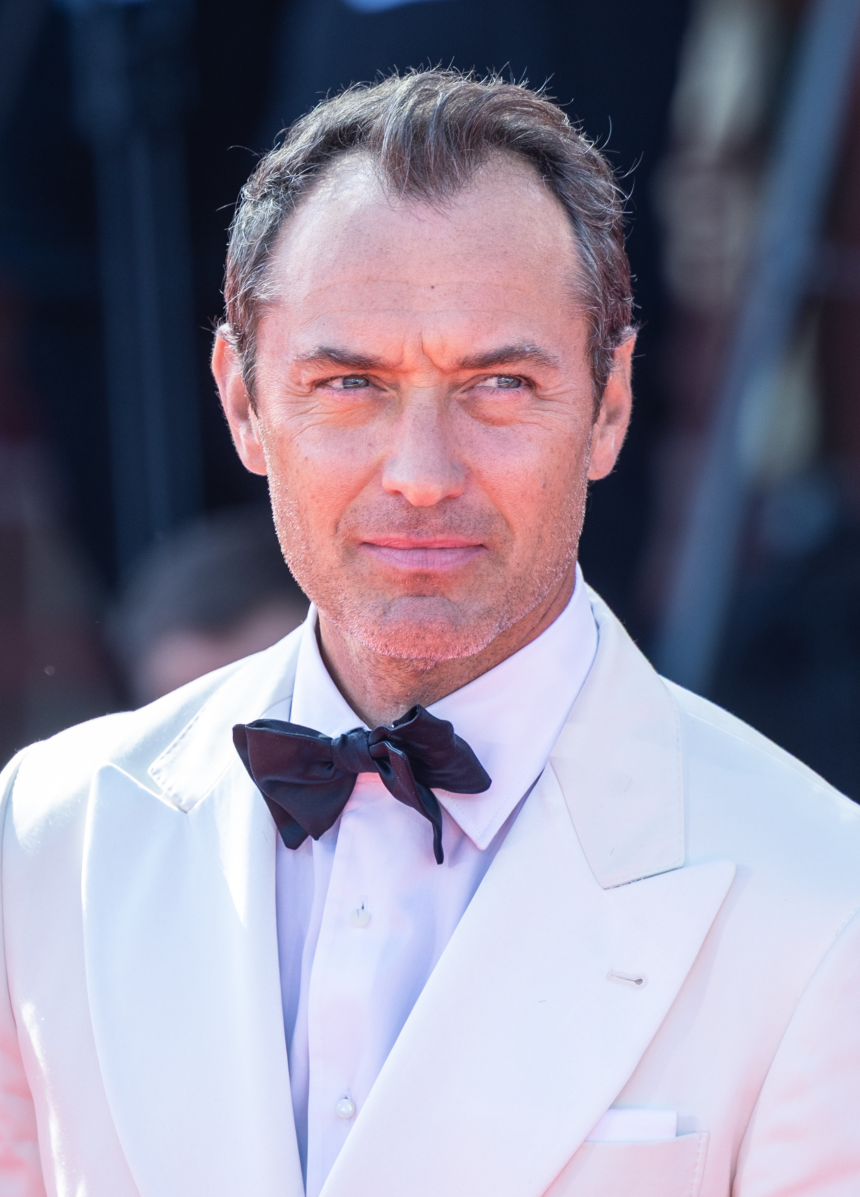
Jude Law: Reinvention, Privacy, and a Career at Its Peak
A Defining Moment in 2026
Few actors sustain relevance across decades while continuously reshaping their craft. Jude Law appears to be doing precisely that. In early 2026, the British actor stands at a unique intersection—balancing renewed critical acclaim for his performance in Wizard of the Kremlin with a deeply private personal life that has unexpectedly drawn public attention.
- A Defining Moment in 2026
- The Performance That Reframed His Career
- A Complex Ensemble Elevates the Narrative
- Beyond the Screen: A Life Under Scrutiny
- Phillipa Coan: A Deliberate Shift Toward Privacy
- The Philosophy of Privacy
- The Cultural Tension: Visibility vs Control
- What Comes Next?
- Conclusion: A Career Defined by Control
The dual narrative surrounding Law today—his artistic transformation and the resurfacing interest in his family—offers a compelling lens into how modern celebrity operates: part performance, part guarded identity.
The Performance That Reframed His Career
Inside Wizard of the Kremlin
Law’s portrayal of Vladimir Putin has been widely described as one of the most technically disciplined performances of his career. Directed by Olivier Assayas and adapted from the novel by Giuliano da Empoli, the film situates itself within the political upheaval following the collapse of the Soviet Union.
Premiering at the Venice Film Festival on August 31, 2025, the film reportedly received a ten-minute standing ovation—an unusually strong response even by festival standards.
Critics emphasized Law’s restraint. Rather than relying on prosthetics or exaggerated mimicry, he constructed a performance rooted in behavioral observation. His preparation reportedly included studying Putin’s physicality, including judo movements, and internalizing subtle psychological cues.
One review captured the tone succinctly:

“Law does not show up until about an hour into the film, but his take on Putin feels spookily accurate without becoming a distraction.”
This distinction—accuracy without caricature—has become central to the film’s reception and its awards potential.
A Complex Ensemble Elevates the Narrative
While Law’s performance anchors the film, its broader impact is reinforced by a carefully assembled cast. Paul Dano portrays Vadim Baranov, a political strategist inspired by real-life Kremlin figures. His role adds intellectual tension to the narrative, complementing Law’s controlled intensity.
Supporting performances from Alicia Vikander and Jeffrey Wright contribute emotional and narrative depth, positioning the film as a serious contender within prestige cinema.
With a reported budget of $26.6 million and a theatrical release on January 21, 2026, the production has already generated sustained industry discussion—particularly around its political framing and artistic ambition.

Beyond the Screen: A Life Under Scrutiny
The Renewed Spotlight on Family
While Law’s professional achievements dominate headlines, his personal life has re-entered public discourse under less controlled circumstances.
His 11-year-old daughter, Ada Law, recently became the center of attention following an incident involving singer Chappell Roan. The situation reportedly escalated after an interaction with a security guard left the child distressed, prompting concern from those close to her—including Brazilian footballer Jorginho Frello.
The episode indirectly brought renewed attention to Law’s past relationship with Catherine Harding, illustrating how interconnected celebrity networks can amplify otherwise isolated incidents.
Phillipa Coan: A Deliberate Shift Toward Privacy
Who Is Phillipa Coan?
At the center of Law’s current personal life is his wife, Phillipa Coan. Unlike many celebrity partners, Coan operates almost entirely outside the entertainment industry.
A business psychologist with a PhD in organisational psychology and behaviour change from the University of Leeds (2014), she specializes in applying psychological principles to sustainability and corporate behavior. She is also a chartered member of the British Psychological Society and a visiting research fellow at Leeds University Business School.
Her consultancy, STRIDE, focuses on helping organizations reduce energy consumption by influencing employee behavior—placing her work at the intersection of psychology and environmental strategy.
A Relationship Built Away From Public View
Law and Coan began their relationship in 2015, introduced by mutual acquaintances. Their early appearances—such as at the Hay Festival in Wales—were notable precisely because they deviated from Law’s earlier, more public relationships.
After four years together, the couple married on April 30, 2019, in a deliberately understated ceremony at the Old Marylebone Town Hall in London. The event was attended by close family and friends, with Law’s son Rafferty serving as best man.
Their age difference—approximately 13 to 14 years—briefly attracted media attention, but it has not defined their public narrative. Instead, the couple has consistently prioritized discretion.
The Philosophy of Privacy
Law has been explicit about his approach to personal life, particularly regarding his marriage:
“She’s mine and no one else’s…I’m very, very happy. Our relationship is a very private thing, and I think part of the fact it works so well is exactly because of that.”
This philosophy extends to their family. The couple welcomed their first child together in September 2020, during the COVID-19 pandemic, and a second child in early 2023. They have chosen not to disclose their children’s names or personal details.
Reflecting on that period, Law noted:
“It’s really wonderful. We feel pretty blessed that we were in a time where we could, as a family, just nest and enjoy each other’s company and every day as it came.”
In an era where visibility often equates to influence, Law’s deliberate opacity represents a counter-model—one where personal boundaries are actively maintained.
The Cultural Tension: Visibility vs Control
Law’s current moment highlights a broader tension within celebrity culture. On one hand, his performance in Wizard of the Kremlin demonstrates the continued demand for transformative, high-caliber acting. On the other, the resurfacing of personal narratives underscores the persistent erosion of privacy in the digital age.
This duality is not unique to Law, but his response to it is notable. Rather than engaging with controversy or expanding his public persona, he appears to be narrowing it—allowing his work to speak while keeping his private life structurally insulated.
What Comes Next?
From an industry perspective, Law’s trajectory suggests several possibilities:
- Awards recognition: His portrayal of Putin is already generating Oscar speculation.
- Continued prestige roles: Collaborations with directors like Assayas indicate a sustained focus on auteur-driven projects.
- Selective public engagement: His approach to privacy is unlikely to change, even as interest in his personal life fluctuates.
More broadly, his career reflects a strategic recalibration—less about volume, more about precision.
Conclusion: A Career Defined by Control
Jude Law’s current phase is not simply about resurgence; it is about control—over craft, narrative, and personal boundaries. His ability to deliver a performance that commands global attention while maintaining a tightly guarded private life is increasingly rare.
In a media environment driven by constant exposure, Law’s model suggests an alternative: relevance without overexposure, visibility without surrendering identity.