



Jared McCain’s Defining Moment: Opportunity, Pressure, and the Path Forward
In the closing stretch of the NBA regular season, timing often determines trajectory. For Jared McCain, that moment has arrived—shaped by circumstance, performance swings, and the broader ambitions of the Oklahoma City Thunder as they prepare for another deep postseason push.
- A Rookie Learning Curve Under Championship Expectations
- The Lakers Game: A Statistical Contribution with Strategic Implications
- The Opportunity Created by Absence
- The Broader Context: A Championship Ecosystem
- Performance Volatility: A Technical Breakdown
- The Psychological Dimension: Timing Meets Expectation
- What Comes Next: Indicators to Watch
- Conclusion: A Window That Demands Execution
A recent matchup against the Los Angeles Lakers—held at the Crypto.com Arena—offered a snapshot of McCain’s current position: a talented young guard navigating inconsistency while sitting on the edge of a potential breakthrough.

A Rookie Learning Curve Under Championship Expectations
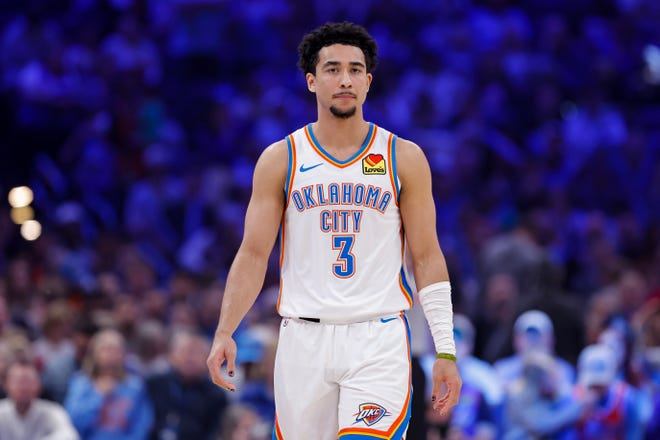
McCain’s integration into Oklahoma City’s system has been anything but static. After arriving ahead of the February 5 trade deadline, he quickly demonstrated his ability to contribute within a structured, high-efficiency offense.

During a stretch when All-Star forward Jalen Williams was sidelined, McCain’s role expanded significantly. The results were encouraging:
- 13.1 points per game
- 46.5% shooting from the field
- 43.5% from three-point range
These numbers reflect more than just scoring—they indicate adaptability, spacing awareness, and a capacity to operate within a championship-caliber rotation.
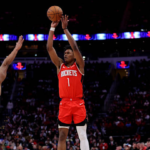
However, the return of Williams on March 23 altered the team’s hierarchy. With touches redistributed and minutes reduced, McCain’s production dropped sharply:
- 5.3 points per game
- 41.0% field goal shooting
- 19.0% from three-point range
- Minutes reduced from 19.8 to 14.7 per game
This shift underscores a common developmental challenge: transitioning from opportunity-driven production to consistency within a fully healthy roster.
The Lakers Game: A Statistical Contribution with Strategic Implications
In Oklahoma City’s dominant 123–87 victory over the Lakers, McCain delivered a notable performance, contributing 15 points in a game led by Shai Gilgeous-Alexander, who recorded 25 points and eight assists.
While the Thunder’s win extended their impressive run—six consecutive victories and 18 wins in their last 19 games—McCain’s output carries a different kind of significance. It signals a potential recalibration at a critical juncture of the season.



The Lakers, depleted by injuries to key players including Luka Dončić and LeBron James, struggled offensively, recording their lowest-scoring game of the season.
For McCain, however, the context matters less than the timing. With the playoffs approaching, individual rhythm becomes as important as team momentum.
The Opportunity Created by Absence
The Thunder’s decision to rest Jalen Williams due to a lingering hamstring strain introduces a critical variable. From a rotational standpoint, this absence opens a temporary window for McCain to reclaim offensive responsibility.
The logic is straightforward:
- Increased minutes lead to more shot opportunities
- Expanded role allows rhythm development
- Reduced pressure hierarchy enables decision-making freedom
This scenario mirrors the earlier stretch in which McCain thrived. The difference now is psychological rather than structural—he must translate past efficiency into present consistency.
Williams himself highlighted the volatility of such injuries, describing hamstring issues as “spooky” due to their tendency to flare up and disrupt rhythm. That same unpredictability extends to players like McCain, whose performance is closely tied to usage patterns.
The Broader Context: A Championship Ecosystem
Oklahoma City is not simply experimenting with rotations—they are managing assets for a title defense. Head coach Mark Daigneault’s priority is clear: maintain player health while ensuring depth readiness.
This places McCain in a dual-role environment:
- Short-term contributor filling gaps created by injuries
- Long-term playoff asset capable of providing scoring bursts off the bench
In elite teams, such roles are not optional—they are decisive. Bench production often determines playoff outcomes, particularly in tightly contested series.
The Thunder’s current dominance suggests a system operating at peak efficiency. However, sustaining that level requires reliable secondary contributors. McCain’s development is therefore not isolated—it is structurally linked to Oklahoma City’s championship ambitions.
Performance Volatility: A Technical Breakdown
McCain’s statistical decline post-Williams return is not unusual, but it is instructive. Several factors likely contributed:
1. Usage Rate Reduction
With fewer offensive possessions initiated through him, McCain’s rhythm naturally declined.
2. Shot Quality Variability
Lower minutes often correlate with lower-quality shot opportunities—late-clock attempts, contested looks, or limited spacing.
3. Confidence Feedback Loop
Shooting percentages, particularly from three-point range, often reflect confidence levels. A drop from 43.5% to 19.0% suggests a disruption in shooting mechanics or decision timing.
4. Role Ambiguity
Transitioning between primary and secondary roles can create hesitation, particularly for younger players.
These elements collectively define what analysts refer to as “situational inconsistency”—a phase common among developing guards adjusting to elite-level competition.
The Psychological Dimension: Timing Meets Expectation
Beyond statistics, McCain’s current situation is shaped by expectation. This is his first exposure to:
- Late-season pressure
- Playoff preparation intensity
- High-stakes rotation competition
The need to “snap out of his ongoing slump” is not merely a performance directive—it is a mental recalibration. Players at this stage must balance patience with urgency, maintaining confidence while adapting to fluctuating roles.
What Comes Next: Indicators to Watch
As the regular season concludes, several indicators will determine McCain’s trajectory:
Short-Term Signals
- Shot selection efficiency
- Three-point shooting recovery
- Defensive consistency in limited minutes
Medium-Term Indicators
- Rotation stability heading into playoffs
- Trust from coaching staff in late-game situations
- Ability to impact games without high usage
Long-Term Projection
If McCain can reestablish his earlier efficiency, he positions himself as a valuable rotational guard in a championship system—potentially extending his role in future seasons.
Conclusion: A Window That Demands Execution
Jared McCain’s current phase is not defined by decline, but by transition. His early production demonstrated capability; his recent struggles highlight the complexity of sustaining it within a competitive roster.
The temporary absence of Jalen Williams provides more than minutes—it offers a recalibration point. For McCain, the task is precise: convert opportunity into consistency before the postseason begins.
In championship ecosystems, roles are fluid but expectations are fixed. McCain’s ability to respond in these final games will determine not only his playoff relevance but his standing within one of the NBA’s most formidable teams.