




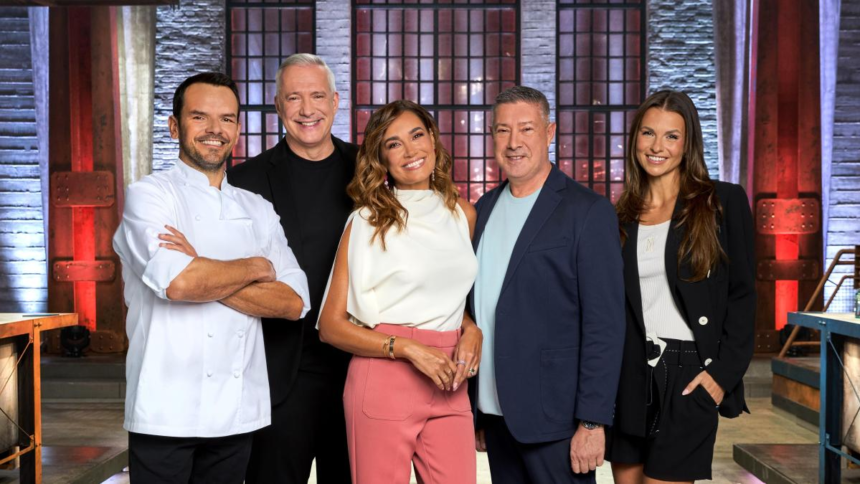
“Grill den Henssler”: Chaos, Competition, and Culinary Ego in a High-Stakes Kitchen
A Narrative Feature: When Precision Meets Pressure on Primetime TV
On a Sunday evening in Cologne, the familiar rhythm of knives chopping and pans sizzling gave way to something far less predictable. The latest episode of Grill den Henssler, VOX’s long-running culinary competition, delivered not just refined gastronomy—but a sequence of mishaps, sharp critiques, and raw emotion that exposed the fragility of even the most seasoned chefs.
- “Grill den Henssler”: Chaos, Competition, and Culinary Ego in a High-Stakes Kitchen
- Setting the Stage: A Clash of Culinary Heavyweights
- The Improvisation Test: When Basics Become Complex
- Verbal Fireworks: Ego, Humor, and Friction
- The Dessert Disaster: A Turning Point in the Kitchen
- Results: Narrow Victories and Strategic Dominance
- Beyond the Kitchen: Format, Appeal, and Audience Reaction
- Looking Ahead: Sustainability of Henssler’s Dominance
- Conclusion: A Kitchen Where Control Is an Illusion
At the center of it all was Steffen Henssler, the show’s enduring figurehead, facing off against a trio of elite culinary professionals in a special “coach edition.” What unfolded was less a routine cooking contest and more a layered narrative about control, improvisation, and the psychological demands of competitive cooking.
Setting the Stage: A Clash of Culinary Heavyweights
The episode brought together a formidable lineup:
- Steffen Henssler (53) – the show’s dominant force and defending “Koch-King”
- Daniel Gottschlich (43) – two-Michelin-star chef and “Koch des Jahres 2025”
- Max Stiegl (45) – returning challenger seeking redemption
- Ali Güngörmüş (49) – a highly respected two-star chef
The format was straightforward in theory: multiple rounds testing creativity, technique, and composure. In practice, it became a study in how quickly even elite chefs can lose control under unfamiliar conditions.
Henssler himself acknowledged the challenge succinctly:
“If you’re standing here in this kitchen and suddenly something goes wrong, the parameters are simply different… The worst thing for a chef is to be in a different kitchen.”
The Improvisation Test: When Basics Become Complex
The opening round required participants to construct an appetizer using four ingredients: sole, radish, potato, and coriander—all within nine minutes.

What this process achieves is simple: it strips chefs of preparation and forces instinctive decision-making. It reveals not just skill, but adaptability.
Henssler opted for fried potatoes, a seemingly safe move. However, the execution fell short.
- Jana Ina Zarrella noted: “It really lacks flavor.”
-
Joachim Llambi, characteristically blunt, delivered the harshest critique:
“That wasn’t anything that would blow me away. I could have done that myself – and I’m not good.”
The remark encapsulated the tone of the evening—technical scrutiny paired with entertainment-driven bluntness.
Verbal Fireworks: Ego, Humor, and Friction
As the cooking intensified, so did the exchanges between participants and judges.


When Alexander Herrmann criticized Henssler’s dish as lacking refinement, comparing it to an improvised fallback meal, Henssler responded sharply:
“Dude! Your mother works at Nordsee—as a smell!”
Meanwhile, tension spilled into the jury panel itself. A playful yet pointed exchange saw Jana Ina Zarrella threatening Llambi with a fork after he referenced Brazil’s infamous 7:1 World Cup defeat.
These moments serve a clear function: they transform a technical cooking competition into a multi-layered entertainment product where personality is as important as plating.
The Dessert Disaster: A Turning Point in the Kitchen
The final round—the dessert—became the episode’s defining moment.
The challenge, set by Zarrella, was deceptively simple:
- Chocolate cake
- Liquid core of brigadeiro sauce
- Fresh strawberries
For Ali Güngörmüş, execution quickly unraveled.
While being distracted by host Laura Wontorra, who pressed him with rapid-fire questions—including whether he would consider cooking for the German national football team—Güngörmüş struggled to maintain focus.
His response was candid:
“Nee, das will ich nicht. Die zahlen nicht gut. Ein Freund von mir hat sich da mal beworben.”
Moments later, disaster struck.
- White chocolate sheets left too long in the oven began to smoke
-
Güngörmüş reacted in frustration:
“Scheiße! Oh nee! Warum sagt ihr denn nichts? Mann!”
-
Adding to the chaos, he spilled coconut milk on his trousers, lamenting:
“Oh Mist! Ich habe nur eine dabei und muss morgen noch nach München.”
Across the kitchen, Henssler seized the moment, mockingly celebrating:
“So sehen Sieger aus, schalalalala!”
Results: Narrow Victories and Strategic Dominance
Despite the visible setback, Güngörmüş’s dessert impressed the jury more than Henssler’s, earning a 24:21 win in the final round.
However, the broader competition told a different story:
- Total score: Henssler wins 89:84
- Güngörmüş wins dessert round
- Gottschlich secures a draw in the appetizer (20:20)
- Stiegl loses the main course duel (22:25)
Crucially, Henssler’s dominance in the “kitchen competitions” rounds—where additional points were awarded—proved decisive. He claimed all three, adding nine points that ultimately secured victory.
This marked his 11th consecutive win, reinforcing his status as the show’s central figure.
Beyond the Kitchen: Format, Appeal, and Audience Reaction
“Grill den Henssler” continues to operate at the intersection of:
- Technical cooking competition
- Reality TV dynamics
- Personality-driven entertainment
The inclusion of high-profile chefs raises expectations, but also introduces volatility. Even Michelin-level expertise does not guarantee success in a format defined by time pressure, unfamiliar environments, and constant distraction.
Audience reactions also highlight evolving expectations. The presence of judges like Joachim Llambi—better known outside culinary circles—has sparked criticism:
“Was hat der Llambi mit Essen zu tun?”
This tension reflects a broader shift in televised competitions, where entertainment value increasingly rivals domain expertise.
Looking Ahead: Sustainability of Henssler’s Dominance
Henssler’s continued winning streak raises a structural question for the show: can the format remain compelling if outcomes become predictable?
The host himself hinted at potential future directions, expressing interest in unconventional guests such as:
- Stefan Raab (though he dismissed the idea humorously: “He doesn’t really like cooking.”)
- A themed episode featuring “Tatort” actors Jan Josef Liefers and Axel Prahl
These ideas suggest a strategic pivot toward novelty and crossover appeal—essential for maintaining audience engagement in a saturated entertainment landscape.
Conclusion: A Kitchen Where Control Is an Illusion
This episode of “Grill den Henssler” underscores a fundamental truth about competitive cooking: mastery does not eliminate risk.
From smoking ovens to sharp-tongued critiques, the show thrives on unpredictability. The dessert disaster involving Ali Güngörmüş encapsulated this perfectly—demonstrating how quickly precision can collapse under pressure.
Yet in the end, the structure of the competition favored consistency over isolated brilliance. Henssler’s ability to accumulate points across multiple segments secured his victory, even when individual dishes fell short.
It is this balance—between chaos and control, skill and spectacle—that continues to define the show’s enduring appeal.