

Samsung Galaxy S26 vs. Galaxy S25: Is Samsung’s Latest Flagship Really Worth the Upgrade?
Samsung’s Galaxy S series has long represented the company’s vision for premium Android smartphones, but in recent years the lineup has evolved less through dramatic reinvention and more through careful refinement. That trend continues with the Samsung Galaxy S26, a device that looks remarkably familiar next to last year’s Galaxy S25.
At first glance, the two phones appear nearly identical. They share similar displays, camera hardware, premium materials, and software support policies. Yet beneath the surface, Samsung has introduced several meaningful upgrades to the Galaxy S26, including improved battery life, faster charging, a new Exynos 2600 chipset in many regions, enhanced AI-powered features, and upgraded selfie capabilities.
The bigger question, however, is whether those improvements justify the higher asking price.
For buyers deciding between the newer Galaxy S26 and the more affordable Galaxy S25, the answer is more nuanced than simple specifications alone might suggest. Samsung’s strategy in 2026 reflects a broader shift happening across the smartphone industry: flagship devices are no longer reinvented every year. Instead, manufacturers are focusing on polish, software intelligence, efficiency, and ecosystem integration.
Samsung’s New Philosophy: Refinement Over Reinvention
The Galaxy S26 series arrives during a period when smartphone innovation has matured. Gone are the days of yearly leaps in camera quality or revolutionary design changes. Instead, Samsung appears focused on incremental upgrades that improve day-to-day usability without fundamentally changing the experience.
That philosophy is visible immediately when comparing the Galaxy S26 and Galaxy S25. Both phones feature Armor Aluminum 2 frames, Gorilla Glass Victus 2 protection on the front and back, IP68 water resistance, and compact flagship form factors.
The Galaxy S26 measures 149.6 x 71.7 x 7.2 mm and weighs 167g, while the Galaxy S25 comes in slightly smaller at 146.9 x 70.5 x 7.2 mm and 162g. The difference is largely due to the Galaxy S26’s slightly larger 6.3-inch display compared to the S25’s 6.2-inch panel.
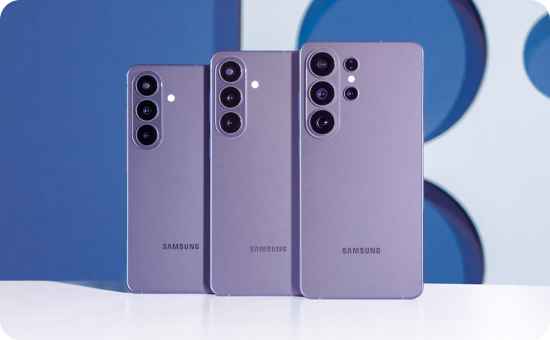
Visually, the biggest distinction is Samsung’s revised camera island design on the S26. Some users may appreciate the updated aesthetic, but others may prefer the cleaner look of the S25, especially since reviewers noted that the S26 tends to wobble more when placed on flat surfaces.
The Display Experience Barely Changes — And That’s Not a Bad Thing
Samsung has long dominated smartphone display technology, so it is perhaps unsurprising that the company made very few changes here.
Both phones use LTPO OLED displays with 120Hz adaptive refresh rates and nearly identical brightness levels approaching 1,400 nits. Resolution also remains unchanged at 1080 x 2340 pixels.
In practical use, most consumers would struggle to tell the difference between the two panels.
Rather than introducing unnecessary display changes, Samsung appears to have focused on preserving what already worked exceptionally well. That decision aligns with a growing industry pattern where smartphone displays have largely plateaued in terms of visible year-over-year improvements.
Exynos Returns: The Most Controversial Upgrade
The biggest story surrounding the Galaxy S26 is not the design or cameras — it is the processor strategy.
Last year, Samsung shipped the Galaxy S25 globally with Qualcomm’s Snapdragon 8 Elite for Galaxy chipset. In 2026, however, Samsung returned to its familiar dual-chip approach. Markets including Europe and South Korea receive the Exynos 2600 processor, while the United States, China, and Japan continue using the Snapdragon 8 Elite Gen 5 for Galaxy.
The Exynos 2600 is manufactured using a 2nm process, compared to the Snapdragon chip’s 3nm architecture. Samsung also paired the Exynos chip with AMD-designed Xclipse 960 graphics.
Benchmark testing suggests that Samsung’s new processor delivers noticeable improvements:
- AnTuTu 10: 2,441,481 on the S26 vs. 2,193,701 on the S25
- Geekbench 6: 10,824 vs. 10,050
- 3DMark Wild Life: 7,230 vs. 6,703
Those gains range between roughly 8% and 11%, depending on the workload.
While those numbers are respectable, they also reinforce an important reality: the Galaxy S25 was already extremely fast. For many users, the difference in everyday performance may be difficult to notice outside demanding gaming or AI-heavy tasks.
Still, Samsung is clearly positioning the Galaxy S26 as a more AI-capable device. The company says the S26 lineup was “built from the ground up for an AI-first mobile experience” and includes One UI 8.5 with enhanced Galaxy AI integration.
Among the standout features is “Now Nudge,” a contextual AI assistant that recognizes on-screen activity and suggests relevant actions in real time. Samsung says the feature can recommend opening your calendar when discussing plans or instantly surface photo galleries when someone requests an image.
Battery Life Gets a Meaningful Boost
One area where the Galaxy S26 clearly improves over its predecessor is endurance.
Samsung increased battery capacity from 4,000mAh on the Galaxy S25 to 4,300mAh on the Galaxy S26. Combined with efficiency gains from the newer hardware and software optimizations, the newer device delivers noticeably longer battery life.
Testing showed particularly strong gains in:
- Web browsing
- Video streaming
- General active use time
The Galaxy S26 achieved an active use score of 15:20h compared to 13:09h on the S25.
Charging performance also improved substantially despite both phones retaining 25W wired charging specifications.
The Galaxy S26 reached:
- 34% charge in 15 minutes
- 62% charge in 30 minutes
- Full charge in 64 minutes
Meanwhile, the Galaxy S25 managed:
- 28% in 15 minutes
- 56% in 30 minutes
- Full charge in 77 minutes
Reviewers believe Samsung adopted a more aggressive charging curve on the newer model.
Wireless charging remains unchanged at 15W Qi2 support, though magnetic cases are still required for magnetic charging accessories.
Camera Hardware Stays Familiar
For photography enthusiasts hoping for a major camera overhaul, the Galaxy S26 may feel conservative.
Samsung retained essentially the same rear camera hardware found on the Galaxy S25:
- 50MP main sensor
- 12MP ultrawide
- 10MP telephoto with 3x optical zoom
Most daylight photography differences are subtle. Reviewers noted that the S26 tends to produce warmer colors and greener foliage, while detail rendering appears slightly finer and less aggressively sharpened.
Low-light performance, however, remains inconsistent on both devices.
Samsung introduced a revised low-light processing approach on the Galaxy S26, but reviewers found results mixed. In some scenes, the S26 produced brighter, cleaner images, while in others the older S25 delivered more reliable color reproduction.
One clear improvement arrives on the front-facing camera.
The Galaxy S26 replaces the older 25–26mm selfie lens with a wider 23mm equivalent lens, producing sharper images and wider framing that is particularly useful for group selfies and vlogging.
Video Features Push the S26 Forward
Video recording capabilities remain broadly similar across both devices:
- 4K60 recording on all cameras
- 8K30 recording on the main sensor
- Advanced Pro video modes
However, Samsung added two notable creator-focused upgrades to the S26:
- Horizon lock stabilization
- LUT support for Log video recording
These additions are unlikely to matter to casual users, but they could appeal strongly to mobile filmmakers and content creators.
The Pricing Problem
The biggest challenge facing the Galaxy S26 is not technical — it is economic.
Samsung’s own comparisons reveal that the Galaxy S26 starts with 256GB storage in most markets, while the Galaxy S25 began at 128GB.
That upgrade comes alongside higher prices.
Reviewers repeatedly concluded that the Galaxy S25 delivers nearly the same overall experience at a significantly lower cost. Price differences of roughly €150/$150 make the older phone particularly attractive for budget-conscious buyers.
In fact, many reviewers argued that the Galaxy S25 may actually represent the smarter purchase overall.
A Broader Industry Trend
The Galaxy S26 reflects a growing reality across the premium smartphone market: annual hardware upgrades are becoming smaller and more targeted.
Consumers increasingly hold onto devices longer, especially as companies like Samsung now promise seven years of software support.
That long-term support dramatically changes buying behavior. Shoppers are more willing to purchase previous-generation devices because the software experience remains current for years.
Interestingly, some consumers see this slower upgrade cycle positively. Reader reactions highlighted environmental benefits tied to Samsung’s iterative approach, with one commenter praising the company for “providing less of a reason for people to upgrade unnecessarily every year or two.”
So Which Phone Should You Buy?
The answer depends largely on priorities.
The Galaxy S26 is objectively the more capable phone:
- Better battery life
- Faster charging
- Improved sustained performance
- Enhanced AI capabilities
- Better selfie camera
- New video tools
But the Galaxy S25 remains extremely competitive:
- Similar design
- Nearly identical display
- Comparable cameras
- Excellent performance
- Lower price
For users upgrading from much older Samsung devices, the Galaxy S26 offers a polished flagship experience with meaningful AI improvements and better endurance.
For Galaxy S25 owners, however, the leap is far less compelling.
Samsung’s 2026 flagship is not a revolution. It is a refinement — smarter, slightly faster, more efficient, and more AI-focused, but fundamentally familiar.
And in many ways, that may be exactly what modern smartphone buyers now expect.


