





Fear Factor: House of Fear” Grand Finale Airs Tonight on Fox
A Breaking News Report on the High-Stakes Reality Show Showdown
The revived adrenaline-fueled franchise Fear Factor: House of Fear reaches its defining moment tonight, as the season one grand finale airs on FOX. After weeks of escalating physical and psychological trials, four finalists now stand one step away from claiming the show’s ultimate prize: $200,000.
- The Final Showdown: Four Contestants, One Winner
- What the Finale Achieves: A Test of Pure Fear and Precision
- Challenge One: Underwater Panic Meets Predatory Pressure
- Final Duel: The Truck Leap That Defines the Season
- The Stakes: More Than Just Prize Money
- How to Watch the Finale
- Cultural Context: Why “Fear Factor” Still Works
- What Comes Next for the Franchise
- Conclusion: A Season Defined by Fear Reaches Its Limit
Broadcast at 9 p.m. ET, the finale promises a climactic spectacle that blends fear, endurance, and precision under pressure—elements that have long defined the legacy of the Fear Factor franchise.
The Final Showdown: Four Contestants, One Winner
Nine grueling episodes have narrowed the competition to four contenders, each representing a distinct approach to survival in high-pressure environments:
- Chelsea Montgomery (34) – A Tennessee-based practitioner known for strategic gameplay and alliance-building
- Jayleen Carmona (28) – A Los Angeles marketing professional with notable resilience under pressure
- Ethan Macmillan (20) – A Canadian emergency dispatcher praised for composure and tactical thinking
- Rob Rast (35) – A San Diego entrepreneur recognized for physical strength and patience
Each finalist has endured a season defined by “mind-blowing stunts, harrowing challenges, and a twisted game of social strategy.”
Now, with all alliances stripped away, the finale reduces the competition to its core principle: confronting fear directly.



What the Finale Achieves: A Test of Pure Fear and Precision
The structure of the finale is designed to eliminate any remaining strategic advantages and focus solely on individual capability. It achieves three critical outcomes:
- Separates mental resilience from physical strength
- Forces contestants into high-risk, time-sensitive decisions
- Determines who can function under extreme psychological pressure
Only those who can balance all three will advance.
Challenge One: Underwater Panic Meets Predatory Pressure
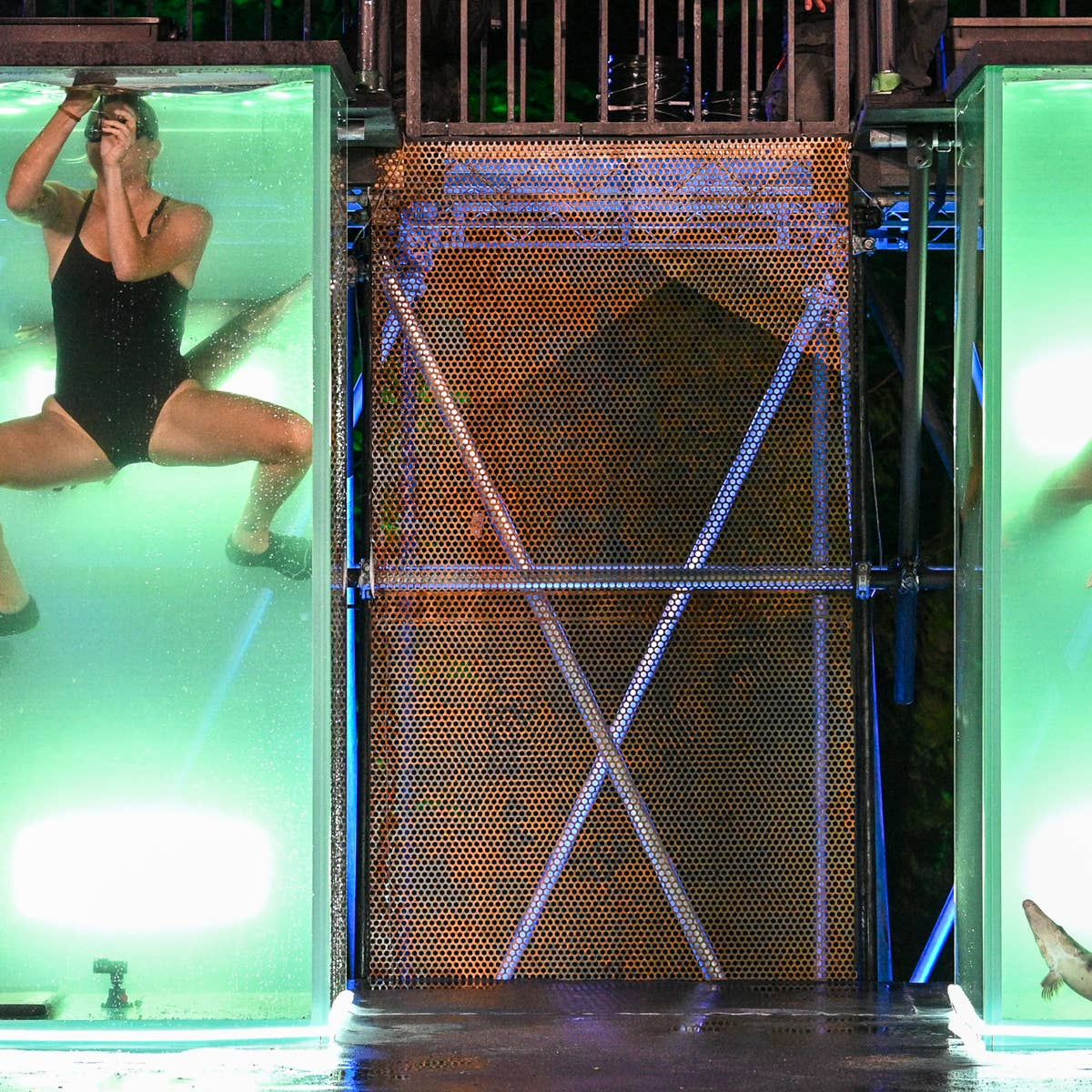
The first major test pushes contestants into containment tanks where they must solve a puzzle while submerged in water—an exercise combining claustrophobia, breath control, and cognitive function.
Complicating matters further, the tanks are populated with large fish, likely alligator gars, known for their intimidating appearance and sharp teeth.



Contestants must navigate a maze mechanism while managing oxygen levels. A small air pocket provides relief—but at a cost: every second spent breathing reduces their chances of winning.
Host Johnny Knoxville captures the intensity of the moment, remarking:
“This is really close… How have they not come up for air yet? I would be toast by now!”
This stage is not simply about survival—it’s about decision-making under suffocation-level stress.
Final Duel: The Truck Leap That Defines the Season
The second and final challenge distills the competition into a single, high-risk stunt.
The remaining two contestants must execute a leap between two speeding semi-trucks, requiring precise timing, balance, and absolute control of fear.
This moment represents the culmination of the season’s escalating difficulty. As described in coverage leading up to the episode, the finale is:
“hurtling toward its hair-raising season finale with a climactic showdown.”
Failure in this stage is immediate and decisive. Success, however, secures both victory and the $200,000 prize.
The Stakes: More Than Just Prize Money
While the $200,000 reward is substantial, the symbolic value of winning may carry equal weight.
The show’s defining tagline—“Fear Is Not A Factor!”—serves as both a psychological benchmark and a narrative endpoint. The winner is not just the last competitor standing but the individual who demonstrates mastery over fear itself.
Throughout the season, contestants have endured:
- Fire-based stunts
- Electric shock challenges
- Physical endurance trials
- Social manipulation dynamics
The finale strips away these layered elements, leaving only raw confrontation with fear.
How to Watch the Finale
Viewers can tune in live on FOX at 9 p.m. ET on March 25, 2026, with additional viewing options available:
- Streaming platforms such as Hulu (next-day access)
- Live TV streaming services offering trial access and promotional deals
The finale is expected to generate significant social media engagement as audiences react in real time to the outcome.
Cultural Context: Why “Fear Factor” Still Works
The enduring appeal of the Fear Factor format lies in its simplicity: controlled exposure to extreme fear.
Originally hosted by Joe Rogan, the franchise has undergone multiple revivals. The latest iteration, led by Johnny Knoxville, leans heavily into spectacle and psychological intensity, aligning with modern reality TV trends.
Unlike competition formats driven by talent or skill alone, House of Fear focuses on instinct, survival, and emotional control—elements that resonate across audiences.
What Comes Next for the Franchise
The performance of this finale will likely influence the future of the reboot.
If audience engagement and ratings meet expectations, potential developments may include:
- Expanded seasons with higher stakes
- International adaptations
- Cross-platform streaming integration
The show’s ability to evolve while maintaining its core identity will determine its long-term viability.
Conclusion: A Season Defined by Fear Reaches Its Limit
Tonight’s grand finale of Fear Factor: House of Fear represents more than the end of a competition—it marks the culmination of a controlled experiment in human endurance.
Four contestants entered with different strengths. Only one will leave having proven that fear, under the most extreme conditions, can be controlled—or at least confronted.
The final outcome hinges on a simple question:
Who can function when fear becomes overwhelming?
The answer arrives tonight.