

Colbert Obama Interview: Why Barack Obama’s Late-Night Conversation Became a Political Moment
Former President Barack Obama’s interview with Stephen Colbert was more than a late-night television appearance. It became a pointed reflection on presidential power, democratic norms, political communication, and the role of public leadership at a moment when American politics remains deeply polarized.
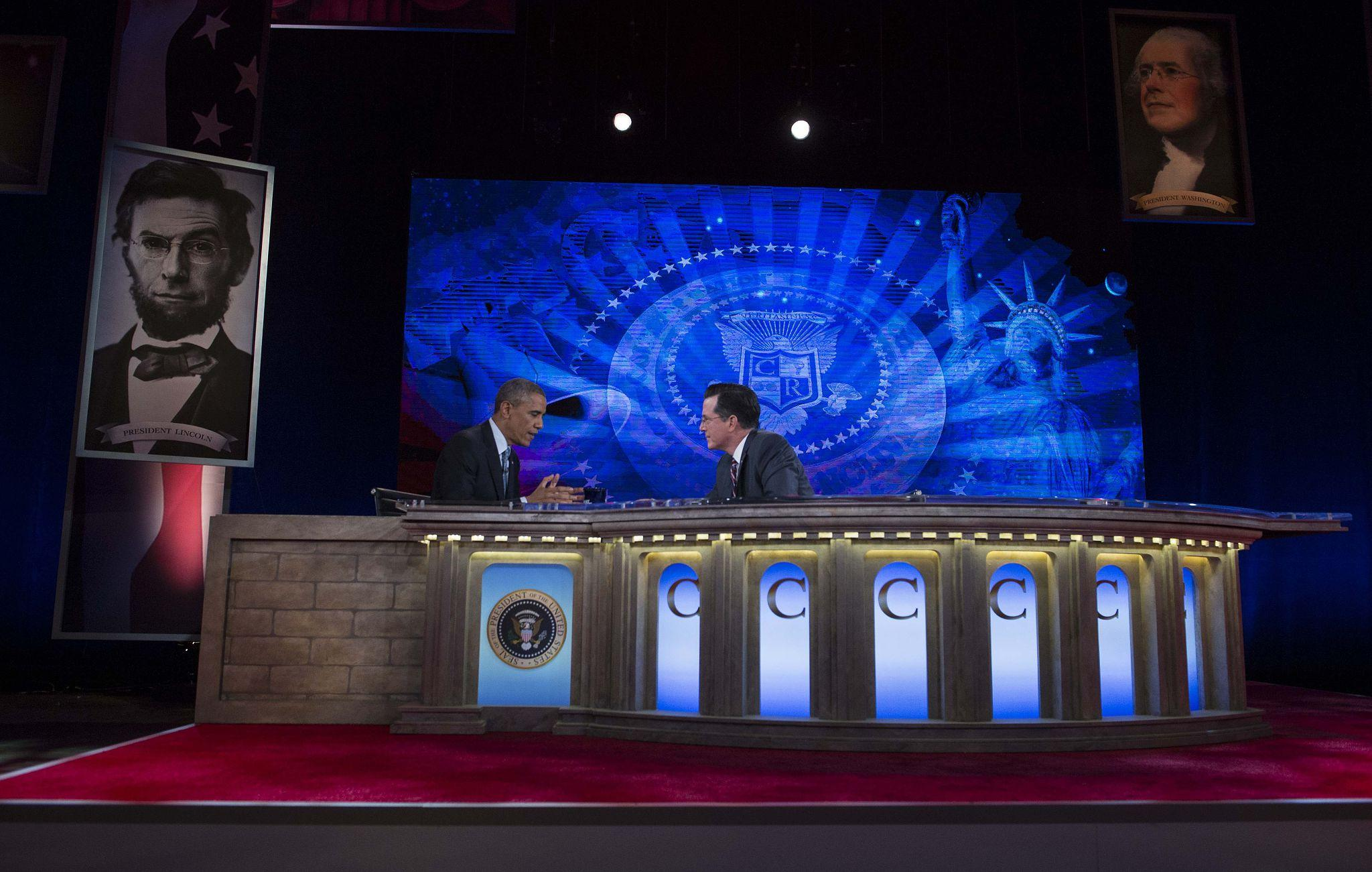
The conversation aired Tuesday night on “The Late Show With Stephen Colbert” and was filmed in early April at the Obama Presidential Center on the South Side of Chicago, ahead of the center’s opening to the public on Juneteenth. During the nearly 25-minute interview, Obama avoided mentioning President Trump by name, but many of his remarks were clearly aimed at the direction of Trump’s second term and the broader condition of American governance.
A Late-Night Interview With a Serious Political Core
The setting carried symbolic weight. Obama spoke from the site of his soon-to-open presidential center in Chicago, a project tied to his post-presidential legacy and civic engagement. Colbert, meanwhile, is nearing the end of his CBS show, with the final “Late Show” episode set to air on May 21.
That backdrop gave the interview a farewell-tour atmosphere for Colbert and a legacy-building dimension for Obama. But the substance quickly moved beyond nostalgia. Obama addressed questions about executive power, the Justice Department, political leadership, Democratic messaging, presidential pardons, and even aliens.
Late-night comedy has long been a space where politics and entertainment overlap. In this interview, however, the jokes served as entry points into a sharper discussion about democratic guardrails.
Obama’s Warning on the Justice System
One of the most consequential parts of the interview came when Colbert asked Obama about presidential powers he believes should be restricted. Obama focused on the independence of the Justice Department and the danger of using criminal prosecution as a political weapon.
“We can survive a lot — bad policy, funky elections, there’s a bunch of stuff that, you know, we can overcome,” Obama said. “We can’t overcome the politicization of our justice system, the awesome power of the state. You can’t have a situation in which whoever is in charge of the government starts using that to go after their political enemies or reward their friends.”
Obama said some norms he followed as president were not formal laws, but he suggested the country may now need to put those principles into statute.
“The White House shouldn’t be able to direct the attorney general to go around prosecuting whoever the president wants to prosecute,” Obama said. “The norm is — the idea is that the attorney general is the people’s lawyer. It’s not the president’s consiglieri.”
The remark framed the attorney general not as a personal defender of the president but as a public officer accountable to the law. Obama’s use of “consiglieri” underscored his concern that the Justice Department could become a tool of personal loyalty rather than constitutional responsibility.
Executive Power, Pardons and “Side Hustles”
Obama’s concerns did not stop with the Justice Department. He also discussed presidential pardons, noting that the pardon power is written into the Constitution. But he added a pointed caution: “maybe don’t pardon people who’ve given you a bunch of campaign contributions.”
He also raised concerns about the politicization of the military.
“There had been a whole series of norms that were in place to ensure that you weren’t trying to make the military loyal to you, as opposed to the Constitution, and the people of the United States,” Obama said. “We’re going to have to find mechanisms to restore that.”
In another notable line, Obama said a president should not have a “bunch of side hustles.” The comment was part of a broader warning about conflicts of interest, foreign entities, private business interests, and the presidency’s immense public power.
Taken together, these comments presented Obama’s argument that democracy depends not only on elections but also on norms: an independent justice system, a nonpartisan military, ethical boundaries, and limits on personal financial entanglements.
“The Bar Has Changed”: Obama Jokes About a Colbert Run
The interview also contained lighter moments. When Colbert jokingly raised the possibility of running for president, Obama initially called it “a stupid idea,” but then shifted into a joke with a political edge.
“The bar has changed,” Obama said, holding back laughter. “Let me put it this way: I think that you could perform significantly better than some folks that we’ve seen. I have great confidence in that.”
Colbert asked, “Is that an endorsement?”
“It was not,” Obama replied.
The exchange worked as comedy, but it also reflected a deeper theme of the interview: Obama’s belief that the presidency has been tested by figures who disregard norms he considers essential.
Obama’s Advice to Democrats: Speak Plainly
Beyond institutional concerns, Obama turned to the Democratic Party’s messaging problem. At a time when Democrats are described as divided over leadership, strategy and how to confront the Trump administration, Obama said he was not overly worried about ideological disagreements.
“I’m not as worried about this so-called rift,” Obama told Colbert.
“There are a bunch of things that we agree on,” Obama said. “It’s really more of a question of, All right, what are the specific things that we have to do?”
For Obama, the bigger problem is communication. He urged Democrats to stop talking as though they were in an academic setting and to speak directly to voters.
“What I’m more interested in for Democrats is: Do you know how to just talk to regular people like we’re not in a college seminar,” Obama said. “Can you talk plain English to folks?”
That line captured one of the interview’s central political messages. Obama was not simply criticizing Republicans or warning about Trump. He was also challenging Democrats to communicate more clearly, avoid jargon, and connect with ordinary people.
Why Obama Praised Zohran Mamdani
Obama pointed to Mayor Zohran Mamdani of New York as an example of effective political communication. Mamdani, described in the provided information as a democratic socialist whose politics are far to the left of Obama’s, was praised by the former president for avoiding language that sounds detached from voters’ daily lives.
Obama called Mamdani “an extraordinary talent” and said successful Democrats would, like Mamdani, avoid “gobbledygook.”
That praise was notable because it crossed ideological lines within the Democratic coalition. Obama’s point was less about adopting Mamdani’s politics and more about adopting a style of communication that sounds accessible, concrete and human.
The Obama Presidential Center and the Meaning of Legacy
The interview also gave Obama a chance to discuss the Obama Presidential Center in Chicago, which is set to open to the public on Juneteenth. He said he hopes the center will help people think about “this extraordinary journey this country took to get to” his presidency.
He described that journey as part of a long American struggle over inclusion.
“It’s this struggle between the idea that ‘we the people’ includes everybody — that’s it’s just some, it’s not just some select few,” Obama said.
The remark connected his presidential legacy to a broader civic argument: that American democracy is defined by the continuing expansion of who counts as part of “we the people.”
The Alien Question: Obama Lightens the Mood
After a heavy discussion of governance, Colbert pressed Obama on whether the government is hiding information about extraterrestrial life. Obama laughed off the idea that the government could successfully keep such a secret.
“One of the things you learn as president is government is terrible at keeping secrets,” Obama said.
He added: “If there were aliens, or alien spaceships, or anything under the control of the United States government that we knew about, seen, photographs, what have you, I promise you, some guy guarding the installation would have taken a selfie with one of the aliens and sent it to his girlfriend.”
The alien exchange offered comic relief, but it also fit the tone of the interview: Obama used humor to make a broader point about government, secrecy and public skepticism.
Why the Interview Matters
The Colbert Obama interview stood out because it blended late-night humor with a serious critique of American political power. Obama did not deliver a campaign speech, and he did not repeatedly name Trump. Instead, he spoke in the language of norms, institutions and public responsibility.
His core argument was clear: the presidency is not only about policy preferences. It is also about restraint. It requires limits on personal power, respect for independent institutions, ethical boundaries, and a commitment to governing on behalf of the public rather than personal allies or political enemies.
For Democrats, Obama’s message was equally direct. He urged the party to speak plainly, avoid academic language, and connect with voters in a way that feels grounded in everyday life.
The result was an interview that moved between comedy, civic warning and political strategy. It showed Obama trying to shape the conversation around democracy while Colbert, nearing the end of his late-night run, used the platform to host one of the most politically charged conversations of his farewell period.
Conclusion
The “Colbert Obama interview” became significant because it captured several major themes in American politics at once: the limits of executive power, the independence of the Justice Department, the danger of politicizing institutions, the future of Democratic messaging, and Obama’s evolving post-presidential role.
Obama’s remarks were measured but unmistakably pointed. He warned that the country can survive many political failures, but not the transformation of the justice system into a tool of personal or partisan power. At the same time, he challenged Democrats to communicate with clarity and confidence.
In a media environment where late-night television, politics and public trust are deeply intertwined, the interview served as both a warning and a reminder: democratic institutions depend not only on laws, but also on the habits, norms and language leaders choose to uphold.


