A Career-Defining Moment at Talladega
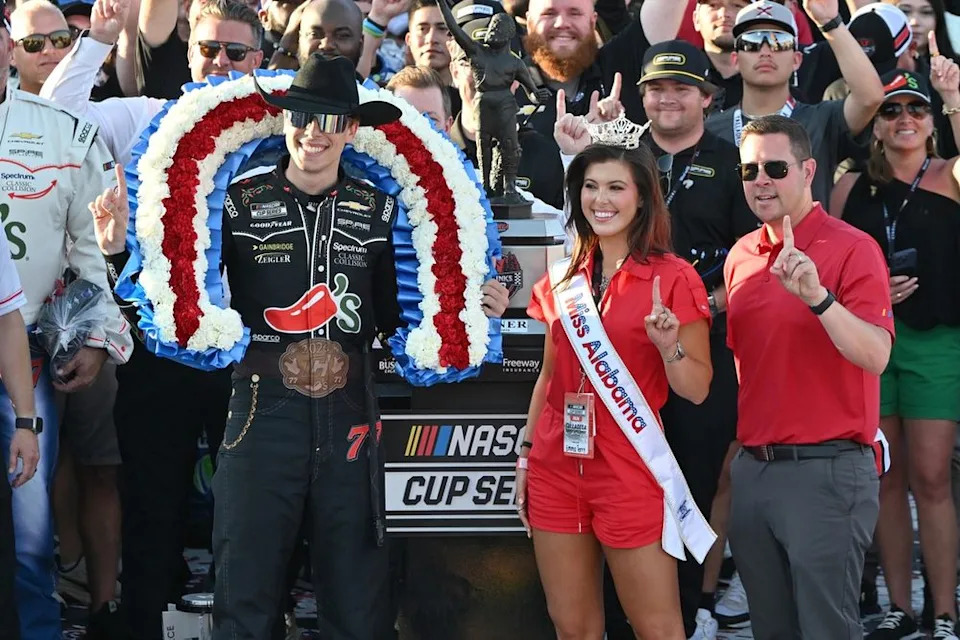
Carson Hocevar’s arrival as a NASCAR Cup Series winner was not gradual—it was emphatic, emotional, and unmistakably bold. On April 26, 2026, at the iconic Talladega Superspeedway, the 23-year-old driver captured his first career Cup victory in dramatic fashion, outdueling Chris Buescher on the final lap of the Jack Link’s 500.
In his 91st career start, Hocevar demonstrated the composure and aggression that have defined his rapid rise. With assistance from Alex Bowman’s drafting push, he surged ahead in the closing moments, crossing the finish line just ahead of Buescher in a race that epitomized the unpredictability of superspeedway racing.
This victory was not just a milestone—it was a statement.
The Making of a Contender
Hocevar’s journey to this moment reflects a blend of raw talent, calculated risk-taking, and persistence. Driving the No. 77 Chevrolet for Spire Motorsports, he had already built a reputation as a fearless competitor willing to challenge established veterans.
That edge has not always been universally welcomed in the NASCAR garage. Hocevar’s aggressive style has occasionally drawn criticism, but it has also marked him as a driver unafraid of high-pressure situations—an essential trait at tracks like Talladega, where split-second decisions define outcomes.
His Talladega performance reinforced that identity. Leading 19 of the race’s 188 laps, Hocevar was not merely opportunistic—he was consistently competitive throughout the event.
“I knew we were going to win. I really did,” Hocevar said after the race, underscoring a level of confidence uncommon for a first-time Cup winner.
Emotion Behind the Victory
Beyond the statistics and strategy, the victory carried deep personal significance. After taking the checkered flag, Hocevar celebrated in unconventional style—sitting on the window frame of his car, waving to fans, and later climbing onto the roof after a burnout.
But the most poignant moment came during his post-race interview.
“I’m just so thankful. This is the biggest dream I’ve ever thought of. … Hopefully my grandpa’s watching. My grandma died last year, so I’m so thankful that I can give my grandpa a trophy now.”
In a sport often defined by speed and spectacle, this emotional tribute grounded the victory in something more enduring: family and personal motivation.
A Race Defined by Chaos and Opportunity
Talladega’s reputation for unpredictability was on full display. The race’s defining moment came during Stage Two, when Bubba Wallace—leading at the time—was spun after contact from Ross Chastain. The incident triggered “The Big One,” a massive wreck involving at least 26 cars, including top contenders like Joey Logano, Ryan Blaney, and Kyle Larson.
Such incidents often reshape the competitive landscape, eliminating frontrunners and opening the door for emerging drivers. Hocevar capitalized on that opportunity, navigating the chaos with precision while others faltered.
The race also highlighted ongoing challenges in superspeedway racing, including the tension between fuel-saving strategies and aggressive pack racing. As Joey Logano noted, drivers are often forced to choose between conserving fuel and risking crashes—an issue that continues to influence race dynamics.
The Significance for Spire Motorsports
Hocevar’s win carried broader implications beyond individual achievement. It marked only the second victory in the history of Spire Motorsports, following Justin Haley’s win at Daytona in 2019.
For a smaller team competing against NASCAR’s powerhouse organizations, such victories are transformative. They validate long-term investment, attract sponsorship interest, and elevate the team’s competitive credibility.
Hocevar’s breakthrough positions Spire Motorsports as more than just a participant—it signals their potential to contend.
Impact on the Championship Landscape
The timing of the victory could prove pivotal. With 16 races remaining before the playoffs, Hocevar’s win propelled him into eighth place in the standings, significantly strengthening his position in the championship race.
Meanwhile, Tyler Reddick continues to lead the points standings after 10 races, holding a substantial advantage over competitors like Denny Hamlin and Ryan Blaney.
In this context, Hocevar’s victory is not an isolated success—it is a strategic leap forward in a tightly contested season.
A New Generation Emerges
Hocevar’s triumph is part of a broader trend within NASCAR: the rise of a new generation of drivers challenging established stars. He became the second first-time winner of the season, joining Ty Gibbs, signaling a shift in the competitive hierarchy.
This generational transition reflects evolving dynamics within the sport, where younger drivers bring fresh approaches to racecraft, risk management, and team collaboration.
Hocevar embodies this shift—combining technical skill with an instinctive understanding of high-speed racing scenarios.
Future Prospects: What Lies Ahead?
1. Playoff Contention and Consistency
The immediate challenge for Hocevar is sustaining performance. A single victory guarantees playoff eligibility, but advancing deep into the postseason requires consistency across diverse track types.
His ability to translate superspeedway success into intermediate and short-track performance will be critical.
2. Managing Aggression vs. Strategy
Hocevar’s aggressive driving style is both an asset and a potential liability. As he gains experience, refining that approach—balancing risk with strategic discipline—will determine his long-term success.
Veteran drivers often evolve in this regard, and Hocevar’s trajectory suggests he has the capacity to do the same.
3. Team Development and Resources
Spire Motorsports’ growth will play a significant role in Hocevar’s future. Increased investment, improved engineering support, and stronger partnerships could elevate the team’s competitiveness across the calendar.
A rising driver paired with an ascending team creates a powerful synergy.
4. Marketability and Fan Engagement
Hocevar’s personality—evident in his unconventional celebration and candid interviews—positions him as a marketable figure within NASCAR. In an era where fan engagement is crucial, such authenticity can translate into broader popularity and commercial opportunities.
Conclusion: A Defining Chapter Begins
Carson Hocevar’s victory at Talladega is more than a first win—it is a defining chapter in a career that appears poised for significant growth.
From his fearless racing style to his emotional connection with fans and family, Hocevar represents the evolving face of NASCAR. His journey illustrates how talent, resilience, and opportunity converge in motorsport’s most unpredictable moments.
As the 2026 season progresses, the question is no longer whether Hocevar can win—it is how far he can go.


