


Bieber at Coachella 2026: A Headline Set That Divided the Desert
A Festival Moment That Sparked Debate
When Justin Bieber stepped onto the Coachella main stage in April 2026, expectations were calibrated at a historic high. The global pop icon, reportedly commanding a record $10 million fee for his headline appearance, was positioned as one of the defining acts of the festival’s 25th edition.
- A Festival Moment That Sparked Debate
- The Performance: Minimalism Meets Nostalgia
- Viral Reaction: “Unprofessional” or Intentional?
- A Contrast in Styles: Bieber vs. Coachella Spectacle
- The Cultural Layer: Beyond Performance
- Artistic Intent vs. Audience Expectation
- What It Means for Coachella—and Bieber
- Conclusion: A Defining—but Divisive—Moment
Instead, what unfolded became one of the most debated performances of the weekend—an unconventional set that split audiences between admiration and criticism.
This was not a typical Coachella spectacle. It was something quieter, stranger, and ultimately more polarizing.
The Performance: Minimalism Meets Nostalgia
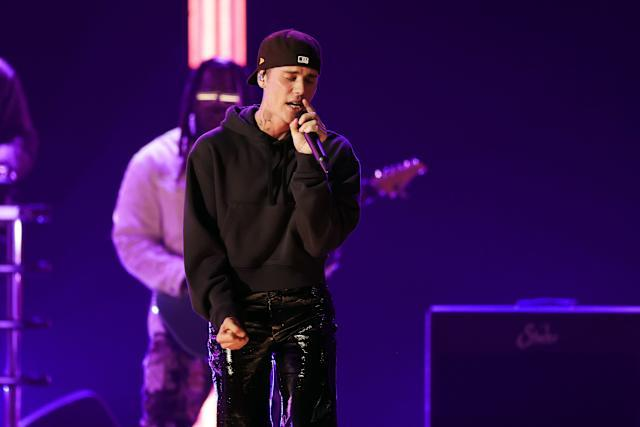
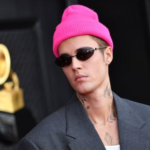
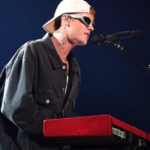
Bieber’s set leaned heavily into a stripped-back format. Dressed casually in a hoodie and shorts, he sat on a stool with a laptop, navigating his own catalog through YouTube while performing live vocals over the tracks.
The staging was intentionally minimal:


- No elaborate choreography
- No large ensemble of dancers
- No complex visual production
- Limited costume changes
Instead, the centerpiece of the performance became the music itself—and Bieber’s relationship with it.
At one point, he told the audience:
“Tonight is such a special night, but I feel like we gotta take you guys on a bit of a journey.”
That “journey” took fans through his evolution, blending newer material from SWAG and SWAG II with early hits like “Baby,” “Favorite Girl,” and “Beauty and a Beat.”
A particularly striking moment came when Bieber revisited his early YouTube videos—the same platform that launched his career at age 12—projecting them on the big screen while performing alongside his younger self.
For some, it was deeply reflective. For others, it felt underwhelming.
Viral Reaction: “Unprofessional” or Intentional?
The response online was immediate and sharply divided.
Critics argued the performance lacked effort and production value, especially given Bieber’s reported fee. Some fans described it as “unprofessional,” pointing to the reliance on pre-existing YouTube videos and minimal stage engagement.
Others framed it differently.
Supporters saw the set as a deliberate artistic choice—a rejection of spectacle in favor of authenticity. They interpreted the laptop segment not as laziness, but as a conceptual device highlighting Bieber’s long career and digital-era origins.
One perspective that gained traction described the performance as:
- A “full-circle moment”
- A reflection on fame and personal growth
- A more sustainable, less physically demanding stage format
This divide underscored a broader question: What do audiences expect from modern headline performances?
A Contrast in Styles: Bieber vs. Coachella Spectacle
The reaction to Bieber’s set was amplified by comparisons to other headliners, particularly Sabrina Carpenter.
Carpenter’s performance was described as a “five-act theatrical production,” complete with:
- Multiple costume changes
- Cinematic visuals
- Guest appearances
- Large-scale choreography
Against this backdrop, Bieber’s minimalist approach appeared even more unconventional.
The contrast sparked wider cultural discussions, including debates about:
- Gender expectations in performance standards
- The pressure on artists to deliver spectacle
- Whether simplicity can compete with high-production shows
The Cultural Layer: Beyond Performance
Bieber’s Coachella appearance wasn’t just about music—it became a cultural flashpoint.
Elsewhere during the festival, his presence intersected with broader global trends. A surprise appearance alongside Wizkid and Tems highlighted the growing influence of Afrobeats on global pop culture, reinforcing Coachella’s role as a platform for cross-cultural collaboration.
Meanwhile, other acts—from The Strokes humorously acknowledging their slot before Bieber to Karol G delivering a high-energy, culturally rich headline performance—added layers to the festival narrative.
In that context, Bieber’s set stood out not for scale, but for its deviation from it.
Artistic Intent vs. Audience Expectation
At its core, the Bieber Coachella moment reflects a tension shaping the modern music industry:
1. Spectacle vs. Authenticity
Large-scale productions dominate major festivals, but artists increasingly experiment with stripped-down formats to signal artistic sincerity.
2. Nostalgia as Strategy
Bieber’s use of early YouTube footage tapped into a powerful emotional trigger—reminding audiences of his rise from teenage internet sensation to global superstar.
3. The Economics of Headliners
With headline fees reaching eight figures, audiences often equate cost with production value, raising expectations for visual and technical complexity.
4. Digital Culture on Stage
By literally navigating YouTube during his set, Bieber blurred the line between live performance and digital consumption—an approach that reflects how music is experienced in 2026.
What It Means for Coachella—and Bieber
Coachella 2026 reaffirmed its status as a cultural epicenter, but Bieber’s performance may be remembered as one of its most debated moments.
For Bieber, the implications are nuanced:
- He demonstrated creative autonomy
- He challenged conventional performance norms
- He risked alienating part of his audience
With a second weekend performance scheduled, anticipation remains high. Whether he adjusts his approach or doubles down on the concept will likely shape the longer-term narrative.
Conclusion: A Defining—but Divisive—Moment
Justin Bieber’s Coachella 2026 set did not aim to impress in traditional ways. It avoided spectacle, reduced scale, and leaned into introspection.
That decision produced a rare outcome: a performance that became as much about conversation as it was about music.
In an era dominated by visual excess, Bieber’s minimalist headline set forced a reconsideration of what a live performance should be—and whether authenticity can compete with expectation on the world’s biggest stages.