





Amad Diallo at the Center of a Premier League Storm
A match incident that reignited debates about consistency, VAR thresholds, and modern officiating
- Introduction: A Moment Bigger Than One Decision
- The Incident: What Happened at the Vitality Stadium
- The Official Verdict: A Split Decision
- Carrick’s Frustration: The Consistency Argument
- The VAR Question: Threshold vs. Interpretation
- Amad Diallo’s Rising Influence—and Scrutiny
- A Game of Margins: How One Call Changed the Narrative
- The Bigger Debate: Consistency vs. Subjectivity
- What Comes Next: Implications for the Season
- Conclusion: A Defining Snapshot of Modern Football
Introduction: A Moment Bigger Than One Decision
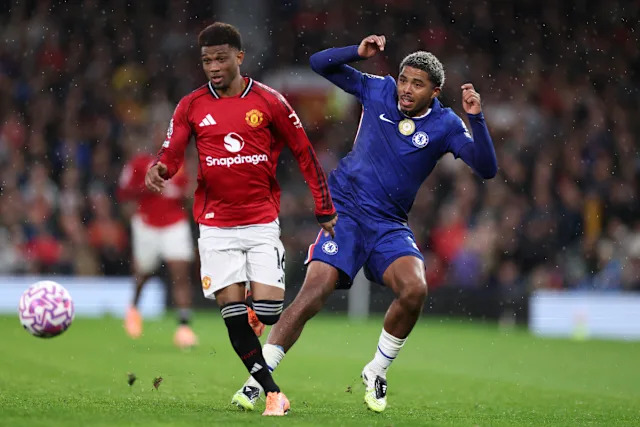
When Amad Diallo went to ground inside the penalty area during Manchester United’s tense clash with AFC Bournemouth, it looked—at least to many watching—as straightforward as it gets. Two hands on the attacker, contact in the box, a player falling under pressure.
Yet the referee waved play on.
Within seconds, the game flipped. Bournemouth surged forward and scored. What might have been a decisive 2–0 lead for Manchester United turned into a level contest—and eventually, a 2–2 draw.



Days later, the incident is no longer just about a single call. It has become a focal point for wider concerns about refereeing consistency, VAR interpretation, and the evolving nature of football decision-making at the highest level.


The Incident: What Happened at the Vitality Stadium
The sequence itself was straightforward. Diallo, advancing into the penalty area, appeared to be impeded by Bournemouth defender Adrien Truffert. The contact involved both hands—enough to prompt immediate appeals from United players.
Referee Stuart Attwell declined to award a penalty. VAR official Craig Pawson reviewed the moment but chose not to intervene.
What followed was decisive. Bournemouth transitioned quickly and equalized through Ryan Christie in the 67th minute, dramatically altering the trajectory of the match.
The controversy lay not just in the decision itself, but in its timing. Football often hinges on fine margins, and here, a single judgment call directly preceded a goal at the other end.



The Official Verdict: A Split Decision
The Premier League’s Key Match Incidents (KMI) Panel later reviewed the incident. Their conclusion was nuanced—and far from unanimous.
- The panel voted 3–2 against awarding a penalty
- Their reasoning: the contact was “not impactful” and fell below the threshold for a foul
- However, two members disagreed, describing the action as “non-footballing” and worthy of a penalty
Critically, the panel unanimously supported VAR’s decision not to intervene, emphasizing the “high threshold” required to overturn an on-field call.
This dual-layered outcome—split on the foul, unified on VAR—captures the modern tension in officiating: subjective interpretation on the pitch versus procedural consistency in review.
Carrick’s Frustration: The Consistency Argument
For United, the issue was not isolated to one moment. It was about consistency within the same match.
Manager Michael Carrick expressed clear frustration:
“So the Cunha one, he gives, the second one on Amad he doesn’t… it’s crazy. It’s as obvious as you can get.”
Earlier in the game, United had been awarded a penalty for a similar holding offense. To Carrick and others, the inconsistency was difficult to reconcile.
From a coaching perspective, such inconsistencies undermine tactical predictability. Teams adapt to refereeing standards during a match; when those standards shift, it introduces uncertainty that can directly affect outcomes.
The VAR Question: Threshold vs. Interpretation
The incident highlights a critical aspect of modern football: the VAR intervention threshold.
VAR is not designed to re-referee games. Instead, it intervenes only in cases of “clear and obvious error.” In this case, even though some panel members believed a penalty should have been awarded, the lack of consensus reinforced VAR’s non-intervention.
This creates a paradox:
- A decision can be debatable or even incorrect
- Yet still not meet the threshold for VAR correction
The result is a system that prioritizes procedural consistency over absolute accuracy—an approach that continues to divide opinion among players, managers, and fans.
Amad Diallo’s Rising Influence—and Scrutiny
For Diallo himself, the moment reflects his growing importance within Manchester United’s attacking structure.
Still in the early phases of establishing himself as a consistent starter, the Ivorian winger has increasingly become a focal point in high-pressure situations. His ability to draw defenders, attack space, and influence key moments places him directly under the spotlight.
Incidents like this—where he is at the center of contentious decisions—are often a byproduct of that evolution. As attacking responsibility increases, so does scrutiny.
A Game of Margins: How One Call Changed the Narrative
The broader impact of the incident is best understood in terms of match dynamics.
- Scenario A: Penalty awarded → potential 2–0 lead → game likely controlled
- Scenario B: No penalty → immediate counterattack → Bournemouth equalize
Football outcomes often hinge on such binary moments. The absence of a penalty did not just deny United a scoring opportunity—it actively contributed to a shift in momentum.
In elite competitions like the Premier League, where margins are razor-thin, these swings can define seasons.
The Bigger Debate: Consistency vs. Subjectivity
At its core, this controversy feeds into a long-standing debate:
Can football officiating ever be truly consistent?
The KMI Panel explicitly stated that it evaluates incidents individually, rather than comparing them within the same match.
This approach, while methodologically sound, clashes with how players and managers experience games in real time. For them, consistency is not theoretical—it is contextual.
The result is an enduring friction between:
- Institutional logic (case-by-case analysis)
- Competitive logic (within-match consistency)
What Comes Next: Implications for the Season
Manchester United reportedly considered raising concerns with refereeing authorities, not necessarily to overturn the decision, but to address perceived inconsistencies.
For Diallo, the focus will shift back to performance. However, moments like this tend to linger—especially when they influence match outcomes.
For the Premier League, the incident reinforces ongoing challenges:
- Maintaining trust in VAR processes
- Ensuring clarity in officiating standards
- Balancing human judgment with technological oversight
Conclusion: A Defining Snapshot of Modern Football
The Amad Diallo penalty controversy is not just about one decision. It encapsulates the complexities of modern football:
- The fine margins that decide matches
- The evolving role of VAR
- The persistent challenge of consistency
In isolation, it is a debatable call. In context, it is a case study in how the game is officiated today.
As the season progresses, similar moments will inevitably arise. The question is not whether controversy will occur—but whether the system governing those decisions can keep pace with the expectations of players, managers, and fans.