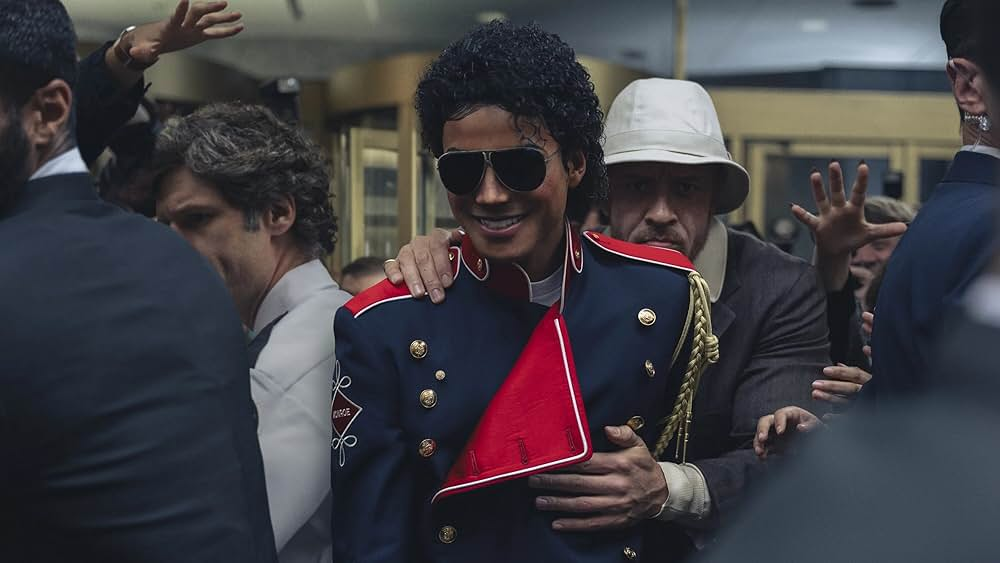
A Story of Legacy, Pressure, and Transformation
In the world of entertainment, few names carry as much weight as “Jackson.” For Jaafar Jackson, that name is not just a symbol of global fame—it is a deeply personal inheritance. Now, with his breakout role portraying his uncle Michael Jackson in the highly anticipated biopic “Michael,” Jaafar stands at a defining crossroads: balancing legacy with individuality, and expectation with ambition.
This is not simply a story about a young actor landing a major role. It is a narrative shaped by family history, artistic discipline, and the immense challenge of bringing one of the most iconic figures in music history back to life.

Growing Up Inside a Cultural Dynasty
Jaafar Jackson was born in Los Angeles in 1996, into one of the most influential families in entertainment history. He is the son of Jermaine Jackson—founding member of the Jackson 5—and fashion designer Alejandra Genevieve Oaziaza.
This lineage places him directly within the orbit of Michael Jackson, not as an outsider looking in, but as someone who experienced the legend as family. He has recalled those early years with a sense of normalcy often absent from public perception:
“I remember just growing up… we’d have family time… It was all fun.”
Those moments—watching movies, spending time together—provided Jaafar with a unique emotional connection to Michael Jackson, one that would later become critical in shaping his portrayal.
From Music Aspirations to a Defining Opportunity
Before stepping into Hollywood’s spotlight, Jaafar’s career followed a quieter trajectory. He explored music, releasing his debut single “Got Me Singing” in 2019 and participating in projects such as The Jacksons: Next Generation and music videos with family members.
Financially and professionally, he remained in the early stages of his career, with an estimated net worth of around $500,000—modest by industry standards but reflective of a developing artist.
That changed dramatically when he was cast as Michael Jackson in “Michael,” a role that followed a global search. Producer Graham King reportedly concluded that “it was clear that he is the only person to take on this role.”
The decision was rooted not just in resemblance, but in authenticity—something only a family member could plausibly deliver.
Preparing to Become Michael Jackson
Taking on the role of Michael Jackson is unlike any conventional acting challenge. It requires replicating not just physical traits, but an entire cultural phenomenon—voice, movement, emotion, and presence.
Jaafar approached this transformation with rigorous discipline. Over two years, he immersed himself in study and physical training, pushing his limits to replicate the King of Pop’s iconic style:
- He rehearsed dance routines for hours daily, sometimes until “my feet would bleed or would go numb.”
- He studied Michael’s speech patterns, practicing tone and cadence by reading aloud in his voice.
His approach extended to vocal performance as well. Rather than relying solely on pre-recorded tracks, Jaafar blended his own voice with Michael’s:
“When I was doing all the performances, I was actually singing out live in the microphone on top of Michael’s track. So it’s a blend of my vocal and Michael’s.”
In some scenes, the voice heard is entirely his:
“It’s actually me singing, the a cappellas, which was really fun to do.”
This combination of technical precision and emotional authenticity is central to the film’s portrayal.
The Film: Capturing a Cultural Phenomenon
Directed by Antoine Fuqua and written by John Logan, “Michael” is not a traditional cradle-to-grave biopic. Instead, it focuses on the artist at his peak—highlighting the music, the performances, and the cultural impact that defined an era.
The film premiered in Berlin, a city known for its passionate Michael Jackson fan base—a strategic decision signaling its global ambitions.
From the opening sequence, the film immerses audiences in Jackson’s world, launching with “Wanna Be Startin’ Something” and recreating the electrifying energy of his live performances.
Rather than smoothing over complexity, the film explores:
- The intense discipline of his childhood in Gary, Indiana
- The demanding influence of his father, Joseph Jackson
- The evolution of his artistry during the Bad era
Colman Domingo’s portrayal of Joseph Jackson adds depth to this dynamic, presenting a figure defined by control and ambition rather than caricature.
Jaafar Jackson’s Performance: Between Imitation and Embodiment
The success of “Michael” hinges largely on Jaafar’s performance—and early reactions suggest he has achieved something rare.
There are moments, observers note, when the distinction between actor and subject fades entirely:
There are moments when you stop thinking about who’s playing the role and just see Michael.
This ability to transcend imitation is perhaps Jaafar’s greatest achievement. His connection to the role allows him to move beyond surface-level mimicry and tap into something more intuitive.
Even within his own family, the reaction has been powerful. His grandmother, Katherine Jackson, offered what he considers the highest praise:
She said how excellent I did and how much I embody Michael… there were moments she couldn’t tell if it was me or Michael.
Industry Expectations and the Oscar Question
Biopics about music legends have historically been fertile ground for awards recognition. Performances portraying figures like Ray Charles, Freddie Mercury, and Elvis Presley have frequently earned Academy Award nominations.
Jaafar Jackson now enters that same conversation.
However, the odds remain complex. First-time actors rarely secure leading Oscar nominations, especially in roles of this magnitude. Yet, the commercial success expected for “Michael” could elevate his chances significantly.
Even without awards recognition, the film positions him as a major new figure in Hollywood—one whose future extends far beyond a single role.
Legacy, Responsibility, and Cultural Impact
What sets Jaafar Jackson apart is not just his talent, but the weight of responsibility he carries. Portraying Michael Jackson is not merely a performance—it is an act of cultural preservation.
The film itself reinforces Michael Jackson’s enduring influence:
- His role in breaking racial barriers on MTV
- The global impact of Thriller, still the most iconic music video in history
- His ability to unite audiences across cultures and generations
In a time marked by division and uncertainty, the film serves as a reminder of music’s power to connect people.
A Career on the Brink of Transformation
For Jaafar Jackson, “Michael” is more than a debut—it is a pivot point.
Before the film, he was an emerging artist navigating the early stages of a creative career. After it, he stands poised to become a global figure in entertainment.
The trajectory is clear:
- Increased visibility in Hollywood
- Potential expansion into music and production
- Significant growth in financial and cultural influence
As industry observers note, his current position is not a peak—but a starting line.
Conclusion: Defining a New Chapter in a Legendary Story
Jaafar Jackson’s journey reflects a rare convergence of heritage and ambition. Few actors are tasked with portraying someone they knew personally—fewer still must do so under the scrutiny of a global audience.
Yet, by combining disciplined preparation, emotional authenticity, and a deep personal connection, he has stepped into one of the most challenging roles in modern cinema with remarkable confidence.
The story of Jaafar Jackson is no longer just about lineage. It is about emergence—an artist stepping out of a legendary shadow and beginning to define his own place within it.