

Madhya Pradesh: A Region Driving Change in Public Healthcare Innovation
Introduction: Understanding “प्रदेश” Through a Real-World Lens
The term “प्रदेश” (Pradesh), commonly used in India, refers to a state or region—an administrative and cultural unit that plays a crucial role in governance, development, and public welfare. Among India’s many states, Madhya Pradesh stands out not only for its geographical centrality but increasingly for its evolving role in healthcare innovation.
Recent developments from the state highlight how regional institutions can drive meaningful change, particularly in public healthcare systems that serve vast and diverse populations.
A Landmark Medical Achievement in Madhya Pradesh
In a significant advancement for public healthcare, doctors at Netaji Subhash Chandra Bose Medical College Hospital in Jabalpur performed a pioneering breast reconstruction surgery. This procedure marks the first time such a technique has been successfully executed in a government hospital within Madhya Pradesh.
The surgery involved reconstructing a breast for a 45-year-old woman who had undergone a mastectomy due to advanced-stage breast cancer. Instead of using expensive implants, doctors used the patient’s own abdominal fat and skin tissue—an approach that is both cost-effective and medically sophisticated.
Why This Matters: Healthcare Accessibility in Indian States
प्रदेश-level developments like this are critical because:
- Public hospitals serve the majority of the population, especially in semi-urban and rural regions.
- Advanced procedures are often limited to private hospitals due to cost and expertise.
- Innovations in government institutions can democratize access to quality healthcare.
Dr. Sanjay Yadav, a breast cancer specialist involved in the procedure, emphasized a key challenge:
“In India, most cases of breast cancer are detected when the cancer is in its advanced stages.”
This reality makes reconstructive surgery not just a cosmetic procedure, but a vital component of psychological and emotional recovery.
The Science Behind the Surgery
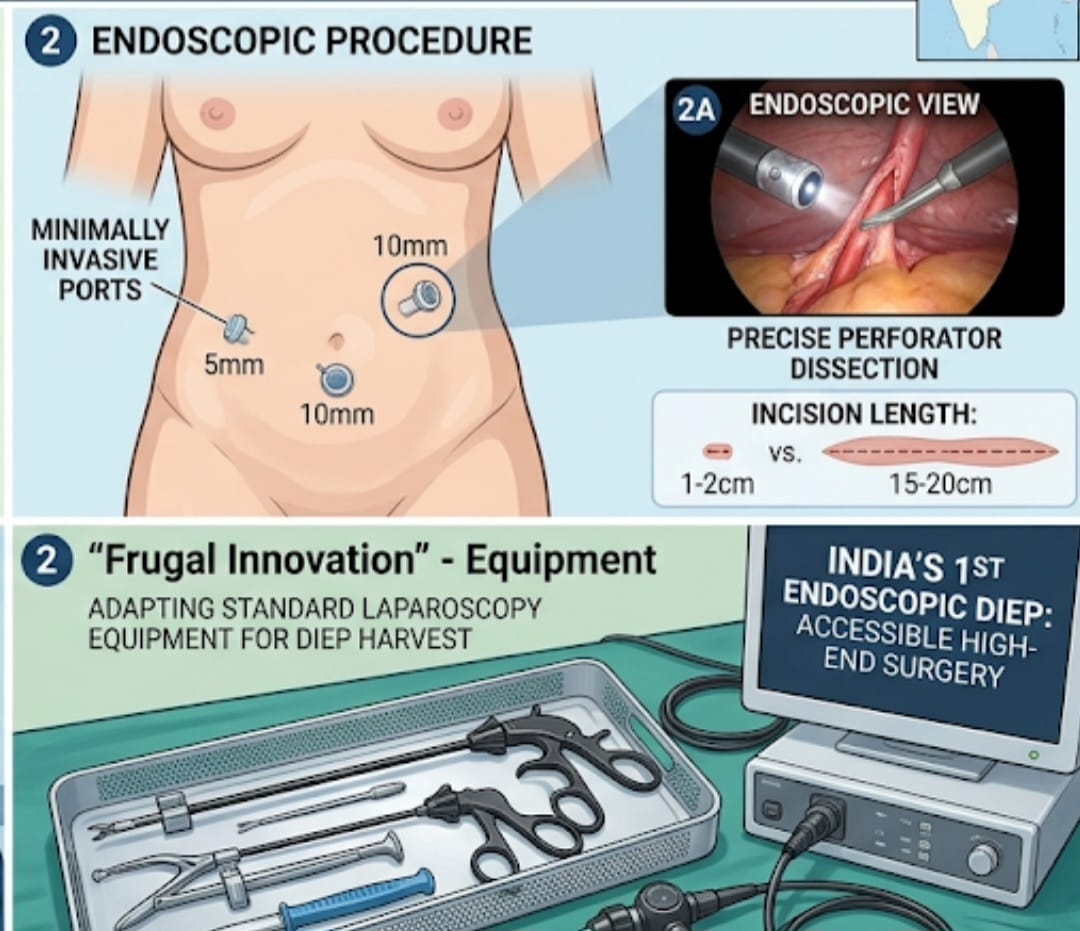
The procedure carried out in Jabalpur used a technique where:
- Fat tissue and skin were extracted from the lower abdomen.
- Endoscopic (minimally invasive) methods were used to reduce pain and recovery time.
- The extracted tissue was grafted onto the chest to reconstruct the breast.
Plastic surgery specialist Dr. Pawan Agrawal explained:
“We used fat tissue and skin from the lower abdomen and attached it to the breast through surgery… due to the use of endoscopy, the patient experienced less discomfort and faster healing.”
This approach is widely recognized internationally but remains underutilized in India due to limited awareness and training.
The Institutional Backbone: A Regional Medical Hub
Netaji Subhash Chandra Bose Medical College is one of the largest medical institutions in Madhya Pradesh, admitting approximately 250 MBBS students annually. It serves not only Jabalpur but also surrounding regions like Mahakaushal and Vindhya.
The institution is notable for:
- Conducting innovative medical research
- Publishing findings in scientific journals
- Filing patents for new techniques
Such regional centers are increasingly becoming engines of innovation within India’s healthcare ecosystem.
Cost, Accessibility, and Patient Impact
One of the most compelling aspects of this surgery is its affordability.
Dr. Yadav noted:
“This surgery is not very expensive, because it uses the body’s own tissues… in foreign countries it is very costly.”
This has profound implications:
- Patients who cannot afford implants now have viable alternatives.
- Recovery is often more natural and less invasive.
- Psychological outcomes improve as patients regain body confidence.
Broader Implications for “प्रदेश” Development
This case highlights a larger narrative about how Indian states—or “प्रदेश”—are evolving:
1. Decentralization of Innovation
Healthcare advancements are no longer confined to metropolitan cities.
2. Strengthening Public Infrastructure
Government hospitals are increasingly capable of handling complex procedures.
3. Regional Expertise Development
Local medical teams are building specialized skills that reduce dependence on external institutions.
4. Improved Quality of Life
Patients benefit from affordable, accessible, and advanced treatments within their own region.
What Comes Next?
The success of this surgery is not a one-off event. The medical team has already planned another similar procedure within a week, signaling confidence and scalability.
Looking ahead, several trends are likely:
- Increased adoption of reconstructive techniques in public hospitals
- Greater awareness among patients about post-cancer recovery options
- Expansion of training programs for surgeons in advanced procedures
- Policy support for integrating such treatments into standard care protocols
Conclusion: Redefining the Role of a “प्रदेश”
The story emerging from Madhya Pradesh demonstrates that a “प्रदेश” is more than just an administrative boundary—it is a dynamic ecosystem capable of driving innovation, improving lives, and setting benchmarks for others.
As regional institutions continue to evolve, they are reshaping the narrative of public healthcare in India—making it more inclusive, advanced, and patient-centered.


