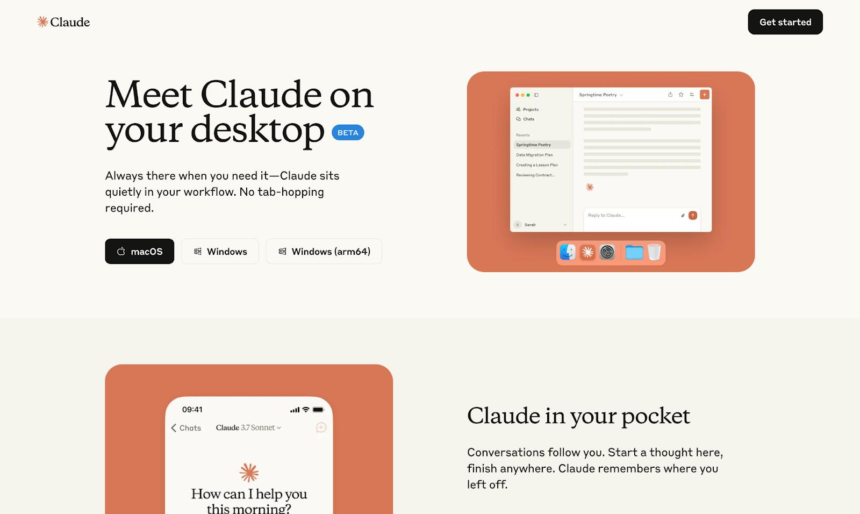
Claude AI: From Conversational Assistant to Full Creative Engine
The evolution of artificial intelligence has followed a clear trajectory: from rigid automation to adaptive conversation, and now toward creative collaboration. At the center of this shift is Anthropic’s flagship system, Claude AI—a platform that is no longer confined to text generation but is increasingly positioned as a comprehensive creative and productivity tool.
- The Expansion of Claude AI: Beyond Text and Code
- Claude Design: Redefining Creative Workflows
- Integration with Existing Ecosystems
- Accelerating Prototyping and Product Development
- Real-Time Collaboration and Team Productivity
- Emotional Intelligence: Perception vs Reality
- The Black Box Problem: Understanding Claude
- From Clippy to Claude: A Historical Perspective
- Broader Implications for Business and Society
- What Comes Next for Claude AI?
- Conclusion: A Structural Shift in AI Utility
Recent developments, particularly the introduction of Claude Design, signal a structural shift in how AI integrates into workflows. Rather than assisting at the margins, Claude is now embedded directly into the core of design, product development, and business communication processes.
The Expansion of Claude AI: Beyond Text and Code
Claude AI initially gained recognition as a conversational model capable of generating text, assisting with coding, and handling complex reasoning tasks. However, the latest update—Claude Design—marks a deliberate expansion into visual creation and prototyping.


Claude Design enables users to collaborate with AI to produce:
- Visual designs and marketing assets
- Interactive prototypes
- Presentation decks
- Product workflows and wireframes
This transition reflects a broader industry movement: AI is shifting from being a passive tool to an active collaborator capable of executing end-to-end workflows.


The system is powered by the advanced Claude Opus 4.7 vision model, allowing it to interpret, generate, and refine visual outputs in a conversational environment.
Claude Design: Redefining Creative Workflows
At its core, Claude Design addresses a longstanding bottleneck in creative industries—limited exploration time.
Traditional workflows force designers to narrow ideas early. Non-designers, meanwhile, often struggle to convert abstract concepts into tangible outputs. Claude Design attempts to eliminate both constraints.
Key Capabilities
- Prompt-to-design generation: Users can describe an idea and receive a visual output instantly
- Iterative refinement: Designs evolve through conversation, not static revisions
- Inline editing and controls: Adjustments can be made directly within the workflow
- Multi-format input support: DOCX, PPTX, XLSX, and codebases can all be used as inputs
The system also includes a web capture tool, allowing users to pull elements from live websites and incorporate them into prototypes, improving realism and usability testing.


Integration with Existing Ecosystems
Claude Design is not designed as a standalone tool. Instead, it integrates directly into existing workflows.
Outputs can be exported in multiple formats:
- Canva-compatible files
- PDF and PPTX
- Standalone HTML
This integration is reinforced through collaboration with Canva, as explained by Melanie Perkins:
“We’ve loved collaborating with Anthropic over the past couple of years and share a deep focus on making complex things simple. At Canva, our mission has always been to empower the world to design, and that means bringing Canva to wherever ideas begin. We’re excited to build on our collaboration with Claude, making it seamless for people to bring ideas and drafts from Claude Design into Canva, where they instantly become fully editable and collaborative designs ready to refine, share, and publish.”
This interoperability ensures that AI-generated content can move directly into production environments without friction.
Accelerating Prototyping and Product Development
One of Claude Design’s most significant impacts is in product development.
Designers can convert static mockups into interactive prototypes without engineering involvement. This reduces dependency on technical teams during early-stage experimentation.
Olivia Xu from Brilliant described the impact:
“Brilliant’s intricate interactivity and animations are historically painful to prototype, but Claude Design’s ability to turn static designs into interactive prototypes has been a step change for us. Our most complex pages, which took 20+ prompts to recreate in other tools, only required 2 prompts in Claude Design. Including design intent in Claude Code handoffs has made the jump from prototype to production seamless.”
The implication is clear: AI is compressing multi-stage workflows into a single interactive process.
Real-Time Collaboration and Team Productivity
Claude Design introduces collaborative features typically found in modern productivity tools:
- Organization-wide sharing
- Access control (private/public)
- Real-time co-editing
- Group conversations with AI participation
This positions Claude not just as a tool, but as a shared workspace participant.
Aneesh Kethini from Datadog highlighted the efficiency gains:
“Claude Design has made prototyping dramatically faster for our team, enabling live design during conversations. We’ve gone from a rough idea to a working prototype before anyone leaves the room, and the output stays true to our brand and design guidelines. What used to take a week of back-and-forth between briefs, mockups, and review rounds now happens in a single conversation.”
This reflects a broader transformation: AI is reducing iteration cycles from days to minutes.
Emotional Intelligence: Perception vs Reality
Claude AI is often perceived as empathetic or emotionally aware. However, this is a functional illusion rather than genuine emotion.
Anthropic explains that Claude uses “emotional concepts”—internal behavioral patterns that simulate appropriate responses. These are not feelings but structured response strategies.
As clarified:
- Claude recognizes emotional cues
- It selects response patterns that resemble human empathy
- It does not experience emotions
This distinction is critical for understanding how users interact with AI systems. The perception of emotional intelligence enhances usability, but the underlying mechanism remains computational.
The Black Box Problem: Understanding Claude
Despite its capabilities, even its creators acknowledge a significant limitation: incomplete understanding of how the system operates internally.
A statement attributed to Dario Amodei underscores this uncertainty:
“We do not understand how our own AI creations work…. This is unprecedented in the history of technology.”
This introduces a fundamental tension:
- AI systems are becoming more capable
- Their internal processes are less interpretable
The phenomenon is often described as the alignment problem, where systems may act effectively but not always in alignment with human intentions.
From Clippy to Claude: A Historical Perspective
The evolution of AI assistants highlights how far the technology has progressed.
Early systems like Microsoft’s Clippy attempted to make computing approachable but lacked contextual awareness and adaptability. Claude represents a different paradigm:
- Context-aware responses
- Multi-modal capabilities
- Continuous learning and adaptation
The contrast illustrates a shift from intrusive assistance to collaborative intelligence.
Broader Implications for Business and Society
Claude AI’s expansion into design and prototyping has implications across multiple sectors:
1. Design Democratization
Non-designers can now create professional-grade outputs, reducing dependency on specialized roles.
2. Workflow Compression
Processes that previously required multiple tools and teams are consolidated into a single interface.
3. Productivity Gains
Organizations can iterate faster, reducing time-to-market for products and campaigns.
4. Skill Transformation
The role of professionals shifts from execution to direction—guiding AI rather than performing tasks manually.
What Comes Next for Claude AI?
Anthropic has indicated plans to expand Claude Design’s integrations in the near term, connecting it with additional tools used by design and product teams.
Future developments are likely to include:
- Deeper integration with development environments
- Enhanced multimodal capabilities (voice, video, 3D)
- More autonomous workflow execution
- Improved interpretability and safety mechanisms
The trajectory suggests that Claude is evolving toward a general-purpose creative operating system, rather than a standalone assistant.
Conclusion: A Structural Shift in AI Utility
Claude AI represents a turning point in how artificial intelligence is applied in real-world workflows. The introduction of Claude Design moves AI from supportive functionality into active creation.
This shift is not incremental—it is structural.
By enabling real-time collaboration, accelerating prototyping, and bridging the gap between idea and execution, Claude is redefining productivity across industries.
At the same time, unresolved challenges—particularly around interpretability and alignment—remain central to its long-term impact.
The result is a dual reality: unprecedented capability paired with ongoing uncertainty. Navigating that balance will define the next phase of AI adoption.