


WWE WrestleMania 42 and Brock Lesnar: The Night the Beast Walked Away
A Defining Moment in WWE History
WWE WrestleMania 42 delivered spectacle, drama, and legacy-defining moments—but none resonated more deeply than the closing chapter of Brock Lesnar’s in-ring career.
On a night filled with championship clashes and headline-worthy performances, it was Lesnar’s quiet, symbolic exit that became the most talked-about development. After decades of dominance across WWE and combat sports, the “Beast Incarnate” appeared to signal his retirement in front of a global audience, leaving behind a moment that transcended wrestling itself.
The Match That Changed Everything
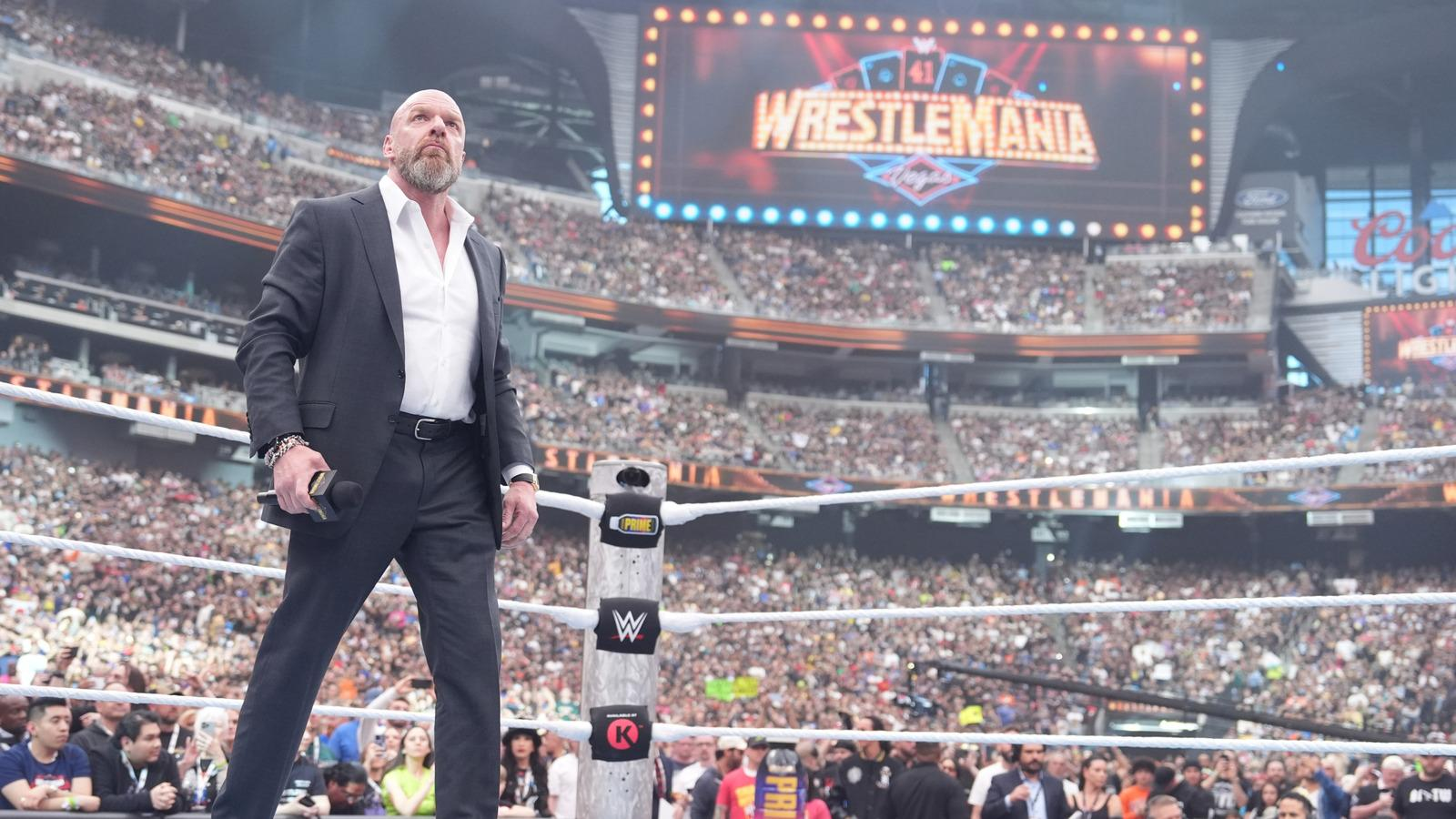
At WWE WrestleMania 42, held at Allegiant Stadium in Las Vegas, Lesnar faced rising powerhouse Oba Femi in a clash that symbolized more than just competition—it represented a generational shift.
The bout, which opened Night 2, was intense and physical from the outset. Lesnar showcased flashes of his trademark dominance, even landing his devastating F5. However, the narrative quickly shifted. Femi absorbed the punishment and responded with authority, executing a chokeslam followed by his finisher, Fall From Grace, to secure a decisive victory.
This was not just a loss—it was a statement.
A Symbolic Goodbye in the Ring
What followed the match carried far greater weight than the result itself.
Lesnar remained in the ring, visibly emotional. In a rare public display of vulnerability, he removed his gloves and boots and placed them in the center of the ring—a long-standing wrestling tradition that signals retirement.
He then embraced his longtime advocate, Paul Heyman, before walking away as the crowd chanted, “Thank you, Brock.”
For an athlete known for intensity and stoicism, the moment carried unmistakable finality.
Triple H’s Reaction: A Rare Insight
Following the event, WWE Chief Content Officer Triple H addressed the situation.
His remarks suggested that Lesnar’s decision was spontaneous rather than scripted:
- He indicated there was no prior discussion about retirement.
- He described Lesnar as someone who does not linger backstage or engage in lengthy post-match conversations.
- He emphasized that Lesnar’s instincts likely guided the decision in the moment.
Triple H also framed the defeat as a turning point:
“There comes a point in time when somebody comes along that’s bigger, badder and pushes you to a place you can’t come back from.”
In his assessment, Oba Femi represented that moment—a new force that signaled the end of Lesnar’s era.
The Emotional Ripple Across Wrestling
The aftermath extended beyond the ring. WWE legends, fans, and current stars all reacted to the apparent retirement.
Kurt Angle, one of Lesnar’s most iconic rivals, shared a heartfelt message:
“Love you, my brother… There will only be one like you. Enjoy retirement, Brock.”
Fans echoed similar sentiments online, describing Lesnar as a “once-in-a-generation competitor” whose impact reshaped the industry.
Meanwhile, Kofi Kingston interpreted the outcome differently—calling Femi’s victory a long-awaited “avenging” moment tied to Lesnar’s past dominance over WWE champions.
The Legacy of Brock Lesnar
Lesnar’s career stands apart in modern sports entertainment. Few athletes have bridged professional wrestling and legitimate combat sports with such authority.
Key aspects of his legacy include:
- Multiple-time world champion in WWE
- Former UFC Heavyweight Champion
- A crossover superstar with global recognition
- A reputation for redefining physical dominance in the ring
Triple H described him as:
“One of a kind — there was nobody like Brock Lesnar.”
Even his critics acknowledged his influence. Lesnar was often perceived as a “part-time” performer, yet his presence consistently elevated events and drew attention unmatched by most full-time talent.
Was This Really the End?
Despite the symbolism, uncertainty remains.
There had been speculation earlier in the year that Lesnar might have one final match—potentially against Gunther at SummerSlam 2026. Gunther himself hinted at interest in facing Lesnar, noting that he had been “doing his intel” and even referencing a favor owed by Paul Heyman.
This leaves open a critical question:
Was WrestleMania 42 truly the final chapter—or simply a dramatic pause?
Lesnar himself had previously indicated that his return to WWE was temporary:
“I’m the old guy now… I went back to work so I could feed my kids… I’m really grateful for all the opportunities.”
That perspective suggests he was already contemplating closure.
The Rise of Oba Femi
While much attention remains on Lesnar’s exit, the event simultaneously elevated Oba Femi.
Defeating a legend in such decisive fashion positions him as a central figure in WWE’s future. His performance was not just convincing—it was symbolic of a new era.
In wrestling, passing the torch is rarely subtle. This was one of the clearest examples in recent memory.
Cultural and Industry Impact
Lesnar’s apparent retirement carries implications beyond WWE:
- End of an era: One of the last crossover megastars exits the stage
- Shift in star power: WWE continues transitioning toward a new generation
- Narrative storytelling: The retirement angle reinforces WWE’s ability to blend reality and fiction
- Fan engagement: Moments like this sustain emotional investment in long-term storytelling
The wrestling industry thrives on these transitions. Legends depart, new icons rise, and the cycle continues.
Conclusion: A Quiet Exit, A Loud Legacy
WrestleMania 42 will be remembered for many reasons, but Brock Lesnar’s departure stands above them all.
There was no grand speech, no elaborate farewell—just a simple act: boots and gloves left behind in the ring.
Whether this proves to be a definitive retirement or a temporary goodbye, the moment itself is already etched into WWE history. Lesnar did not just compete—he redefined what dominance looked like in professional wrestling.
And if this truly was the end, it was fittingly done on the biggest stage of them all.


