NYT Connections: Inside the Daily Puzzle Redefining Word Games
A Modern Brain Teaser Built on Patterns, Not Vocabulary
The daily rise of word games has reshaped how people engage with language online, and NYT Connections sits at the center of that shift. Developed by The New York Times, the game moves beyond traditional word guessing and instead challenges players to identify relationships between words.
- A Modern Brain Teaser Built on Patterns, Not Vocabulary
- How the Game Works: Structure and Strategy
- April 20 Puzzle (#1044): A Case Study in Misdirection
- Why Connections Feels Harder Than It Looks
- The Expansion: Connections Sports Edition
- Cultural Impact: A Daily Ritual for Digital Audiences
- Strategic Approaches That Actually Work
- The Design Philosophy Behind Connections
- What Comes Next for NYT Connections
- Conclusion: A Puzzle That Rewards Precision
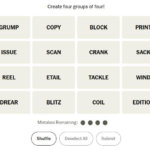
Unlike linear puzzles such as Wordle, Connections operates on association. Each day, players face a 4×4 grid containing 16 words. The objective is to group them into four categories of four words each, based on a shared theme. The challenge is deceptively simple: the themes are often subtle, overlapping, or intentionally misleading.
Connections is part of a broader ecosystem of daily puzzles that reset at midnight, creating a shared, time-bound experience for players globally.



How the Game Works: Structure and Strategy
At its core, Connections is about identifying hidden patterns under pressure.
The Rules That Define the Game
- Players are presented with 16 words in a grid
- They must form four groups of four related words
- Each group corresponds to a theme or category
- The puzzle uses a color-coded difficulty system:
- 🟨 Yellow – easiest
- 🟩 Green – moderate
- 🟦 Blue – harder
- 🟪 Purple – most complex
- Players are allowed four mistakes before the game ends
This structure creates a layered challenge. Solving one group reduces the remaining possibilities, but early mistakes can derail progress quickly.


April 20 Puzzle (#1044): A Case Study in Misdirection
The April 20 puzzle offers a clear example of how Connections balances accessibility with subtle complexity. While rated relatively easy (around 1.3/5 difficulty), it still includes traps designed to mislead players.
The Four Categories
- 🟨 Mass of smoke
BILLOW, CLOUD, PLUME, PUFF - 🟩 Fishing gear
BAIT, HOOK, NET, ROD - 🟦 Associated with black widow spiders
CANNIBALISM, HOURGLASS, VENOM, WEB - 🟪 ___ Monday
BLUE, CYBER, MANIC, MEATLESS
Where Players Get Trapped
One of the most common mistakes comes from false thematic grouping. Words like CLOUD, NET, WEB, and CYBER appear to form a logical “internet-related” category, but this is a deliberate distraction.
Similarly, the purple category relies on recognizing phrases—Cyber Monday, Blue Monday, Manic Monday, Meatless Monday—rather than direct semantic similarity. This makes it harder to identify without contextual recall.
Why Connections Feels Harder Than It Looks
Connections distinguishes itself by testing cognitive flexibility, not just vocabulary. Players must:


- Avoid surface-level associations
- Recognize multiple possible meanings
- Identify linguistic patterns and idioms
- Resist committing too early to a theme
This design leads to a common experience: a puzzle that seems obvious at first glance but becomes increasingly complex under scrutiny.
Even experienced players can make multiple incorrect guesses before finding the correct grouping order.
The Expansion: Connections Sports Edition
The success of the original game has already led to expansion. A notable variation is Connections: Sports Edition, developed in partnership with The Athletic.
This version maintains the same structure but focuses exclusively on sports-related terms. For April 20, the categories included:
- California baseball teams
- Shortened nicknames for Boston teams
- References to the “Miracle on Ice”
- World marathon majors
This adaptation demonstrates the game’s flexibility—it can be tailored to niche audiences while preserving its core mechanics.
Cultural Impact: A Daily Ritual for Digital Audiences
Connections is more than a game; it is part of a broader cultural phenomenon around daily puzzles. Like Wordle, it:
- Encourages routine engagement
- Promotes social sharing of results
- Builds communities around problem-solving
Players often compare strategies, discuss tricky categories, and share frustration over misleading word groupings. The limited number of daily attempts adds urgency, reinforcing its habit-forming design.
Strategic Approaches That Actually Work
Experienced players rely on a set of practical techniques:
1. Start with the Obvious (Yellow Group)
The easiest category typically contains clear synonyms or straightforward associations.
2. Watch for “One Away” Feedback
When the game indicates you are close, reassess individual words rather than abandoning the entire group.
3. Shuffle the Grid
Rearranging the words can reveal new patterns that were not initially visible.
4. Avoid Overfitting Themes
If a group feels too obvious, it might be a trap—especially when multiple words overlap categories.
5. Step Away When Stuck
Returning with a fresh perspective often leads to faster pattern recognition.
The Design Philosophy Behind Connections
Connections reflects a deliberate design shift in puzzle gaming:
- From guessing to reasoning
- From single answers to relational thinking
- From individual play to shared experience
The involvement of crossword editorial expertise—particularly from NYT puzzle creators—ensures that each puzzle balances fairness with challenge.
What Comes Next for NYT Connections
The trajectory suggests continued expansion:
- More themed editions (beyond sports)
- Increased integration with the NYT Games platform
- Greater community-driven engagement
As the puzzle evolves, its core appeal remains unchanged: forcing players to think laterally under constraints.
Conclusion: A Puzzle That Rewards Precision
NYT Connections succeeds because it demands more than knowledge—it requires judgment. Each puzzle tests how well players can filter noise, identify patterns, and avoid cognitive traps.
The April 20 puzzle illustrates this balance clearly: straightforward categories layered with deceptive overlaps. For regular players, that tension is precisely what keeps the game compelling.
Connections is not about knowing words. It is about understanding how they relate.