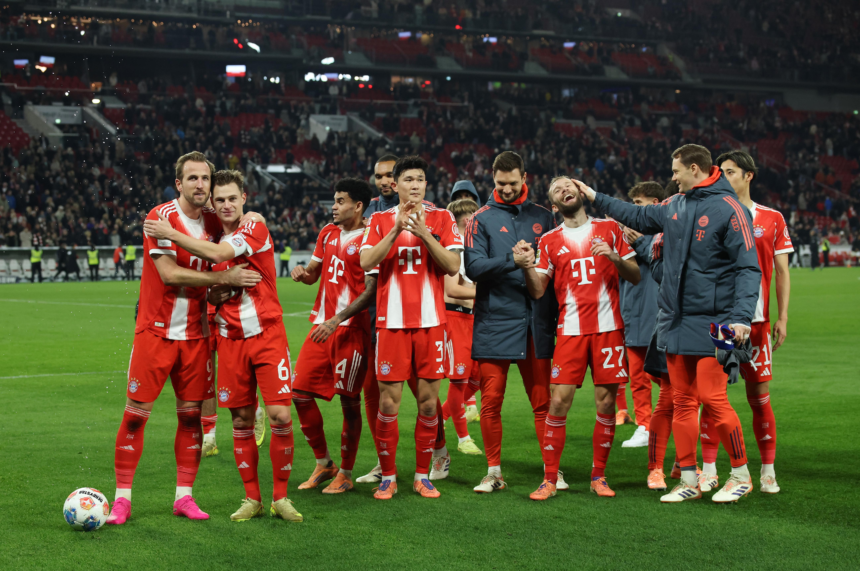
Bayern vs VfB Stuttgart: Title Sealed in a Night of Momentum and Meaning
A Decisive Matchday That Defined the Season
On April 19, 2026, at the Allianz Arena, FC Bayern Munich delivered a performance that captured the essence of their season—resilience, control, and clinical execution. A 4–2 victory over VfB Stuttgart did more than secure three points; it officially crowned Bayern as champions of the Bundesliga for the 35th time.
- A Decisive Matchday That Defined the Season
- Stuttgart Strike First, Bayern Respond with Authority
- Second-Half Control Reflects Championship Mentality
- Tactical Rotation Highlights Squad Depth
- Emotional Connection Between Team and Supporters
- A Shift in Culture Under Kompany
- No Celebration, Immediate Refocus
- The Treble Ambition Becomes Real
- Conclusion: A Title That Signals More Than Success
The result carried additional weight. With four games still remaining, Bayern mathematically sealed the title, extending a period of dominance that has seen them win 13 of the last 14 league campaigns. It was not just another title—it was a statement of sustained superiority.
Stuttgart Strike First, Bayern Respond with Authority
The match did not begin as a celebration. Stuttgart entered with purpose, driven by their own ambitions of securing Champions League qualification. Their sharp movement in the final third unsettled Bayern early, and the breakthrough arrived in the 21st minute.


Chris Führich finished a well-constructed move to give Stuttgart a deserved lead, assisted by Bilal El Khannouss. At that moment, the atmosphere inside the Allianz Arena briefly shifted from anticipation to tension.
Bayern’s response was immediate and decisive.


Jamal Musiala initiated the comeback with individual brilliance, delivering a precise cross that Raphael Guerreiro converted in the 31st minute. Two minutes later, Nicolas Jackson capitalized on Stuttgart’s defensive error to make it 2–1. By the 37th minute, Alphonso Davies extended the lead to 3–1 after a well-worked attacking sequence involving Luis Díaz.
Within a six-minute spell, Bayern had transformed the game—and effectively broken Stuttgart’s resistance.
Second-Half Control Reflects Championship Mentality
The second half was defined less by urgency and more by control. Bayern adjusted tempo, managed possession, and dictated the rhythm of play. This phase reflected a team accustomed to closing out decisive matches.
Harry Kane, introduced at halftime, added a fourth goal in the 52nd minute—his 32nd league goal of the season. The sequence originated from a set-piece situation involving Michael Olise and Kim Min-jae, with Kane reacting quickest to convert from close range.


Stuttgart managed a late consolation goal through Chema Andrés in the 88th minute, but the outcome had long been settled. Bayern’s composure ensured there was no late drama.
Tactical Rotation Highlights Squad Depth
One of the defining aspects of the match was Bayern’s squad rotation. Manager Vincent Kompany made multiple changes following a demanding midweek Champions League victory over Real Madrid.
Key players such as Harry Kane and Dayot Upamecano were initially rested, while Nicolas Jackson led the attack and Hiroki Ito partnered Kim Min-jae in defense. The rotation did not weaken Bayern—it reinforced the depth and adaptability of the squad.
This flexibility has been central to Bayern’s success. Across 47 competitive matches this season, the team has scored 161 goals, a club record that underscores their attacking efficiency regardless of personnel changes.
Emotional Connection Between Team and Supporters
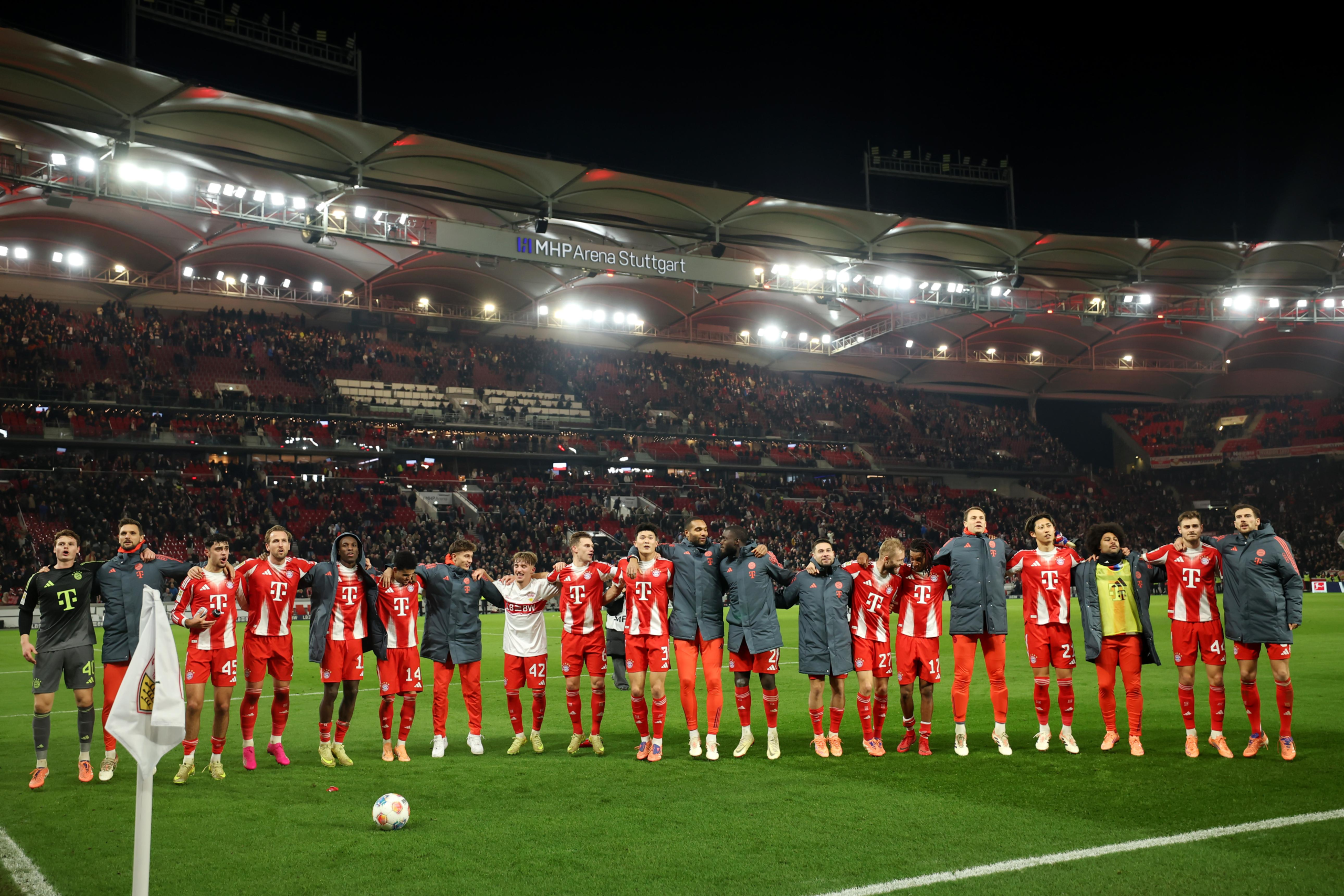
Beyond the result, the post-match scenes revealed a deeper narrative. As players gathered in front of the South Stand, supporters celebrated not just the title but the collective identity of the team.
Vincent Kompany, initially standing back with his staff, was eventually urged forward by captain Manuel Neuer. The reaction from fans was immediate and overwhelming, with chants echoing across the stadium. Club president Herbert Hainer later described the moment as the “Picture of the Year.”
The connection between coach and supporters has become a defining feature of Bayern’s current era. Observers have compared the atmosphere to that of 2013 under Jupp Heynckes—a period associated with one of the club’s most successful campaigns.
A Shift in Culture Under Kompany
Kompany’s influence extends beyond tactics. His management style—calm, direct, and inclusive—has reshaped the internal environment of the squad. Every player is integrated into the system, and rotation is not perceived as disruption but as part of a collective strategy.
This approach has reduced external distractions and strengthened internal cohesion. It also explains how Bayern managed to secure a title-clinching win with what was effectively a second-string lineup.
The data supports the narrative: dominance in the league table, a record-breaking goal tally, and sustained performance across multiple competitions.
No Celebration, Immediate Refocus
Despite securing the Bundesliga title, Bayern’s response was notably restrained. There were no extended celebrations, no trophy presentation, and no post-match festivities.
Midfielder Joshua Kimmich made the team’s mindset clear:
“We’re focused and won’t be celebrating any more today.”
Harry Kane reinforced that perspective, noting that Kompany would already be analyzing upcoming opponents later that evening.
The reason is straightforward. Bayern remain active in two major competitions: the DFB-Pokal and the UEFA Champions League. Their next fixtures include a semi-final clash against Bayer Leverkusen and a high-stakes encounter with Paris Saint-Germain.
The Treble Ambition Becomes Real
Winning the Bundesliga is only part of Bayern’s objective. The club is now positioned to pursue a third treble in its history—a feat that requires success in domestic and European competitions.
Supporters made their expectations explicit during the celebrations, chanting “European Cup” and signaling that league dominance alone is insufficient. The team acknowledged the demand, joining in briefly before returning focus to the tasks ahead.
The pathway is clear but demanding:
- DFB-Pokal semi-final against Bayer Leverkusen
- Champions League semi-final against Paris Saint-Germain
Success in both competitions would elevate this season from dominant to historic.
Conclusion: A Title That Signals More Than Success
The 4–2 victory over Stuttgart was not just a match result—it was a consolidation of identity. Bayern Munich demonstrated depth, tactical intelligence, emotional connection with supporters, and an uncompromising focus on future objectives.
With the Bundesliga secured and two major trophies still within reach, the club enters the final phase of the season with momentum and clarity. The immediate task is no longer about winning the league—it is about defining an era.