

Carlos Alcaraz: The New Benchmark on Clay and Beyond
A Season of Pressure, Promise, and Perspective
At just 22, Carlos Alcaraz is navigating a defining phase of his career—one where expectations, legacy comparisons, and evolving ambitions intersect. As the 2026 European clay season begins, the Spaniard finds himself balancing dominance on the court with a growing sense of maturity off it.
“Two long months ahead, but exciting ones.”
That single remark captures both the physical grind and the anticipation surrounding Alcaraz’s campaign—a campaign shaped by past excellence and future uncertainty.
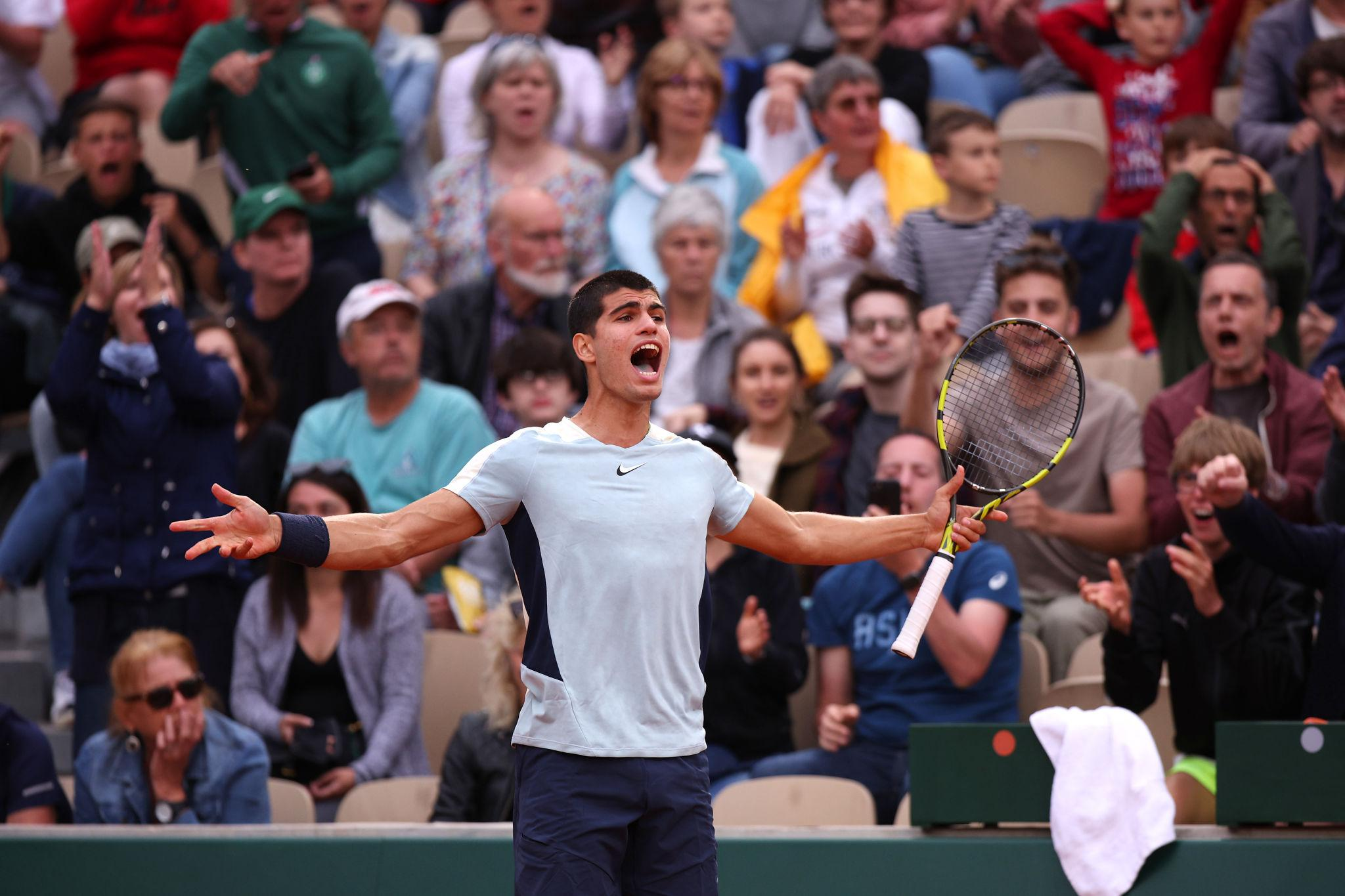
Monte Carlo: Where Momentum Begins Again
Returning to the Rolex Monte-Carlo Masters, Alcaraz wasted little time reasserting his authority. His opening victory—a commanding 6-1, 6-3 win over Sebastian Baez—signaled continuity from his remarkable 2025 clay run.
That previous season was not merely successful; it was historically efficient. A 22-1 record on clay positioned him as the dominant force on the surface and set the stage for his current title defense in Monaco.
“I enjoy so much playing on clay. I miss it so much. For me, that’s the most important thing.”
For Alcaraz, clay is not just a surface—it is an identity. His movement, creativity, and adaptability find their fullest expression on red dirt, where endurance and tactical intelligence are tested relentlessly.
The No. 1 Battle: A Strategic Acceptance
Despite his on-court form, Alcaraz is approaching the ATP rankings race with unusual detachment. Currently tied with Jannik Sinner at 66 weeks as world No. 1, he acknowledges that the top spot may soon slip away.
“The No. 1 spot is not in my mind… sooner or later, I’m gonna lose it.”
This is not resignation—it is calculation. With Sinner gaining ground after a Sunshine Double sweep and fewer points to defend, the ranking shift appears inevitable. Alcaraz, meanwhile, carries the burden of defending a heavy points haul from his dominant 2025 season.
Rather than resist the shift, he is reframing it:
“I will try to just focus on my tennis, to be good on the court.”
The approach signals a broader evolution—prioritizing performance sustainability over short-term ranking control.
A Place Among Legends: Clay-Court Excellence
The conversation around Alcaraz has already moved beyond potential. Statistically, he is now embedded in elite company.
Alongside Rafael Nadal and Björn Borg, Alcaraz ranks among the top three clay-court performers in tennis history based on winning percentage.
- Nadal: 90.5% (484–51)
- Borg: 86.1% (285–46)
- Alcaraz: 84.4% (103–19)
These numbers are not merely impressive—they are historically rare.
Nadal’s dominance at French Open, with 14 titles, established the modern benchmark. Borg’s six titles once defined clay excellence. Now, Alcaraz, already a two-time defending champion in Paris, is extending that lineage into a new era.
What distinguishes him is stylistic hybridity: the defensive elasticity of Nadal, the baseline precision of Borg, and a creative explosiveness uniquely his own.
Beyond Tennis: The Alcaraz Persona
While his competitive intensity defines his matches, Alcaraz’s off-court persona reveals a contrasting dimension—one grounded in relaxation and personal escape.
During the Miami Open, images surfaced of him aboard a luxury Sunreef catamaran. Though not his own vessel at the time, he has since commissioned a custom 88-foot Sunreef Ultima yacht.
“Mine, they’re gonna build it… it’s going to take one year, one year and a half. So I’m super excited about it.”
For Alcaraz, the sea represents disconnection:
“During the sea, everything is chill. My thing to disconnect from everything.”
Even here, competition subtly blends with camaraderie. In a lighthearted exchange, he proposed a deal with Tommy Paul:
“I better invite him… but I’ll tell him you’re gonna take me out for fishing. Half and half.”
The remark underscores a broader reality—Alcaraz is not only shaping tennis narratives but also redefining how elite athletes balance intensity with personal grounding.
Tactical Outlook: The Road Ahead
On court, the immediate focus remains sharp. His next challenge at Monte Carlo comes against Tomas Martin Etcheverry, a player capable of disrupting rhythm with resilience and baseline consistency.
More broadly, Monte Carlo serves as a strategic launchpad. Historically, success in the Principality often foreshadows dominance across the European clay swing.
For Alcaraz, the objectives are layered:
- Defend key titles
- Maintain physical durability
- Adapt to ranking shifts
- Extend his clay-court legacy
The margin for error remains narrow, but his track record suggests a capacity to absorb pressure rather than succumb to it.
Legacy in Motion
What makes Alcaraz’s trajectory particularly compelling is its timing. At an age when most players are still stabilizing their place on tour, he is already being measured against generational benchmarks.
Yet his current phase is less about validation and more about consolidation.
He is no longer the emerging talent—he is the standard others are beginning to chase.
Conclusion: A Career Defined by Evolution
Carlos Alcaraz enters the 2026 clay season not as a challenger, but as a reference point in modern tennis. His statistical standing, stylistic versatility, and psychological maturity position him at the center of the sport’s ongoing evolution.
Whether or not he retains the No. 1 ranking in the coming weeks is, in many ways, secondary.
What matters more is the trajectory: a player refining his craft, expanding his identity, and steadily building a legacy that already stands alongside the greatest in tennis history.


