

Australia Women’s Clinical Dominance Over West Indies Women: A Series Defined by Control and Consistency
The recent white-ball encounters between West Indies Women and Australia Women have reinforced a familiar narrative in modern women’s cricket: Australia’s structural depth and tactical discipline continue to set the global benchmark. Across both T20Is and ODIs, the contests revealed not just results, but a clear disparity in execution under pressure.
This analytical feature examines how the series unfolded, the key performances that shaped outcomes, and what the results indicate for both teams moving forward.
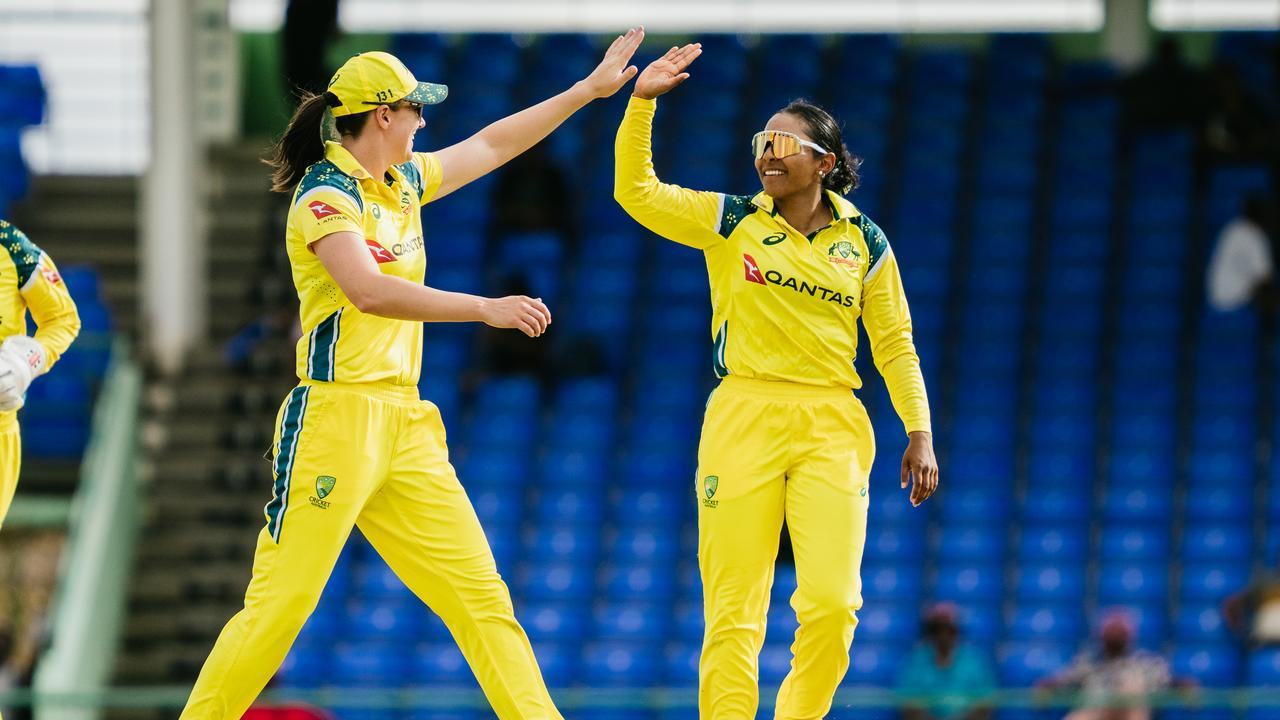
A T20I Statement: Australia Set the Tone Early
The opening T20I at Arnos Vale Ground established the competitive direction of the series.
Australia posted a controlled total of 164/6 in 20 overs, anchored by a composed innings from Beth Mooney, who scored 79 off 55 balls, combining strike rotation with selective boundary hitting. Ellyse Perry added further stability with 36, ensuring the innings did not lose momentum during the middle overs.
West Indies, in response, struggled to maintain tempo. Despite a promising 45 from Qiana Joseph and 28 from Stafanie Taylor, they finished on 121/6, falling short by 43 runs.
Tactical Observations
- Australia’s batting emphasized partnership construction, particularly the 99-run stand involving Mooney.
- West Indies showed early intent but lacked middle-order consolidation.
- Bowling discipline from Australia, led by Alana King (3 wickets), controlled scoring phases effectively.
ODI Series: Structural Superiority on Display
If the T20I exposed gaps, the ODI series confirmed them decisively.
Australia completed a 3–0 ODI series sweep, culminating in a dominant performance in Basseterre, St Kitts. The final match encapsulated the broader trend: West Indies faltered under sustained pressure, while Australia executed with clinical precision.
West Indies were bowled out for 136 in 35.4 overs, unable to recover from a mid-innings collapse.
Bowling Masterclass
The standout performance came from Alana King, who delivered a decisive spell of 5–19, dismantling the West Indies batting order.
Key dismissals included captain Hayley Matthews, whose early resistance (34 runs) briefly stabilized the innings before Australia seized control.
Run Chase Efficiency
Australia chased the modest target with minimal resistance:
- Finished at 1/137 inside 20 overs
- Phoebe Litchfield scored 68 (not out)*
- Ellyse Perry contributed 33 (not out)*
Their unbeaten 87-run partnership highlighted composure and game awareness under low-risk conditions.
Where the Match Was Won: Key Performance Differentials
1. Middle-Order Stability vs Collapse
West Indies repeatedly lost wickets in clusters, particularly after promising starts. In contrast, Australia’s middle order absorbed pressure and rebuilt innings when necessary.
2. Spin Dominance
Australia’s spin attack, led by King and supported by Ashleigh Gardner, consistently disrupted rhythm and forced errors.
3. Tactical Discipline
Australia demonstrated:
- Controlled field placements
- Efficient run chases
- Minimal risk-taking once in control
West Indies, meanwhile, showed flashes of aggression but lacked sustained execution.
Broader Context: A Complete White-Ball Sweep
Australia’s dominance extended beyond the ODIs. The touring side secured:
- 3–0 victory in the T20 series
- 3–0 sweep in the ODI series
This 6–0 white-ball clean sweep underscores their continued supremacy in international women’s cricket.
Implications for Both Teams
Australia Women
- Reinforces status as the most complete unit in world cricket
- Depth in both batting and bowling remains unmatched
- Emerging players like Litchfield continue to integrate seamlessly into the system
West Indies Women
- Need structural improvements in:
- Middle-order consistency
- Game management under pressure
- Individual talent exists (Matthews, Dottin, Taylor), but collective execution remains inconsistent
Looking Ahead: What Comes Next?
For Australia, the trajectory is clear: continued dominance with an evolving squad capable of sustaining performance across formats.
For West Indies, the challenge is more foundational. Addressing tactical discipline and stabilizing batting partnerships will be critical if they aim to compete with top-tier sides.
Conclusion
The West Indies Women vs Australia Women series was less about isolated results and more about systemic contrast. Australia showcased a refined, high-efficiency model built on depth, discipline, and adaptability. West Indies, while competitive in phases, were unable to sustain pressure or convert starts into match-defining performances.
The outcome—a comprehensive white-ball sweep—reflects not just form, but structural maturity at the highest level of the women’s game.


