

Adam Richman News: From Man v. Food Fame to ITV’s World Cup Spotlight
Adam Richman has returned to television screens in a role that may surprise casual viewers but feels entirely natural to those who have followed his career closely. Best known as the original host of the cult food-travel series Man v. Food, Richman is now appearing as part of ITV’s World Cup coverage, swapping oversized food challenges for one of the biggest sporting stages in the world.
The move has sparked a lively reaction among viewers. For some, Richman’s warmth, humour and fan-first style have made him a refreshing addition to the broadcaster’s tournament team. For others, his presence on football coverage has raised questions about why a former food-show presenter is being given airtime during a World Cup.
Yet the discussion around Adam Richman’s latest TV role says as much about modern sports broadcasting as it does about Richman himself. In an era when major tournaments are covered not only through tactical panels and match analysis, but also through culture, fandom, personality and atmosphere, Richman’s job appears to be less about replacing football experts and more about bringing viewers closer to the human side of the game.
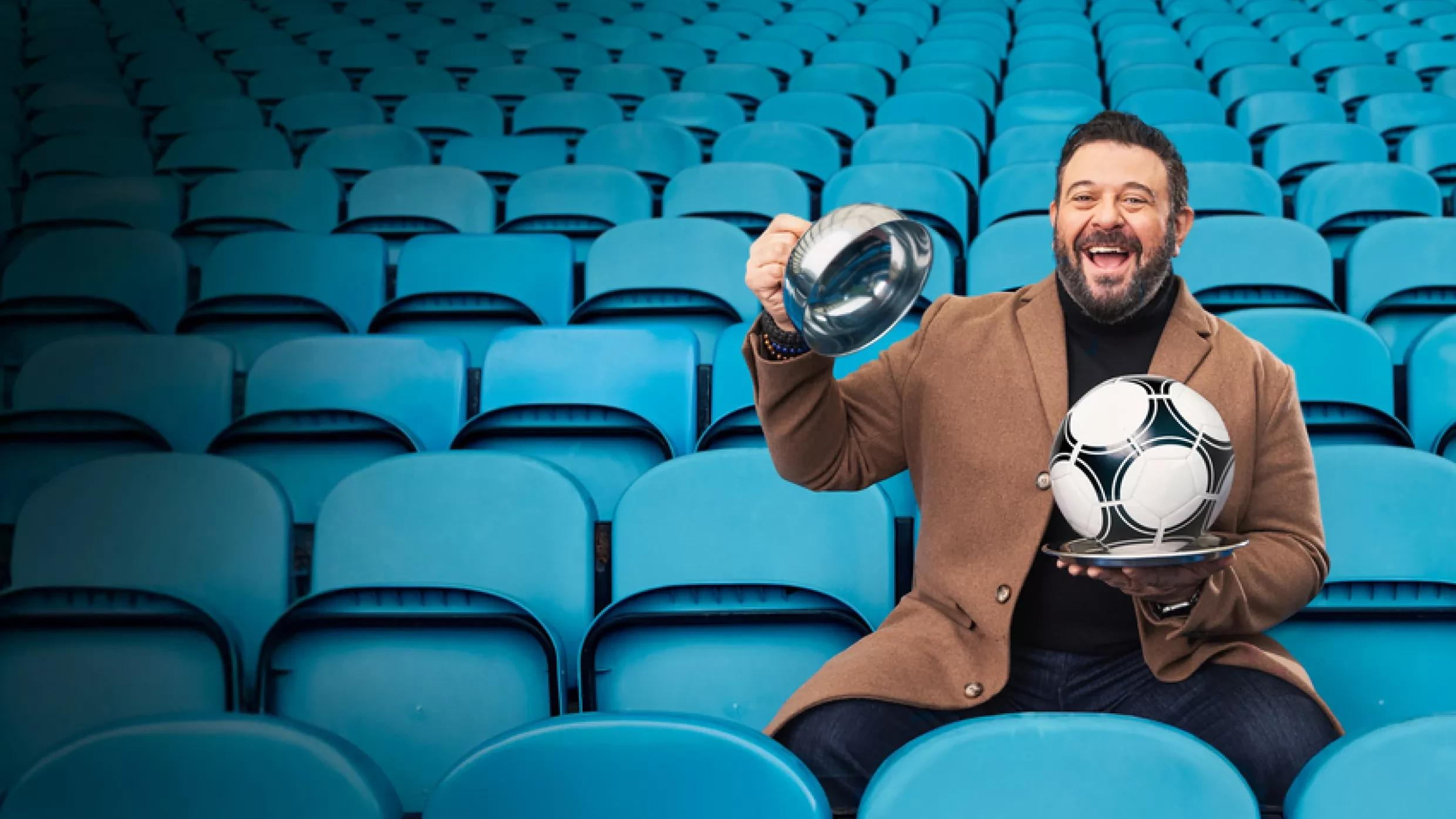
A Familiar Face in an Unexpected Place
Richman is appearing on ITV’s World Cup coverage from New York, where the broadcaster has built part of its tournament presentation around the energy of the city. He has been seen sitting on a sofa with Spanish football expert Semra Hunter at ITV’s set in Brooklyn, as well as interviewing fans in Times Square.
That setting matters. Richman is not being presented simply as a studio analyst breaking down formations or transfer histories. His role appears to lean into what he has always done well on television: meeting people, listening to their stories, finding humour in public spaces and bringing personality to places where food, sport and culture intersect.
For viewers who remember him from Man v. Food, the formula is familiar. In that show, Richman travelled across the United States exploring local food culture before taking on huge eating challenges. Now, instead of local diners and oversized meals, the backdrop is World Cup football — but the core skill remains similar. He is moving through crowds, finding fans, and turning public enthusiasm into television.
Why Adam Richman Fits the World Cup Conversation
The most common criticism of Richman’s ITV role is straightforward: what does a food presenter have to do with the World Cup? One viewer asked exactly that: “What does Adam Richman have to do with the World Cup exactly??”
The answer lies in Richman’s long-established love of football. He is a big Tottenham Hotspur fan and has frequently shown enthusiasm for the game beyond casual celebrity interest. During the tournament, he revealed on X that he had met Zinedine Zidane, describing himself as “shaking” as he told the Ballon d’Or winner that his cat is named “Zizou”, Zidane’s famous nickname.
That moment captures the version of Richman that ITV seems to be using: not a distant celebrity dropped into football coverage, but a visibly excited supporter who understands what it feels like to be overwhelmed by the sport’s biggest names.
One person commenting on Richman’s role said he “loves his football” and “sits with ordinary supporters”. That observation may explain why he has connected with a section of the audience. His strength is not technical authority; it is relatability. He approaches football less as a pundit and more as a fan with a microphone.
Viewers Divided Over His ITV Role
The reaction to Richman’s World Cup appearances has been mixed, but the positive responses have been enthusiastic.
One commenter on X wrote that “he’s just so good and very funny, I love him and his energy”. Another described him as “such a great addition to the ITV World Cup coverage”. A third viewer added that “it’s always great to see the UK[’s] favourite American back on UK TV”.
These comments point to a key part of Richman’s appeal. He is familiar to British viewers, even though he is American. Man v. Food built a strong international audience, and Richman’s approachable presenting style made him a recognisable personality far beyond the United States.
Still, not every viewer has welcomed the change. One critic said Richman is “pushing me to listening to radio coverage every time”. The complaint reflects a broader tension in sports television: how much room should there be for entertainment personalities alongside traditional pundits and journalists?
That debate is not new. Major tournaments now involve hours of coverage beyond the 90 minutes of football. Broadcasters need match analysis, but they also need colour, humour, interviews, fan scenes, cultural context and viral moments. Richman’s presence sits inside that expanded version of sports broadcasting.
Richman Responds to the Backlash
Richman has not appeared deeply shaken by the criticism, but he has acknowledged the support he has received.
After a fan described attacks on him as “slander”, Richman replied: “I obviously don’t put too much stock in other people‘s stupid negativity, but the messages of support that I’ve received really mean the world”.
The response is measured but revealing. Richman knows he is not universally accepted in this role, but he also understands that a large part of television success comes from connection rather than unanimous approval. His message suggests that he is choosing to focus on the viewers who see value in his energy and personality.
For a presenter whose career was built in part on public spectacle, the criticism is unlikely to be unfamiliar. Man v. Food was itself a show that divided opinion: loved by fans for its humour and Americana, questioned by others for its excess. Richman’s career has often existed at the intersection of enthusiasm, performance and public judgment.
From Food Challenges to Football Crowds
To understand why Richman remains a memorable television figure, it helps to revisit the show that made him famous.
He was the original presenter of Man v. Food, which launched in the United States in 2008 and ran until 2012. The original Richman-fronted run lasted four seasons and comprised 85 episodes. The series was later revived in 2017 with a new presenter.
The premise was simple and effective. Richman travelled across the U.S., explored the gastronomic culture of different cities, highlighted local “big food” traditions, and then attempted an enormous eating challenge at a local establishment.
Some of the challenges became part of the show’s mythology. They included a 72-ounce steak in Texas, 180 oysters in New Orleans, and a 30-inch pizza in Georgia. Each of those challenges came with a time limit of one hour.
What made the programme work was not only the size of the meals. It was Richman’s ability to turn restaurants, owners, customers and regional food traditions into a story. He presented food as community, identity and entertainment. That skill translates more easily to football than critics may assume.
World Cup coverage is also about place, atmosphere, culture and collective identity. Fans gather in public squares, bars, studios and stadiums. Broadcasters try to capture not only what happens on the pitch but also what it means to the people watching. Richman, in that sense, is operating in familiar territory.
A Brooklyn-Born Presenter With British Connections
Richman was born in Brooklyn, but his family has roots in Leeds. That detail adds another layer to his popularity with UK audiences. While he is unmistakably American in voice and style, his connection to Britain is not purely professional.
He is also proudly Jewish. In a 2012 interview, he said: “I still wear a Magen David while I’m eating all these bacon cheeseburgers on TV”. In another interview in 2015, he spoke about growing up with his grandma Rose’s gefilte fish, his grandma Gildred’s meatballs, and his mother Sharron’s matzah lasagne.
Those details matter because Richman’s public persona has always blended appetite, identity and family memory. Food, for him, has never been only about consumption. It has also been about heritage, humour and belonging.
That same sense of belonging may help explain why his football fandom feels genuine to supporters who like him. He does not present himself as detached from the crowd. He seems happiest when surrounded by ordinary fans, reacting as one of them.
ITV’s Bigger World Cup Strategy
Richman’s role should also be viewed within the broader context of ITV’s World Cup coverage. ITV is jointly providing the UK’s tournament coverage alongside the BBC, and its presentation has been designed to make an impression.
The tournament began on Thursday and is scheduled to run until July 19. ITV’s coverage has included a glitzy studio approach and a willingness to lean into the spectacle of the event. In that environment, Richman’s casting looks less random and more strategic.
He brings several advantages. He is recognisable. He is comfortable on camera. He has a fan base in the UK. He is American, which is useful for coverage based partly in the United States. He loves football. And unlike traditional pundits, he can move easily into lighter features, fan interviews and atmosphere pieces.
The World Cup is not only a football tournament; it is also a month-long television event. Networks need presenters who can fill space, create moments and keep casual viewers engaged. Richman is well suited to that part of the broadcast.
The Changing Face of Sports Coverage
The debate over Richman’s role reflects a wider change in how sports are covered. Traditional punditry still matters, especially during pre-match, half-time and post-match analysis. But modern audiences also consume tournaments through short clips, social media reactions, behind-the-scenes segments and personality-driven features.
A presenter like Richman can help bridge those formats. He is not there to replace tactical analysis. He is there to add colour and human interest. His segments can appeal to viewers who want more than formations, substitutions and possession statistics.
This approach also reflects how the World Cup itself is experienced. Millions of fans watch matches not only in stadiums but in homes, pubs, public screenings and city centres. The tournament becomes a social event as much as a sporting one. Richman’s television background makes him especially effective at capturing that social dimension.
Why the Backlash May Not Hurt Him
The criticism Richman has received may even reinforce the conversation around his role. Television personalities often succeed when they provoke reaction, provided the reaction is not overwhelmingly negative. In Richman’s case, the backlash has been balanced by visible support from viewers who enjoy his style.
He also benefits from authenticity. His love of football is not newly invented for the tournament. His Tottenham Hotspur fandom, his emotional reaction to meeting Zidane, and his ease among supporters all make it harder to dismiss him as a celebrity tourist.
The more viewers see him engaging naturally with fans, the more likely his role is to be understood. His job is not to explain the offside trap better than a former defender. It is to bring energy, curiosity and warmth to the broadcast.
What Comes Next for Adam Richman?
Richman’s ITV World Cup role could open the door to more sports-adjacent broadcasting opportunities. If audiences continue to respond positively, broadcasters may see value in using him for fan-led features, football culture segments or travel-based sports programming.
His career already proves that he can build a show around local identity and public enthusiasm. Football offers similar storytelling possibilities. Clubs, supporters, cities and matchday traditions all provide the kind of material that suits his presenting style.
The key question is whether viewers will accept him as part of the football media landscape rather than simply remembering him as the man who once faced 72-ounce steaks and 180 oysters. For many fans, that transition is already happening. For others, it may take time.
Conclusion: Adam Richman’s Unusual but Logical TV Reinvention
Adam Richman’s move from Man v. Food to ITV’s World Cup coverage may seem unexpected at first, but it fits the broader direction of modern sports television. Major tournaments are no longer covered only through expert analysis. They are also told through people, places, emotions and shared experience.
Richman brings exactly that kind of energy. His presence has divided viewers, but it has also generated excitement, humour and conversation. Whether interviewing fans in Times Square, sharing a sofa with Semra Hunter, or reacting emotionally to meeting Zinedine Zidane, he is doing what he has always done best: turning public enthusiasm into watchable television.
For Adam Richman, the latest news is not simply that he is back on screen. It is that he has found a new stage — one where food challenges have been replaced by football crowds, but where personality, curiosity and connection still matter most.


