José Mourinho Biography: Age, Net Worth, Career, Family, Teams Coached, Real Madrid Legacy and Current Benfica Chapter
The Enduring Power of “The Special One”
José Mourinho remains one of the most recognizable, polarizing and successful football managers of the modern era. Born José Mário dos Santos Mourinho Félix on January 26, 1963, in Setúbal, Portugal, he built a career that transformed him from a translator and assistant coach into a global managerial icon. His reputation rests on elite tactical organization, relentless psychological warfare, trophy-winning pragmatism, and a media presence so distinctive that his quotes, reactions and press conferences have become part of football’s digital culture.
- The Enduring Power of “The Special One”
- José Mourinho Quick Facts Snapshot
- From Setúbal Roots to a Football Education Built on Detail
- The Benfica Beginning and the Making of a Manager
- Chelsea and the Birth of the Global Mourinho Brand
- Inter Milan and the Treble That Cemented His Immortality
- Jose Mourinho Real Madrid: Records, Rivalries and the War with Barcelona
- Manchester United, Tottenham, Roma and the Later Evolution of Mourinho
- Fenerbahçe, Benfica Return and Jose Mourinho Current Team
- José Mourinho Teams Coached: The Full Managerial Map
- Trophies, Records and the Mourinho Standard of Winning
- José Mourinho Net Worth, Salary, Income Sources and Lifestyle
- José Mourinho Family, Relationships and Private Life
- Jose Mourinho News: Why He Remains a 2026 Headline Magnet
- Jose Mourinho Reddit, Meme Culture and Social Media Presence
- The Tactical Identity Behind the Persona
- Interesting Facts and Lesser-Known Details About José Mourinho
- Influence, Impact and the Legacy of a Football Original
- José Mourinho’s Place in Football History
- Final Reflection: Why José Mourinho Still Matters
For more than two decades, Mourinho has been at the center of the sport’s biggest conversations: Porto’s shock European rise, Chelsea’s Premier League revolution, Inter Milan’s historic treble, Real Madrid’s record-breaking La Liga campaign, Manchester United’s Europa League triumph, Roma’s Conference League breakthrough, and now a dramatic return to Benfica. His career has produced league titles in Portugal, England, Italy and Spain, two UEFA Champions League trophies, and a legacy that continues to divide and fascinate fans across Reddit threads, meme pages, tactical forums and mainstream football debate.
José Mourinho Quick Facts Snapshot
| Category | Details |
|---|---|
| Full Name | José Mário dos Santos Mourinho Félix |
| Date of Birth / Age | January 26, 1963 / 63 years old |
| Place of Birth | Setúbal, Portugal |
| Nationality | Portuguese |
| Profession | Football manager, former assistant coach, former player |
| Current Status | Benfica manager; contract announced through the 2026/27 season, with ongoing Real Madrid return speculation in May 2026 |
| Net Worth | Public estimates vary; latest public estimates place José Mourinho net worth roughly between $50 million and $135 million |
| Income Sources | Coaching salaries, contract compensation, endorsements, media work, public appearances, commercial partnerships |
| Relationship Status | Married |
| Spouse/Partner | Matilde “Tami” Faria |
| Children | Matilde Mourinho and José Mário Mourinho Jr. |
| Major Achievements | 2 UEFA Champions League titles, UEFA Cup, UEFA Europa League, UEFA Europa Conference League, league titles in Portugal, England, Italy and Spain, Inter Milan treble, Real Madrid 2011/12 La Liga title, Chelsea Premier League dominance |
| Teams Coached | Benfica, União de Leiria, Porto, Chelsea, Inter Milan, Real Madrid, Manchester United, Tottenham Hotspur, Roma, Fenerbahçe, Benfica again |
From Setúbal Roots to a Football Education Built on Detail
José Mourinho’s family background shaped his football intelligence long before he became a touchline celebrity. His father, José Manuel Mourinho Félix, was a professional goalkeeper and later a coach, while his mother, Maria Júlia Carrajola dos Santos, worked as a teacher. Growing up in Setúbal, Mourinho was exposed to the rhythm of dressing rooms, tactical conversations and the emotional volatility of football from an early age. That environment gave him a practical understanding of the game before he ever stepped into elite management.
As a young man, Mourinho attempted a playing career, but he quickly recognized that his future was not in becoming a star footballer. His strengths were observational: reading patterns, understanding people, absorbing tactical structures and communicating ideas. His education in physical education and sport science helped him combine academic knowledge with football instinct, a blend that later became central to his coaching identity. Mourinho’s rise was not built on a glamorous playing record; it was built on analysis, language, preparation and the ability to make elite players believe in a plan.


His early professional development accelerated when he worked as an interpreter and assistant in Portugal and Spain, most famously during the Barcelona years under Bobby Robson and Louis van Gaal. This period became one of the most important chapters in the José Mourinho biography because it exposed him to elite football methodology, continental tactical schools, world-class dressing rooms and the political intensity of major clubs. Although “Jose Mourinho Barcelona” is often searched by fans because of his later rivalry with the club, his time there was foundational rather than adversarial.
The Benfica Beginning and the Making of a Manager
Mourinho’s first senior managerial post came at Benfica in 2000, a brief but symbolic appointment that introduced him to elite Portuguese football as the man in charge. His first spell was short, but it established two important traits that would define the rest of his career: self-belief and an unwillingness to operate without institutional support. He left Benfica after only a short tenure, but the experience became an early marker of the ambition and authority he would later carry into bigger jobs.


After Benfica, Mourinho moved to União de Leiria, where he sharpened his managerial voice away from the glare of a superclub. The União de Leiria spell is often overlooked, but it was the bridge between promise and proof. His work there attracted attention because his teams were disciplined, competitive and clearly coached. He was not simply a former assistant with good connections; he was becoming a manager with visible tactical fingerprints.
That progression led to Porto, the club that changed everything. At Porto, Mourinho did not merely win domestically; he delivered one of the most consequential European runs of the 21st century. The 2002/03 UEFA Cup victory and the 2003/04 UEFA Champions League triumph turned him from a rising Portuguese coach into a global name. Porto’s Champions League win was not just a trophy; it was a statement that a manager with structure, nerve and tactical clarity could disrupt Europe’s established hierarchy.
Chelsea and the Birth of the Global Mourinho Brand
Mourinho arrived at Chelsea in 2004 and instantly reframed the identity of the club. His famous self-confidence, intense press presence and immediate results made him one of the defining figures of the Premier League’s modern era. Chelsea became physically powerful, tactically compact and mentally ruthless. The team’s defensive record, counter-attacking efficiency and week-to-week consistency made them a benchmark for elite English football.
The first Chelsea era delivered Premier League titles in 2004/05 and 2005/06, along with domestic cup success. Mourinho’s impact extended beyond silverware. He changed the language of English football management, making press conferences feel like tactical events and transforming psychological pressure into a competitive tool. The José Mourinho career story became inseparable from his public persona: sharp, confrontational, charismatic and deeply effective.


His return to Chelsea in 2013 added another Premier League title in 2014/15 and reinforced his status as one of the club’s most important managers. The second spell ended poorly, but even that downturn became part of the Mourinho pattern: intense success, escalating friction and a dramatic exit. His career has often moved in cycles of immediate impact, high standards, public tension and legacy-defining trophies.
Inter Milan and the Treble That Cemented His Immortality
If Porto made Mourinho famous and Chelsea made him a global brand, Inter Milan made him immortal in football history. Taking charge in 2008, he inherited a club used to domestic success but still searching for the European breakthrough that had eluded it for decades. Mourinho added tactical discipline, emotional edge and European confidence to a squad filled with experienced professionals.
The 2009/10 season remains one of the great managerial achievements of the modern game. Inter won Serie A, the Coppa Italia and the UEFA Champions League, completing a historic treble. The Champions League run, including the famous semi-final against Barcelona, showcased Mourinho’s ability to design game plans for extreme pressure. He did not always seek aesthetic approval; he sought control, survival and victory.
That treble also made Mourinho one of the few managers to win the European Cup with two different clubs, having already done so with Porto. His 2010 recognition as the inaugural men’s FIFA World Coach of the Year reflected the scale of that achievement and the aura he carried into his next challenge.
Jose Mourinho Real Madrid: Records, Rivalries and the War with Barcelona
José Mourinho’s Real Madrid era from 2010 to 2013 was one of the most intense chapters of his career. He arrived in Spain at a time when Barcelona, led by Pep Guardiola, had become the dominant tactical and cultural force in world football. Mourinho’s assignment was clear: make Real Madrid competitive again against one of the greatest teams ever assembled. That mission shaped every part of his Madrid tenure.
The rivalry with Barcelona was fierce, emotional and often combustible. Searches for “Jose Mourinho Barcelona” usually point to two different realities: his early coaching education at Barça and his later role as the chief antagonist of Guardiola’s Barcelona. At Real Madrid, Mourinho built a fast, aggressive, devastating counter-attacking side around Cristiano Ronaldo, Mesut Özil, Karim Benzema, Ángel Di María, Xabi Alonso and other elite players.
The 2011/12 La Liga season was the peak of Mourinho’s Madrid project. Real Madrid won the league with historic numbers, including 100 points and a then-record 121 goals, breaking Barcelona’s domestic grip. The victory at Camp Nou in April 2012 became one of the defining moments of the campaign, symbolizing Madrid’s ability to beat Barcelona not only emotionally but strategically.
Mourinho also won the Copa del Rey in 2010/11 and the Supercopa de España in 2012. Yet the Madrid chapter was never simple. His tenure brought trophies, records and renewed competitiveness, but also dressing-room tensions, media battles and a sharp divide among supporters. Even now, “Jose Mourinho Real Madrid” remains a search term loaded with debate: genius or disruption, necessary warrior or destabilizing force. The answer is complicated because the era was both.
Manchester United, Tottenham, Roma and the Later Evolution of Mourinho
Mourinho’s Manchester United appointment in 2016 placed him in another institution carrying heavy historical weight. United were still searching for post-Sir Alex Ferguson stability, and Mourinho brought immediate trophy credibility. His first season delivered the Community Shield, League Cup and UEFA Europa League, giving United a European title and Champions League qualification.
The United spell also showed the changing landscape around Mourinho. The Premier League had become faster, more analytically sophisticated and tactically diverse. His methods still produced results, but his public criticism of players and combative media style created tension. The second-place league finish in 2017/18 was later framed by Mourinho as one of his major achievements because of the internal and competitive challenges around the club.
At Tottenham Hotspur, he inherited a talented but unsettled squad. He guided the club to a League Cup final but was dismissed before the final was played. The Tottenham period added to the debate about whether Mourinho’s model was aging or whether he was repeatedly entering clubs with structural problems that trophies alone could not solve.
Roma offered a different kind of platform. In Italy, Mourinho reconnected with a passionate fan base and delivered Roma’s first major European trophy by winning the inaugural UEFA Europa Conference League in 2022. That success made him the first manager to win the Champions League, UEFA Cup/Europa League and Europa Conference League, placing him in a unique European category.
Fenerbahçe, Benfica Return and Jose Mourinho Current Team
Mourinho joined Fenerbahçe in 2024, bringing his profile to Turkish football and instantly turning the club into a global talking point. The move generated enormous attention because it placed one of football’s most famous managers in one of Europe’s most emotionally charged football cultures. His Fenerbahçe chapter ended in August 2025 after the club failed to qualify for the Champions League.
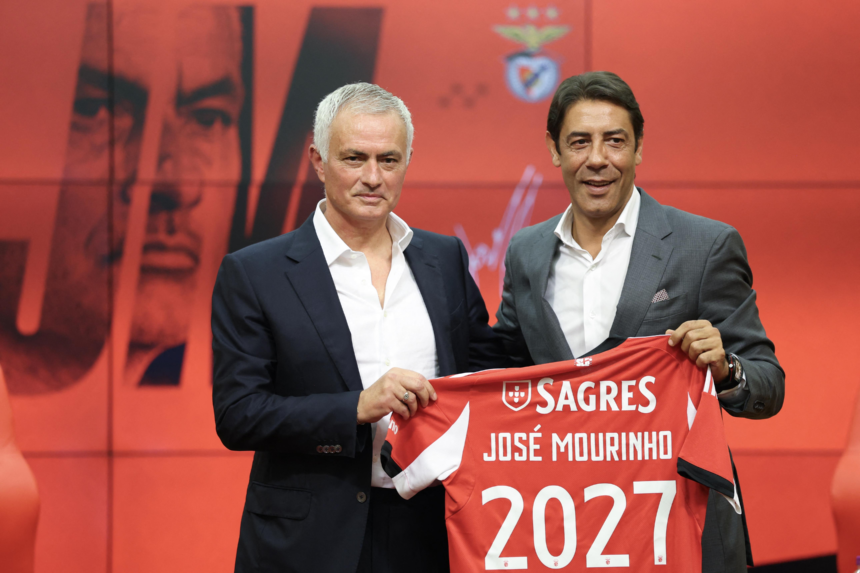
His next move was a full-circle return to Benfica. On September 18, 2025, Mourinho was presented as Benfica coach, returning to the club where his senior managerial career had started 25 years earlier. His deal was announced through the 2026/27 season, and the presentation carried obvious symbolic weight: the Portuguese icon coming home to one of the country’s biggest clubs after more than two decades abroad.
As of May 2026, José Mourinho’s current team is Benfica, although his future has become a major topic because of heavy speculation linking him with a return to Real Madrid. Benfica have reportedly offered him a renewal, while Madrid-related reports have intensified around the possibility of a Bernabéu comeback. That makes his current status unusually fluid: officially Benfica manager, but central to one of the biggest coaching rumor cycles in European football.
José Mourinho Teams Coached: The Full Managerial Map
José Mourinho teams coached include Benfica, União de Leiria, Porto, Chelsea, Inter Milan, Real Madrid, Manchester United, Tottenham Hotspur, Roma, Fenerbahçe and Benfica again. That list alone explains his unusual career range: Portugal, England, Italy, Spain and Turkey, with repeated exposure to the highest-pressure clubs and competitions in Europe.
His career is defined not only by where he coached, but by what he changed at those clubs. Porto became European champions. Chelsea became a Premier League machine. Inter became treble winners. Real Madrid broke Barcelona’s league dominance. Manchester United won a European title. Roma lifted their first major European trophy. Benfica became the stage for his late-career homecoming. Few managers have had so many eras that can be summarized by a trophy, a cultural shift or a rivalry.
Trophies, Records and the Mourinho Standard of Winning
Mourinho’s trophy cabinet is one of the deepest in modern management. His major honors include two UEFA Champions League titles, one UEFA Cup, one UEFA Europa League, one UEFA Europa Conference League, league titles in Portugal, England, Italy and Spain, multiple domestic cups and several super cups. His Chelsea teams won three Premier League titles across two spells, his Porto teams dominated domestically and conquered Europe, and his Inter team completed one of the most celebrated trebles in football history.
The Real Madrid 2011/12 title remains one of his most statistically impressive achievements. Winning La Liga with 100 points and 121 goals against Guardiola’s Barcelona placed that Madrid side among the most productive league teams ever assembled. The numbers matter because they challenge the simplified view of Mourinho as merely defensive. At his best, his teams could be devastating with the ball, especially when transition speed, attacking spacing and individual quality aligned.
His European record also carries historic weight. Winning the Champions League with Porto and Inter required two very different managerial performances: one as an underdog architect and one as the leader of a veteran elite squad. Later, winning the Europa League with Manchester United and the Conference League with Roma expanded his continental résumé across different levels of UEFA competition.
José Mourinho Net Worth, Salary, Income Sources and Lifestyle
José Mourinho net worth is difficult to verify precisely because public estimates vary widely and football management contracts often include private bonuses, severance clauses, image rights and tax structures. Recent public estimates range from around $50 million to roughly $135 million, with the higher figure reflecting his long history of elite salaries, compensation packages, endorsement deals and media value.
His income sources are broader than basic coaching salary. Mourinho has earned major contracts at Chelsea, Inter Milan, Real Madrid, Manchester United, Tottenham, Roma, Fenerbahçe and Benfica. He has also benefited from commercial partnerships, public appearances, brand campaigns and television work. His profile as “The Special One” is commercially valuable because he is instantly recognizable even beyond football tactics.
At Benfica, salary estimates vary, with one public figure placing his earnings around €4 million net per season plus bonuses, while another 2026 estimate places his annual Benfica earnings at approximately $3.5 million. These figures should be treated as estimates rather than audited totals, but they reinforce the same conclusion: Mourinho remains one of football’s most marketable and highly paid managers.
Mourinho’s lifestyle has generally reflected elite football’s international rhythm rather than celebrity excess. His career has taken him through Lisbon, London, Milan, Madrid, Manchester, Rome, Istanbul and back to Portugal. His public image is polished and controlled: tailored coats, sharp press-room presence and a personal brand built around authority, intelligence and provocation.
José Mourinho Family, Relationships and Private Life
José Mourinho relationships and family life have remained comparatively stable despite his public volatility as a manager. He married Matilde “Tami” Faria in 1989, and the couple have two children: Matilde Mourinho and José Mário Mourinho Jr. His marriage has often been presented as a private anchor behind a career defined by pressure, travel and constant public scrutiny.
Mourinho’s family background also remains important to his identity. His father’s football career gave him early access to the sport’s professional world, while his mother’s educational background helped shape a disciplined household. Mourinho has often projected an image of loyalty to family and roots, even as his professional life has taken him across Europe’s most demanding football environments.
His children have also lived partly in the spotlight because of the Mourinho name, but he has generally kept family matters away from tactical and media battles. That separation between private loyalty and public confrontation is one of the defining contrasts of his personality. On the touchline, he is combative and theatrical; away from it, his long marriage and family stability form a quieter part of the José Mourinho biography.
Jose Mourinho News: Why He Remains a 2026 Headline Magnet
Jose Mourinho news remains highly active in 2026 because his Benfica project sits at the center of both Portuguese football and European managerial speculation. His return to Benfica was already a major story because it represented a homecoming after 25 years. The next layer is the Real Madrid link, which has revived memories of his 2010–2013 spell and created one of the most discussed coaching storylines of the season.
Recent reports have connected Mourinho with a possible Madrid return, while also indicating that Benfica have considered plans in case he leaves and have shown interest in keeping him. That uncertainty has made every press conference, result and public comment more newsworthy. Mourinho’s career has always operated at this level: even silence becomes interpreted, even a phrase becomes a headline, and even speculation becomes part of the performance.
The Nicholas Otamendi situation at Benfica has also entered the Mourinho news cycle, with reports indicating that the veteran defender will leave when his contract expires on June 30, 2026. That development adds another layer to Benfica’s squad planning at a time when the manager’s own future is being intensely discussed.
Jose Mourinho Reddit, Meme Culture and Social Media Presence
Jose Mourinho Reddit discussions often revolve around the same themes that have followed him for years: whether he is still elite, whether modern football has moved beyond him, whether his trophy record outweighs his conflicts, and whether his style is misunderstood. Few managers generate debate with the same intensity. A tactical post about his defensive blocks can quickly become a wider argument about personality, legacy and football aesthetics.
The Jose Mourinho meme ecosystem is equally important to his modern cultural relevance. His “I prefer not to speak” and “If I speak I am in big trouble” lines have become enduring internet catchphrases, used far beyond football to express restraint, sarcasm or frustration. These memes matter because they show how Mourinho’s personality has escaped the narrow boundaries of match analysis and entered everyday online language.
On Instagram, Mourinho also maintains a major public audience, with recent tracking placing his account near five million followers. That social reach keeps him visible to younger fans who may know him as much through clips, reaction images and viral quotes as through Porto’s 2004 Champions League run or Inter’s 2010 treble.
The Tactical Identity Behind the Persona
Mourinho’s tactical reputation is often reduced to defensive football, but that description is incomplete. His best teams were built on compactness, pressing triggers, positional discipline, transition speed and emotional control. At Porto, he created a balanced European underdog. At Chelsea, he built a physically dominant side that could control matches without needing excessive possession. At Inter, he produced one of the most disciplined knockout teams in Champions League history.
At Real Madrid, his team could attack with extraordinary speed and volume. The 2011/12 side’s 121 league goals show that Mourinho’s football was never simply about sitting deep. His preferred model was about controlling the most valuable zones and moments: where to press, when to counter, how to protect central spaces, how to manage elite egos and how to turn pressure into an advantage.
His critics argue that his methods can become confrontational and that his teams sometimes struggle when asked to dominate possession against compact opponents. His supporters counter that football is measured by winning, and Mourinho has won across countries, systems and generations. Both interpretations explain why the José Mourinho career remains endlessly debated.
Interesting Facts and Lesser-Known Details About José Mourinho
One of the most fascinating facts about Mourinho is that his global coaching identity was partly shaped by translation. His work with Bobby Robson required not only language skills but also tactical interpretation. He was not merely translating words; he was absorbing elite coaching processes and learning how to communicate complex football ideas across cultures.
Another key detail is that Mourinho’s Barcelona background makes his later Real Madrid rivalry with Barcelona even more layered. He understood the club from the inside before becoming one of its most famous antagonists. That history gave his clashes with Guardiola’s Barça a dramatic quality that went beyond ordinary rivalry.
Mourinho is also among the rare managers whose press conferences are treated as events. His phrases become headlines, his pauses become interpretations, and his criticism often reshapes the news cycle around a club. That media mastery has been both a weapon and a liability throughout his career.
His European résumé is uniquely broad. Winning the Champions League, UEFA Cup/Europa League and Europa Conference League places him in a special category of continental managers. It also allows him to claim relevance across different eras of UEFA competition, from Porto’s early-2000s surge to Roma’s modern European breakthrough.
Influence, Impact and the Legacy of a Football Original
Mourinho’s influence on football management is immense. He helped normalize the manager as a central media character, not simply a coach. Before Mourinho, tactical authority and charisma existed separately in many managers; Mourinho fused them into a single public identity. He became strategist, spokesman, motivator, antagonist and brand.
His impact is visible in the way modern managers handle pressure. Press conferences are now part of the competitive ecosystem. Psychological framing, referee narratives, dressing-room messaging and media control are recognized as tools of elite management. Mourinho did not invent all of these elements, but he made them more visible and more theatrical.
The legacy debate will continue because Mourinho’s career is not clean or universally adored. He has left clubs amid conflict, criticized players publicly, and often prioritized winning over romance. Yet the record is overwhelming: European trophies, domestic titles, historic teams and unforgettable football moments. His legacy is not just that he won; it is that he made winning feel dramatic.
José Mourinho’s Place in Football History
José Mourinho’s biography is ultimately a story about transformation: a Setúbal-born coach’s son who became one of football’s most famous managers; a translator who became the loudest voice in the room; a tactical mind who turned pressure into theater; and a serial winner whose methods still provoke debate decades after his breakthrough.
His current Benfica chapter gives the story a powerful late-career symmetry. The club where he began as a senior manager became the club of his return 25 years later. Whether he stays at Benfica, returns to Real Madrid, or takes on another high-profile challenge, Mourinho remains one of football’s most compelling figures because he is never merely employed by a club; he changes the emotional temperature around it.
For searchers looking for José Mourinho age, José Mourinho net worth, José Mourinho family, José Mourinho relationships, José Mourinho career, José Mourinho current team, José Mourinho teams coached, Jose Mourinho Real Madrid, Jose Mourinho Barcelona, Jose Mourinho Benfica, Jose Mourinho news, Jose Mourinho Reddit or Jose Mourinho meme culture, the full picture is clear: Mourinho is more than a manager. He is a football era in human form.
Final Reflection: Why José Mourinho Still Matters
José Mourinho matters because modern football still measures itself against him. Managers are compared to his trophy record, press conferences are compared to his sharpest lines, defensive masterclasses are compared to Inter 2010, Premier League rebuilds are compared to Chelsea 2004, and Real Madrid debates still return to the team that broke Barcelona’s domestic dominance.
His career has never been gentle, quiet or universally accepted. That is precisely why it endures. José Mourinho is a winner, a provocateur, a tactician, a meme, a headline generator, a family man, a Portuguese football icon and one of the defining managers of the 21st century. The story is still moving, and in classic Mourinho fashion, the next chapter already feels like an event.