Verizon Bets on AI Cybersecurity With Anthropic’s Project Glasswing
As cyber threats grow more sophisticated and critical infrastructure becomes increasingly interconnected, telecommunications giant Verizon is turning to advanced artificial intelligence to strengthen its defenses. The company announced on May 15, 2026, that it has joined Anthropic’s Project Glasswing, an exclusive cybersecurity initiative centered around the experimental Claude Mythos Preview AI model.
The move positions Verizon as the only telecommunications company currently participating in the program, giving it access to one of the most powerful AI-driven vulnerability discovery systems yet developed. The partnership reflects a broader shift in the technology and infrastructure sectors, where AI is no longer just a productivity tool but a frontline security asset capable of identifying software flaws faster than traditional systems and human analysts.

What Is Project Glasswing?
Project Glasswing was created by AI company Anthropic following the development of Claude Mythos Preview, an advanced AI model designed specifically for cybersecurity research and vulnerability analysis.
According to Anthropic, the model can identify “complex vulnerabilities in critical software and operating systems at unprecedented speed.” Verizon confirmed that the initiative is focused on protecting essential infrastructure while encouraging collaboration between major organizations on cybersecurity best practices.
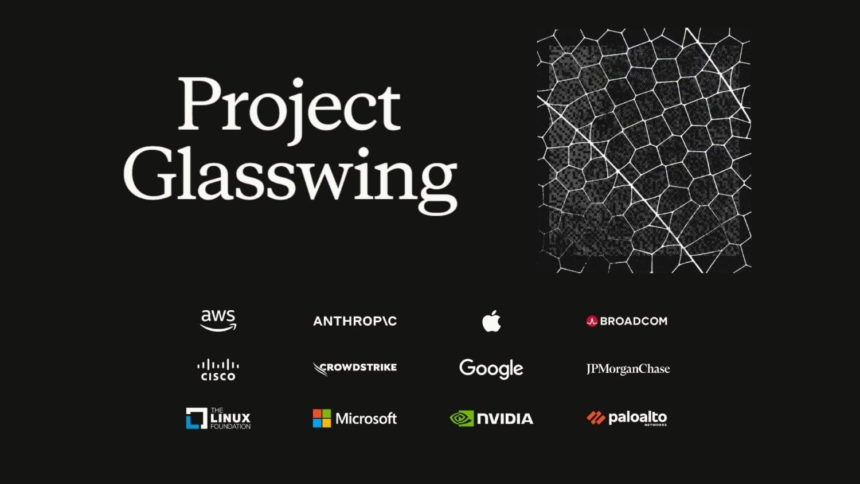
Rather than releasing the model publicly, Anthropic restricted access to a carefully selected group of organizations involved in securing global infrastructure. Verizon now joins a coalition that reportedly includes major technology and security firms such as Amazon Web Services, Apple, Nvidia, Google, Cisco, Microsoft, CrowdStrike, JPMorganChase, and Palo Alto Networks.
The limited-access approach highlights the extraordinary capabilities — and potential risks — associated with AI systems capable of autonomously discovering exploitable weaknesses in software and hardware.
Why Verizon’s Participation Matters
Telecommunications companies sit at the center of modern digital infrastructure. Mobile networks, fiber systems, enterprise connectivity platforms, cloud services, and emergency communication systems all rely on highly secure networks.
By joining Project Glasswing, Verizon is effectively turning its infrastructure into a large-scale testing environment for AI-assisted cybersecurity defense.
In Verizon’s official announcement, the company stated that participation in the initiative would improve its ability to “identify and contain complex vulnerabilities” while maintaining “its high standards of network protection.”
Dan Schulman, Verizon CEO, emphasized the importance of network trust in the company’s announcement:
“Our customers rely on the security of our network every day. As part of Project Glasswing, we are able to test and improve our cybersecurity efforts with new insights to maintain our network’s security.”
Schulman also revealed that Verizon’s information security team had already spent several months rigorously evaluating the technology before publicly joining the initiative.
“Over the past several months, our information security team has been rigorously testing this critical new technology to determine its benefits to our network.”
The company believes its unique role as the only telecommunications participant gives it an opportunity to contribute industry-specific insights back into the broader cybersecurity ecosystem.
“As the only telecommunications company utilizing Mythos Preview, we are uniquely positioned to share cross-industry insights that will help secure the global internet fabric and support our mission to deliver a safe and reliable experience for every customer.”
Claude Mythos Preview: The AI Behind the Initiative
Much of the attention surrounding Project Glasswing comes from the capabilities reportedly demonstrated by Claude Mythos Preview.
Anthropic introduced the model earlier in 2026 as a specialized AI system focused on advanced vulnerability discovery and exploit development. Internal evaluations reportedly showed the model could identify thousands of zero-day vulnerabilities across major operating systems and browsers without extensive human guidance.
Performance benchmarks cited by industry reports indicate that Mythos Preview achieved an 83.1% score on cybersecurity vulnerability reproduction tasks, significantly outperforming Anthropic’s previous-generation models.
The system has already become associated with several high-profile demonstrations of AI-assisted cybersecurity research.
One report described how researchers used Mythos Preview to uncover a working exploit targeting Apple’s M5-powered macOS systems. According to researchers, the AI system helped chain together vulnerabilities and techniques that bypassed Apple’s Memory Integrity Enforcement security framework — a project Apple reportedly spent years developing.
Researchers stated that the exploit development process, which might traditionally take years of expert effort, was completed in only five days with the help of Mythos Preview.
The model has also reportedly uncovered vulnerabilities that remained undetected for decades, including a 27-year-old flaw in OpenBSD and a 16-year-old FFmpeg vulnerability that automated scanners had failed to identify despite millions of scans.
Why Anthropic Is Restricting Access
The power of Mythos Preview has also raised significant safety concerns.
Anthropic’s decision to keep the model within Project Glasswing rather than releasing it broadly reflects fears that such systems could be misused for offensive cyberattacks if placed in the wrong hands.
The company reportedly committed up to $100 million in usage credits to support Project Glasswing participants, alongside millions in donations to open-source security initiatives such as the Linux Foundation’s Alpha-Omega program, OpenSSF, and the Apache Software Foundation.
At the same time, Anthropic has stressed that the long-term goal is to build safeguards capable of controlling dangerous outputs before models like Mythos become more widely available.
Verizon echoed similar concerns in its own announcement, emphasizing that every stage of testing follows “rigorous safety standards” and strict usage policies for emerging technologies.
The Rise of AI-Powered Cybersecurity
Verizon’s participation in Project Glasswing reflects a much larger industry trend: AI is rapidly becoming central to both cyber defense and cyber offense.
Traditional vulnerability discovery methods often depend on manual code review, automated scanning tools, penetration testing, and long research cycles. AI systems like Mythos Preview can dramatically accelerate these processes by analyzing massive codebases, identifying subtle weaknesses, and even proposing exploit chains in hours rather than months.
This creates both opportunity and risk.
For defenders, AI could help organizations patch vulnerabilities before attackers discover them. Critical infrastructure operators, cloud providers, banks, telecommunications companies, and governments may eventually rely heavily on AI-assisted defense systems to secure increasingly complex environments.
But the same technology could also lower the barrier for cybercriminals and nation-state attackers if advanced exploit-generation models become accessible outside tightly controlled partnerships.
Security experts have increasingly warned that the cybersecurity industry may be entering an era where AI systems automate parts of offensive security research once limited to elite specialists.
Verizon’s Strategic Position
Verizon’s decision to join Project Glasswing is also strategically significant beyond cybersecurity alone.
Telecommunications companies are expanding far beyond mobile phone services. Verizon today supports enterprise cloud connectivity, 5G infrastructure, edge computing, smart cities, industrial internet deployments, and critical communications systems used by governments and businesses.
As these services grow, so does the potential attack surface.
AI-assisted vulnerability discovery may therefore become a core requirement for telecom operators seeking to secure next-generation infrastructure.
The partnership also aligns with Verizon’s broader push into advanced technology initiatives. The company has recently emphasized investments in 5G deployment, edge computing, AI integration, and infrastructure modernization projects connected to global events such as the FIFA World Cup 2026.
By joining Project Glasswing early, Verizon gains not only defensive advantages but also influence in shaping how powerful cybersecurity AI systems are deployed responsibly across industries.
What Happens Next?
For now, Project Glasswing remains highly exclusive, and Anthropic has given no indication that Claude Mythos Preview will become generally available in the near future.
Organizations participating in the initiative will continue testing the system across real-world infrastructure, sharing findings and developing operational safeguards for future AI cybersecurity deployments.
If the technology performs as expected, it could fundamentally reshape how vulnerabilities are discovered, prioritized, and mitigated across the global internet.
The broader question facing the industry is whether defensive organizations can deploy AI security systems quickly enough to stay ahead of increasingly automated cyber threats.
Verizon’s decision to participate suggests major infrastructure providers believe that future battle will not simply involve humans versus hackers — but AI systems defending networks against AI-assisted attacks.
As Project Glasswing evolves, it may become one of the earliest examples of how governments, telecom companies, cloud providers, and AI developers collaborate to secure the digital infrastructure that modern society depends upon.