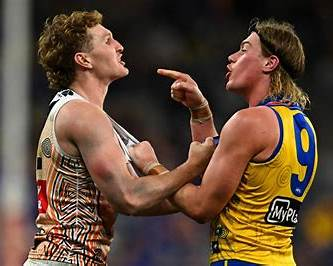
Harley Reid Ignites West Coast as Eagles Stun GWS Giants in Statement AFL Victory
The West Coast Eagles delivered one of their most spirited performances of the 2026 AFL season on Sunday night, defeating the GWS Giants 13.10 (88) to 10.11 (71) at Optus Stadium in a game that could reshape the trajectory of both clubs’ campaigns.
- Harley Reid Delivers a Superstar Performance
- Giants Dominate Early but Waste Opportunities
- Pressure Football Changes the Match
- Bailey Williams and the Supporting Cast Step Up
- GWS Fight Back — But Eagles Refuse to Break
- Controversial 50-Metre Decisions Add Drama
- What the Result Means for Both Clubs
- A Night That Could Shape West Coast’s Future
In front of 36,781 fans in Perth, the Eagles overturned an early deficit with relentless pressure, inspired leadership from emerging superstar Harley Reid, and a collective resilience that had largely been missing during their recent losing stretch. The result marked West Coast’s third win of the season and handed the Giants another damaging setback in an increasingly inconsistent year.
For the Eagles, the victory was about far more than four premiership points. It was evidence that the rebuilding club may finally be discovering its identity under pressure. For GWS, however, the loss deepened concerns about a season beginning to drift away from finals contention.


Harley Reid Delivers a Superstar Performance
Every AFL season has moments when a young star announces himself as a genuine force in the competition. Harley Reid’s performance against the Giants felt like one of those nights.
The explosive midfielder produced a breathtaking second quarter that transformed the game. Reid collected 14 disposals and kicked two goals in the term alone, repeatedly breaking tackles, surging through congestion, and energizing both teammates and supporters.


One highlight sequence perfectly captured his influence: Reid shrugged off Joe Fonti with a powerful fend-off, gathered possession cleanly, bounced the ball through traffic, earned a free kick, and calmly slotted a brilliant goal around his body.
Brownlow Medallist Gerard Healy described it as potentially “his best-ever game,” while commentators praised the way Reid “brutalised” opponents around stoppages.
By full time, Reid had finished with:
- 33 disposals
- 2 goals and 1 behind
- 8 tackles
- 12 inside 50s
His performance was not simply flashy — it was decisive. Every time West Coast needed momentum, Reid delivered it.


Giants Dominate Early but Waste Opportunities
The most frustrating aspect of the night for GWS was how comprehensively they controlled the opening stages without building a meaningful lead.
The Giants dominated the first quarter statistically:
- Double the inside 50s
- Nearly twice as many clearances
- A massive advantage in disposals
- Significant superiority in transition play
Yet despite overwhelming territorial control, they managed only 2.6 in the opening term.
At quarter time, the Giants led just 18-8 — a margin that looked dangerously small given their dominance.
Analysts noted the contrast in styles between the two teams. GWS played fast, aggressive football with rapid handball chains and attacking movement, while West Coast initially appeared hesitant and conservative. But the inability to convert opportunities eventually allowed the Eagles back into the contest.
That missed opportunity would haunt the Giants as the match wore on.
Pressure Football Changes the Match
What followed in the second quarter was arguably the Eagles’ best passage of football all season.
Coach Andrew McQualter resisted panic despite the difficult opening quarter and trusted his side to increase its defensive intensity. The response was dramatic.
West Coast’s pressure surged across the ground:
- Tackles intensified around stoppages
- GWS transition chains were disrupted
- Forward-half pressure created repeat scoring chances
- The crowd atmosphere lifted dramatically
Commentators noted that the Eagles’ pressure rating jumped to extraordinary levels during the comeback.
“Their pressure was through the roof,” Gerard Healy said during the broadcast.
Instead of the slow, sideways ball movement that had frustrated supporters earlier in the season, West Coast suddenly attacked with instinct and confidence.
By halftime, the Eagles had flipped the contest entirely and entered the break leading 46-32.
Bailey Williams and the Supporting Cast Step Up
While Reid dominated headlines, the Eagles’ victory was built on contributions from across the lineup.
Bailey J. Williams delivered one of the finest performances of his career in the ruck, finishing with:
- 40 hit-outs
- 2 goals
- 7 clearances
- 16 disposals
Late in the match, Williams repeatedly won critical contests in the air and around stoppages, helping West Coast maintain field position during GWS’ final push.
Veterans Tim Kelly and Elliot Yeo also played influential roles. Kelly provided composure through the midfield with 25 disposals and strong decision-making, while Yeo’s physical presence and defensive work helped stabilize the team during momentum swings.
Jake Waterman produced crucial late goals under pressure, including a massive set shot that returned West Coast to the lead during the final quarter.
Youngsters including Josh Lindsay, Willem Duursma, Reuben Ginbey, and Tylar Young also showed promising signs for the club’s future.
GWS Fight Back — But Eagles Refuse to Break
The Giants were far from finished after halftime.
GWS responded strongly in the third quarter with a five-goal surge that briefly restored their lead. Their midfield regained control, and their movement through the corridor once again began opening up West Coast defensively.
At three-quarter time, the Giants held a narrow 64-60 advantage.
But unlike earlier rounds this season, the Eagles did not collapse under pressure.
Instead, they matched GWS physically and mentally in the final quarter, kicking four consecutive goals to close the game. The Giants, meanwhile, struggled to handle the Eagles’ pressure and lost the quick transition football that had defined their early dominance.
The Eagles’ defensive intensity became the defining factor of the match.
Controversial 50-Metre Decisions Add Drama
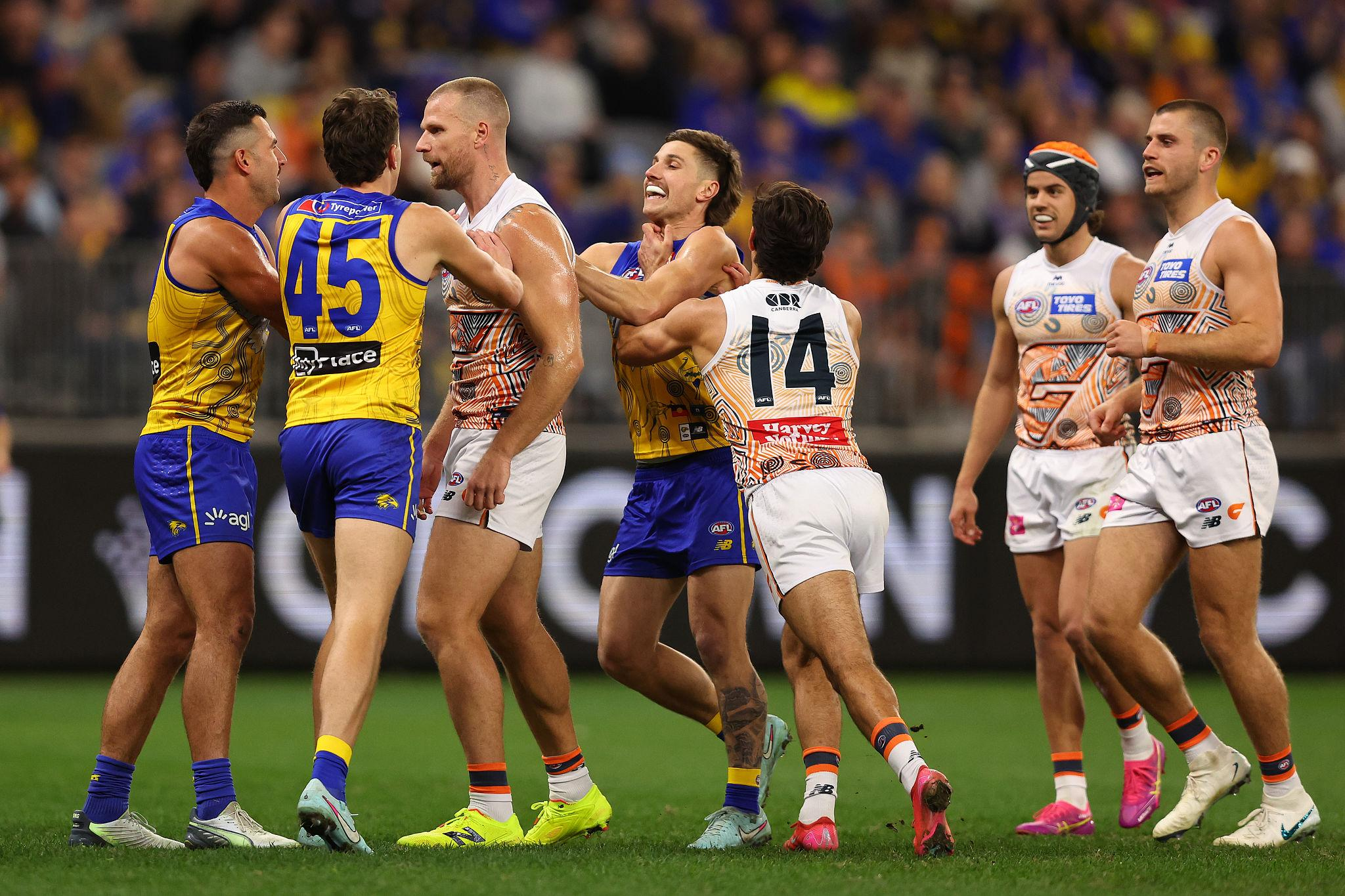
The contest also featured controversy surrounding multiple non-called 50-metre penalties.
Commentators repeatedly questioned why players from both teams avoided punishment after kicking the ball away following whistles.
Former Bulldogs star Brad Johnson expressed visible frustration during the broadcast, arguing the infractions were clear and consistent with existing AFL rules.
Eventually, several penalties were paid — including two against West Coast’s Milan Murdock that effectively created a 100-metre penalty sequence.
Despite the officiating controversy, the intensity of the match never faded.
What the Result Means for Both Clubs
The victory improved West Coast’s record to 3-7 and temporarily eased pressure on a side that had endured a difficult stretch following an encouraging start to the season.
More importantly, the Eagles demonstrated genuine growth in several critical areas:
- Sustained pressure football
- Defensive accountability
- Midfield toughness
- Fourth-quarter composure
For a rebuilding side built around young talent, those developments may matter more than the ladder position itself.
The Giants, however, face growing scrutiny.
Now sitting 13th on the AFL ladder with a 4-6 record, GWS risks falling too far behind the leading finals contenders.
Their inability to capitalize on dominance, combined with lapses under pressure, has become a recurring issue throughout the season.
Analysts openly questioned whether a top-six finish remains realistic for Adam Kingsley’s side after another frustrating defeat.
A Night That Could Shape West Coast’s Future
For months, much of the AFL conversation around West Coast has focused on rebuilding timelines, young talent development, and future potential.
Against GWS, the Eagles finally looked like a team beginning to translate potential into performance.
The atmosphere at Optus Stadium reflected that transformation. Fans who had endured difficult seasons once again found reasons to believe, chanting “EAGLES” loudly as the final siren sounded.
Harley Reid may have been the star, but the significance of the night extended far beyond one player.
West Coast showed intensity, resilience, and belief — qualities that can become foundations for future success if maintained consistently.
For the Giants, meanwhile, the search for answers grows more urgent with every missed opportunity.