




Susanne Daubner: The Voice That Shaped German News Across Generations
A Cultural Impact Discussion
For millions of viewers across Germany, the evening news is inseparable from one familiar presence: Susanne Daubner. Calm, composed, and unmistakably authoritative, Daubner has spent decades delivering information that shapes public understanding of national and global events. But beyond her role as a newsreader, her journey reflects deeper themes—freedom, resilience, and the evolving relationship between media and society.
- A Cultural Impact Discussion
- From East Germany to the National Spotlight
- Reinvention and Rise in Unified Germany
- The Authority of Calm: Why Daubner Resonates
- When News Meets Pop Culture
- Expanding Beyond News: Voice, Media, and Presence
- Personal Life: Privacy in a Public Career
- Career Longevity and Professional Legacy
- Broader Cultural and Media Implications
- What Comes Next?
- Conclusion
Today, as she marks her 65th year, Daubner stands not only as a veteran journalist but as a cultural figure who bridges generations and media eras.
From East Germany to the National Spotlight
Born on March 26, 1961, in Halle (Saale), then part of East Germany, Daubner’s early life unfolded within a tightly controlled political environment. Her entry into broadcasting was almost accidental—her talent was discovered during an open day event for radio and television in East Berlin.
She began her professional path at Rundfunk der DDR before becoming a presenter at the youth-focused station DT64 in 1987. This early stage of her career placed her at the intersection of youth culture and state-controlled media, a tension that would later define her personal turning point.
That turning point came in 1989. After resisting recruitment attempts by the Stasi, East Germany’s secret police, Daubner made the decision to flee. She escaped via Hungary and the former Yugoslavia, later explaining that she felt an overwhelming need for freedom. This moment was not only personal—it reflected the broader societal shifts occurring in Europe at the end of the Cold War.


Reinvention and Rise in Unified Germany
Following her escape, Daubner rebuilt her career in the West. She joined Radio Freies Berlin as a news and program spokesperson, gradually transitioning into television.
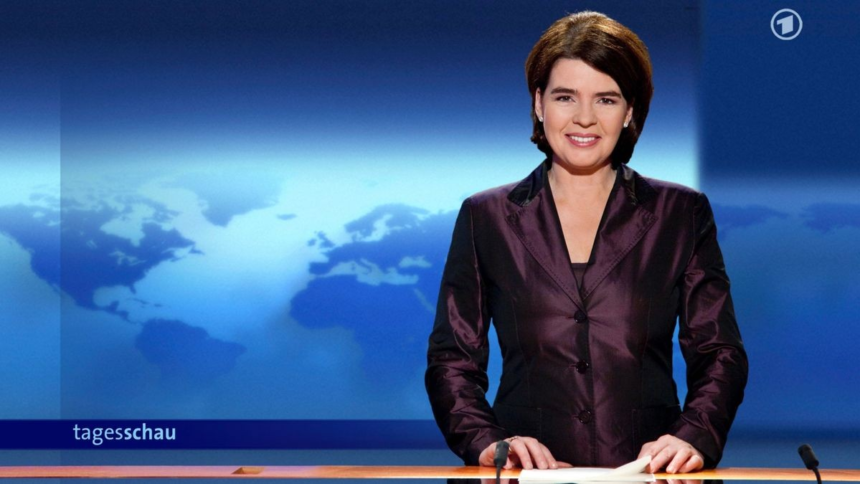
Her first on-screen appearance came in 1992 with Brandenburg Aktuell. By 1999, she had reached the pinnacle of German broadcast journalism, joining ARD’s flagship program Tagesschau, replacing veteran presenter Wilhelm Wieben.
Since then, she has become one of the longest-serving anchors in the program’s history. Her role in the 8 p.m. main edition—the most-watched news broadcast in Germany—has cemented her status as a trusted voice in public life.
The Authority of Calm: Why Daubner Resonates
Daubner’s presentation style is defined by clarity, restraint, and precision. In an era increasingly dominated by fast-paced and emotionally charged media, her delivery offers a counterbalance—measured, factual, and composed.
Related News



Colleagues have emphasized her cultural significance. Fellow Tagesschau presenter Jens Riewa described her as “practically a saint to the nation,” highlighting her ability to unify audiences across generations.
This perception is not accidental. It reflects decades of consistent performance, during which Daubner has become a symbol of reliability in a rapidly changing media landscape.
When News Meets Pop Culture
In recent years, Daubner’s influence has extended beyond traditional journalism into digital and youth culture. A notable example is her role in presenting Germany’s “Youth Word of the Year.”
Her delivery of terms like “cringe” in a formal news tone went viral, creating a striking contrast between traditional broadcasting style and modern slang. The moment demonstrated how legacy media can adapt without losing its identity.
The impact was immediate: younger audiences, often disengaged from conventional news formats, began to interact with Tagesschau content in new ways. What might have been a novelty instead became a case study in how public broadcasters can remain culturally relevant.
Expanding Beyond News: Voice, Media, and Presence
Daubner’s career has also expanded into other areas of media. She has contributed voice work, including a role in the German version of the animated film Zootopia 2, where she voiced the character Fabienne Growley.
Her involvement in entertainment projects illustrates a broader trend: journalists increasingly operate across multiple media formats, blending traditional roles with modern storytelling platforms.
Additionally, her presence has even been immortalized in miniature form at Hamburg’s Miniatur Wunderland, where a model version of Daubner presents news in a tiny studio—an unusual but telling sign of her cultural imprint.
Personal Life: Privacy in a Public Career
Despite her public prominence, Daubner has maintained a notably private personal life. It is known that she has a daughter, born in 1990, whom she has described as her greatest happiness.
She was previously married but divorced roughly a decade later. Beyond these details, she has consistently avoided public discussion of her private affairs, reinforcing a clear boundary between professional identity and personal life.
This approach aligns with her broader public image: disciplined, focused, and anchored in professionalism rather than celebrity culture.
Career Longevity and Professional Legacy
With a career spanning from 1987 to the present, Daubner represents a rare case of sustained relevance in broadcast journalism. She has worked across multiple institutions—from Rundfunk der DDR to Radio Freies Berlin, Ostdeutscher Rundfunk Brandenburg, and ultimately ARD.
Her longevity reflects both adaptability and institutional trust. She has navigated:
- The transition from East German to unified German media
- The shift from radio to television dominance
- The rise of digital and social media
Through each phase, her core identity has remained intact: a presenter committed to accuracy and clarity.
Broader Cultural and Media Implications
Daubner’s career offers insight into several broader trends:
1. Trust in Public Broadcasting
Her continued prominence underscores the enduring importance of trusted public institutions like ARD in an era of fragmented media consumption.
2. The Role of Personality in News
While journalism traditionally prioritizes neutrality, figures like Daubner demonstrate how personality—when grounded in credibility—can enhance audience connection.
3. Bridging Generational Gaps
From traditional broadcasts to viral social clips, Daubner has shown that legacy media figures can successfully engage younger audiences without compromising standards.
What Comes Next?
Looking ahead, Daubner remains a central figure in German media. While discussions about retirement occasionally surface, her continued presence suggests a gradual rather than abrupt transition.
Her influence is likely to persist in several forms:
- Continued anchoring on Tagesschau
- Mentorship of younger journalists
- Occasional cross-media appearances
More broadly, her legacy will continue to shape how news presenters are perceived—not merely as conveyors of information, but as cultural anchors within society.
Conclusion
Susanne Daubner’s career is more than a professional timeline—it is a narrative intertwined with political change, media evolution, and cultural adaptation. From her early days in East Germany to her status as one of Germany’s most recognized news voices, she embodies both continuity and transformation.
Her enduring relevance lies not in reinvention alone, but in consistency: a steady voice in a landscape defined by constant change.